
My guest today on What Cathy Read Next is Adam Fike whose novella Lights Along The Interstate was published in December 2018 and is available in paperback and as an ebook. It’s described as ‘The Canterbury Tales meets Paradise Lost at a classic roadside diner. Except the apple falls from a needle this time’. Intriguing, huh?
Readers have described it as ‘beautifully written’, ‘powerful’, ‘thought-provoking’ and ‘a fun little novella’. If you love interconnected stories or fancy a quick read, this may be the book for you. There’s an extract below to whet your appetite…
About the Book
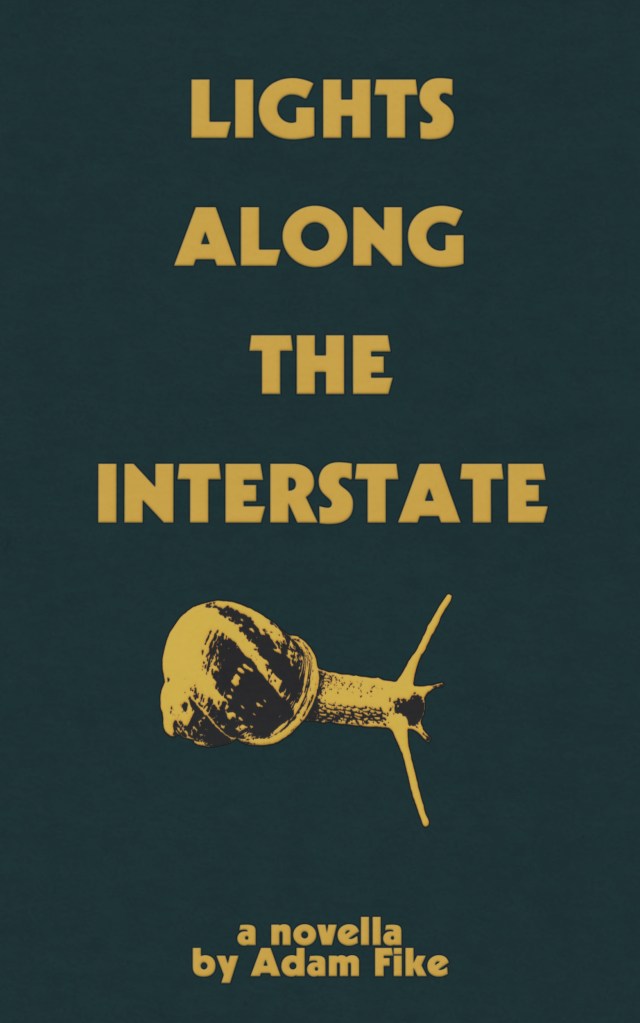
A retirement home escapee is off to parts unknown. The Devil quits (he’s in love with a waitress). Unexpected gunshots create late-night companions. A traveling salesman gets to choose his own place in the Universe. A wandering ex-priest looks for answers between the lines of a legal pad. Somebody’s flinging pennies at a naked businessman and she’s not at all sorry it hurts. Stranded, a student finds himself, and dinner, in the middle of nowhere. A drunk widow skips the service. A long overdue family reunion solves nothing and resolves everything. Then two lost kids the age of grownups decide something really big for the rest of us. And the Bus Driver? Well, all he’s praying for is a good night’s sleep.
Format: Paperback (136 pages) Publisher:
Publication date: 26th December 2018 Genre: Contemporary Fiction
Find Lights Along The Interstate on Goodreads
Purchase Lights Along The Interstate from Amazon UK or Amazon.com
Extract from Lights Along The Interstate by Adam Fike
I’ll bet the first time he came in it was just for coffee and maybe some pie, the pale man says.
Irene fills the guy in the corner booth’s cup and clomps away.
But it’s that waitress that keeps him coming back, he says. See how she wears one of those pink waitress-type uniforms with the frill at the bottom? That’s his thing, I’m telling you. Irene is the name on her blouse. Irene the mean? Irene the dream? He wants to know. Irene the queen, he imagines, because she looks like a princess to him.
The Reverend chuckles.
Trust me, I’m very, very good at this, he says.
Mitchell’s right. Every time the nervous Trucker pulled into town, he spent a few hours in a corner booth at the diner, just picking up clues about the waitress named Irene. Sometimes, he drove hundreds of miles out of his way, picking up his route the next morning without telling anyone. She got off every night at a quarter until two, so it always worked out, and he never lost time. Earlier that night, he decided to finally make his move.
Irene works her way past the metal-trimmed tables, wiping and cleaning.
Tonight, maybe he’d drop a quarter into the jukebox selector at his booth. Maybe not. What sort of thing would she like? He didn’t know. The Trucker looks at his watch. The place just wasn’t right. Too bright. Too shiny. Behind the counter, the rims around the cushions on the stools, the edges around the walls. Bouncing florescence. Tubes of bees. Not romantic. Windows like big mirrors. Not how it was in his mind. Sitting there looking at himself doesn’t do anything for his courage.
At the counter, the drunk Hunter burps over his eggs. He didn’t bother to take off his big orange hunting vest. Or his sidearm. A fork hits the floor. When Irene bends for it, the old drunk is still sober enough to notice.
The Trucker in the corner booth shifts, agitated as Irene rounds the counter toward him, grinding her gum below a heavy, end-of-day glaze.
Anything else, she asks.
The nervous Trucker locks up tight and skids. Irene stares back at him.
Well, she asks.
Nah, he mumbles, slack-jawed, shifting his eyes between her and the floor. She reaches for his cup.
There’s a noise behind her at the counter, like water out of a bucket. Eggs and bourbon coat both the floor and man, now moaning with his head in his hands. No one moves. A happy, neon-faced clock ticks.
The Trucker in the corner booth blinks up at Irene as she glares at the old drunk in disgust. The Trucker doesn’t know what to do, so he puts his hand on her hand, still frozen to his cup on the table.
Irene glances down at him in surprise. He smiles.
The Reverend drops a few dollars on the table and quickly gathers her things.
Caught off guard, staring down at the Trucker, Irene chuckles. The Trucker hesitates, unsure. First, he laughs a little too. Then a little more. The louder she laughs, the more he laughs. She yanks away her hand and sighs for a long moment.
An explosion beside the counter. Another.
The drunk is on his feet, staggering toward them. Mostly toothless. Angry. Hunting pistol in his hand. Quit your laughing at me, he yells, the shots still ringing in his ears.
The first bullet from the Hunter’s pistol passed directly through the Trucker’s chest. The other through the window over his head. The gum drops from Irene’s mouth as she throws herself back against the counter.
The pale man is stunned, hovering mid-thought at the diner door. The Reverend’s eyes are shut tight, her hands over her face, reflex praying.
Well, I didn’t see that coming, the pale man says.
The Trucker in the corner booth reaches out for Irene to hold him until help arrives. Irene screams, bounding over the counter and through the kitchen door with the grace of a deer. A door slams in the distance. Outside the window, she crosses the parking lot’s circular glow, never looking back.
The Trucker in the corner booth watches her go, confused, then falls dead across the table. The drunk Hunter sits himself up on a stool, puts his gun on the counter and belches.
We should go, the Reverend says and pushes through the door.
The pale man in the suit takes a few steps toward the corner booth.
You might as well come with us, he says.
The Trucker doesn’t move.
Really, it’s no fun watching them cart you off, the pale man says.
The Trucker lifts his head, fuddled.
Come on, the pale man says.
The Trucker stumbles to his feet.
Wait, wait, don’t look down, the pale man says, taking the Trucker by the shoulders and stepping with him toward the door.
Actually, know what, he says. Go ahead and look.
The Trucker gasps at his own dead body.
You would have hated me if I hadn’t let you see that, the pale man says, leading the Trucker out the door and towards the idling bus.
About the Author

Adam Fike co-created Wyndotte Street’s original video library, studied sketch and long-form improv at the Upright Citizens Brigade in Los Angeles and is a former suburban Washington D.C. area newspaper reporter.
Connect with Adam
Website | Goodreads




 What Cathy Read Next...