

My guest today on What Cathy Read Next is Susan Ekins, author of Hoodwink!: A ‘true’ medieval whodunnit which was published by The Real Press on 1st December 2024 and is available in paperback from Amazon. Readers have been enthusiastic, describing it as ‘a real page turner’ and ‘a cracking read’.
Intrigued? Then read on…
‘Writing the Saint, Selling the Lies: the Poisonous Pen of Thomas of Monmouth‘
Have you ever come across an unsolved mystery? The author has. In 1144 the body of a 12 year old apprentice was found on Mousehold Heath outside Norwich. To this day, no-one knows who the murderer was, although it was not long before the local Jewish Community was being accused of some barbaric ritual murder, the so-called evidence appearing in a book called the Passion and Miracles of Saint William. Thanks to the vivid imagination of its author, Thomas of Monmouth, and other credulous people, the boy was declared a saint while the Jews lived in fear for their lives.
What would it have been like to live amid this turmoil of these lies? The author has recreated the mystery – fiction, she admits, although based on what few facts there are. Can you guess who did it? Why not read the book and find out.
Two tasters from Hoodwink!: A ‘true’ medieval whodunnit by Susan Ekins
At home, Wlward was grumbling. Where was that boy? Always slipping off somewhere – never to be found. Bed empty – although made, he had to give him that. His daughter calmed him down. “Just fishing. You know what he is. And you wouldn’t object to a nice fat trout, after forty days of nothing but herring.”
“Chance would be a fine thing, Elviva. If that’s really what he’s doing. If he doesn’t get a move on, he’ll be late for work. His father had to pull quite a few strings to get him that apprenticeship, and Daniel’s not a bad master. And people tip well. He says the Jews are particularly generous. Well, time I was off. I don’t want to miss the service. By the way, what was that you were telling me about the cook?”
“Nothing much. I’m not even sure I believe it.”
“What?”
“Some man claiming to be the archdeacon’s cook, called here yesterday afternoon and spoke to Leviva. He said he could get William a job in the kitchens. Offered her thirty shillings if I were to let him go – which I couldn’t, of course. Why didn’t he approach you, I wonder? Or me?”
“Quite right. The boy’s indentured. And the man must have known, or why offer her money? Did William say whether he’d been approached?”
“He said not. And he’s generally a truthful lad. But he did ask his aunt what the man looked like, and when she told him, he didn’t seem that worried, rather more puzzled. The man was well dressed apparently – some sort of high class servant, if not a noble – rode a fine black horse. And a large gold ring. Far too fine to be a cook.”
The plot thickens…
Coming from the garden to access the dark entry, he heard a tremendous commotion, and the noise of squealing, then raised voices and shouts. Several of the Brothers had already reached the bottom of the stairs, among them some worried-looking novices. Tapers flickered in the blackness. The Prior strode across the green, his cloak floating in the breeze.
“What is this commotion? Brothers, pray keep silence. Stop this noise at once.”
Suddenly past him ran a large black, snorting, pig, trying to evade those Brothers who were trying to catch it, some of them waving crosses in its face. They had no success, and it barged through a hedge and ran towards the gate, several novices in hot pursuit, others fallen to their knees, praying. One or two were sobbing.
“The Devil, the Devil come among us,” shouted a voice. “He smells our sin. He comes by night to steal our souls. His stench is all around us.”
Surely not, thought Anselm. Surely not.
But it was indeed Brother Thomas, who stood in a dramatic pose, as if holding back the Red Sea.
“Brothers, you will all calm down. Now. Then file in an orderly manner into your places. There is to be no more of this nonsense. Brother Thomas, see me when the Office is over.”
But Brother Thomas seemed to be the old Thomas, the excessive Thomas, the fanatic, the fantasist. At one point, Anselm thought he was going to refuse. However, he lined up with the first person he saw, which happened to be Anselm, and they filed into the church. Anselm noticed that Thomas was muttering under his breath. He several times caught the words: “vade retro me Satana,” and his heart sank. He feigned a stumble, and sharply nudged Thomas in the ribs. There was a gasp, and the muttering stopped.
However, he had recognised the pig, from the white spot on its rump. It was Bors, the favourite boar of Boduc, a neighbouring pig farmer. But the credulous would still have to be convinced, and from the hysteria this night, that might not be so easy. He found himself sighing again. During the service he saw Brother Dunstan in his stall opposite. His face told a story. No words necessary.
About the Author
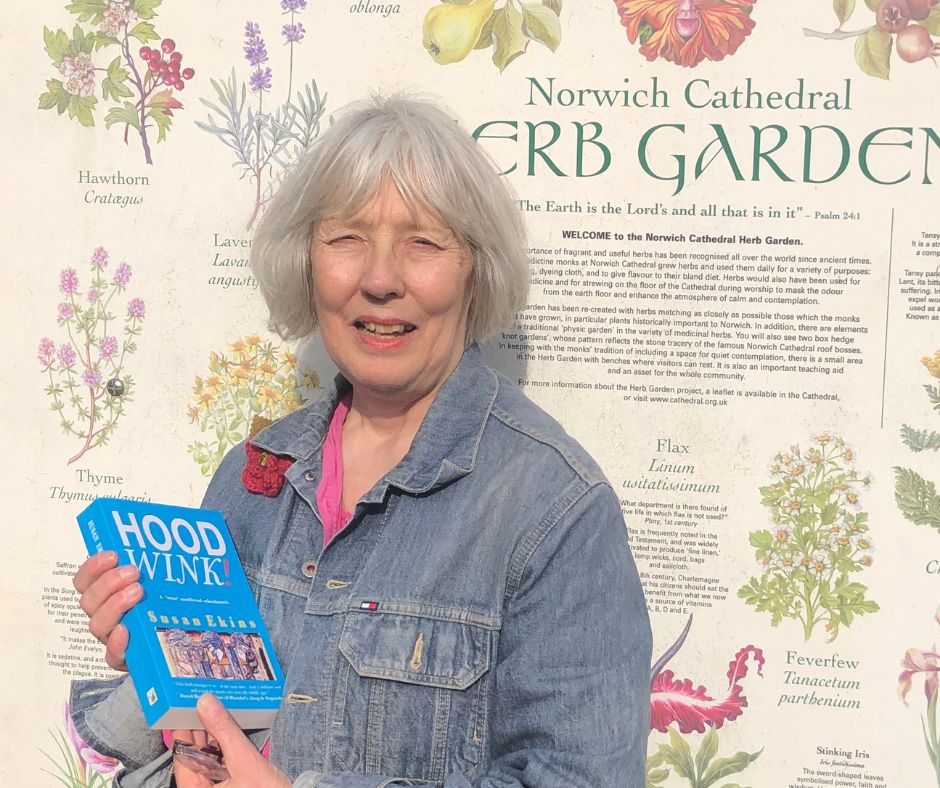
Susan Ekins was born just outside London, and after a cheerful post-war London childhood, and five years at school at the Grey Coat Hospital, she began her studies to become a librarian. But music called, and she then trained as a classical mezzo-soprano, performing for music societies, orchestras and light opera companies in England and Europe, under the name of Susan Lofthouse, for over 45 years.
She is deeply involved in local issues in Battersea including the campaign to save Battersea Park from electric motor racing. For her, community is deeply important. Other interests include history, theatre and Italian. She is married to an environmental economist and their son is a classical pianist.
Connect with Susan
X/Twitter | Facebook




 What Cathy Read Next...