

As regular followers of What Cathy Read Next will be only too aware by now, I love my historical fiction. One of my favourite time periods for historical fiction novels is Ancient Rome. Throw in a bit of political intrigue and I’m a happy reader. So I’m thrilled to be hosting today’s stop on the blog tour for Emperor, the latest in Andrew Frediani’s Rome’s Invincibles series.
I have a wonderful extract below to give you a taste of this thrilling third instalment in the story of Octavian and his rise to power.
 About the Book
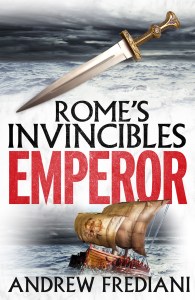
The battle for control of Rome continues. Will Octavian succeed in defeating the dangerous pirate Sextus Pompeius?
Octavian has defeated and killed Caesar’s assassins, but the road to absolute power is still long and treacherous. Threat now comes from Sextus Pompeius – a cunning pirate active along the Italian coasts, who terrorises Perugia’s citizens with his constant attacks. Octavian and his associates don’t have time to celebrate their victory in the final battle in the civil war before another even more bloody threat arises: the one presented by Sextus Pompeius at sea. The long campaign against the pirates proves frustrating, and often sees Octavian close to defeat and even death. Everything seems to conspire against him: his enemy appears to be receiving divine assistance, public opinion is against him, the soldiers lack confidence in their commander, and rebellion is just around the corner…
Format: ebook (398 pp.) Publisher: Aria
Published: 1st September 2017 Genre: Historical Fiction
Purchase Links*
Amazon.co.uk ǀ Kobo ǀ iBooks ǀ Google Play
*links provided for convenience, not as part of any affiliate programme
Purchase the previous books in the series from Amazon
Find Emperor on Goodreads
Extract from Emperor by Andrew Frediani
I
It was better not to get too close to the two severed heads that hung from the rostrum in the middle of the Forum.
By now, they were no more than lumps of decomposed, rotten flesh peeling from skulls, the orbs of the eyes empty, the remaining tufts of matted hair plastered to the cranium and the lips stretched out in a grim rictus of death.
A shiver of disgust went through Gaius Cilnius Maecenas as he contemplated the awful things.
He was surprised by the small crowd that had gathered around what was left of Brutus and Cassius, two assassins of Julius Caesar who had been killed at Philippi just over a month ago. It was extraordinary that people continued to go to the forum to watch them rot after they had already been there for a week.
He turned to Octavian. ““Why do you think they are attracted to these two disgusting trophies?” he asked. As he spoke, he felt a throb of pain in his side: it happened every time he spoke since he had been injured in Macedonia – and by a friend, not by the enemy.
“I was just wondering myself whether they come here on a pilgrimage out of some kind of veneration for the murderers of Caesar or whether they do it to express their contempt…” replied Octavian, who was also unwell and still weakened by the disease that had prevented him fighting in the first battle of Philippi. Yet, he had more than made up for that in the second, fighting on the front line despite not yet having fully recovered, but the effort of it had cost him dearly over the following weeks, and he had been taken ill while they were aboard the ship returning to Italy.
“Probably both, I would imagine,” remarked Agrippa, pointing to the heap of rubbish at the base of the Rostra beneath the two heads. “This stench isn’t the smell of decomposition. They come here to throw stuff at them…”
“Especially when they see that there are members of the triumvirate present,” added Salvidienus Quintus Rufus, the fourth member of the brotherhood that the young heir of Caesar had been assembling for the last two years with the aim of avenging his adoptive father and succeeding him in power. Rufus indicated a plebeian who threw a stone at the two heads, then looked round at them for approval. Soon afterwards a woman with a basket of vegetables hanging from her arm copied him, then smiled at the four men who, surrounded by their bodyguards, stood off to one side observing the scene. Not content, she then began to insult what remained of Brutus and Cassius and those nearby hastened to imitate her.
“It’s no coincidence that there are no senators about, then…” commented Maecenas. “These two are martyrs to freedom, as far as many of them are concerned and they would rather not compromise themselves by coming here. Quite apart from the fact that it would be beneath their dignity to shout insults or throw fruit – if there are actually any of them who hated Brutus and Cassius enough to do so, which I doubt.”
“Yes. If any of them have been here, then they’ve done so in disguise – perhaps dressed as commoners,” mused Agrippa. “And certainly not to insult them – to honour them, perhaps…”
“It remains to be seen just how strong this opposition in the Senate actually is. And what measures we will have to take in that regard,” said Rufus, who, as always, went straight to the point.
Maecenas was beginning to find it hard to tolerate the man. Just before the Battle of Philippi, the sect of Mars Ultor, which Octavian led with their assistance, had been on the verge of falling apart: rivalries, suspicions, failures and murders had compromised the mission that was the reason for the group’s very existence. And then at Philippi things had gone well, mainly, it had to be admitted – in private, at least – thanks to Mark Antony, the unwitting ally of the sect who had led Caesar’s armies to victory. It was thanks to that success that Octavian had been able to consolidate the group and resume his role as triumvir. There was still much to do, both in order to build the society that he and the other members of the sect desired and to finish avenging Julius Caesar and the other fallen members of his family.
 About the Author
Andrew (Andrea) Frediani is an Italian author and academic. He has published several non-fiction books as well as historical novels including the INVINCIBLE series and the DICTATOR trilogy. His works have been translated into five languages.
Connect with Andrea
Website ǀ Facebook ǀ Goodreads
Connect with Aria
Website ǀ Facebook ǀ Twitter ǀ Instagram


 About the Book
 About the Author
 What Cathy Read Next...