
I’m delighted to be hosting today’s stop on the blog tour for A Woman’s Lot by Carolyn Hughes. A Woman’s Lot is the second in the Meonbridge Chronicles series, the sequel to Fortune’s Wheel which I read last year and really enjoyed. Read my review of Fortune’s Wheel here. I’m excited to learn that a third in the series is well under way.
You can read an extract from A Woman’s Lot below as well as my review of this fascinating historical novel which immerses the reader in the daily life of a small village in 14th century Hampshire.
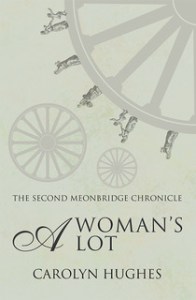 About the Book
How can mere women resist the misogyny of men?
When a resentful peasant rages against a woman’s efforts to build up her flock of sheep… Or a husband, grown melancholy and ill-tempered, succumbs to idle talk that his wife’s a scold… Or a priest, fearful of women’s “unnatural” power, determines to keep them in their place…
The devastation wrought two years ago by the Black Death changed the balance of society, and gave women a chance to break free from the yoke of chatteldom, to learn a trade, build a business, be more than just men’s wives.
But many men still hold fast to the teachings of the Church, and fear the havoc the daughters of Eve might wreak if they’re allowed to usurp men’s roles, and gain control over their own lives.
Not all men resist women’s quest for change – indeed, they want change for themselves. Yet it takes only one or two misogynists to unleash the hounds of hostility and hatred…
Format: ebook, paperback (288 pages) Publisher: SilverWood Books
Published: 4th June 2018 Genre: Historical Fiction
Purchase Links*
Publisher | Amazon.co.uk ǀ Amazon.com
*links provided for convenience, not as part of any affiliate programme
Find A Woman’s Lot on Goodreads
Extract from A Woman’s Lot by Carolyn Hughes
At that moment, the constable knocked on Emma’s door. ‘Is Mistress Titherige with you, Mistress Ward?’
Emma invited him inside and he bowed to Eleanor. ‘Your sheep are found, mistress.’
She blanched at the gloomy expression on the constable’s face. ‘Are they dead?’ she asked, in a whisper.
He shuffled his feet and, when he spoke, his voice was quiet too. ‘Two dead, mistress. The third, nearly so––’
Eleanor cried out. ‘Dead! My lovely ewes. And their unborn lambs.’
Emma put her arm around Eleanor’s shoulders. ‘It’s wicked, that’s what it is. Those poor innocent creatures…’
Eleanor got to her feet. ‘Take me to them, master constable.’
But Geoffrey demurred. ‘No, no, Mistress Titherige, there’s no need—’
She tossed her head. ‘Yes, there is. I want to see them. Please lead me, master constable.’ And she swept from Emma’s house and strode down the lane behind Geoffrey, who was still trying, but failing, to dissuade her from her mission.
But if Eleanor had been determined to see what had happened to her sheep, when she did so, she wished she had not come after all.
The derelict barn was cold and damp, its roof partly fallen in, and the ancient hay piled up in the stall where her sheep were penned was giving off a foul and musty stink. As Geoffrey had already said, two of the sheep were dead, lying close together in the rotten hay, their tongues lolling from their mouths, their lovely fleeces all filthy and reeking. One had dried blood around her tail and, when she saw it, Eleanor’s hand flew to her mouth.
‘Had she already birthed?’ she said, a choke rising in her throat. She cast about her, looking for a lamb. Then Geoffrey hurried forward and scrabbled in the hay, one of his men holding a lantern high.
Shortly, Geoffrey stood up. ‘It’s here, mistress. Don’t look––’
But, refusing his advice, Eleanor went forward too. He pointed, and she pressed both hands to her face, as she stared down on the pitiful little body, dark and bloodied, nestled in the foul hay a short distance from its dam.
‘Where’s the third?’ she said, her voice a whisper.
‘Over ’ere, missus,’ said the constable’s man.
The third sheep lay apart from the others, on its side, panting, its eyes sunken.
‘She’s been deprived of water,’ said Eleanor, kneeling by the animal’s side. ‘How cruel…’
‘Or mebbe just ignorant?’ said the constable. He bent down and picked up some hay. ‘The hay’s all rotten, mistress. It’s been here years. Won’t ’ave done them no good.’
She looked up at him. ‘Bad hay and no water?’ She stroked the sheep’s muzzle, and tears filled her eyes. ‘The poor, poor creatures.’
Eleanor wiped away the tears on the sleeve of her kirtle. ‘Anyway, she’s past saving. So please, master constable, arrange for her to be freed from her suffering.’
Geoffrey bowed his head. ‘Will Cole’ll do it.’
My Review
It’s 1352 and Meonbridge is still struggling to cope with the impact of the ‘Mortality’. Not just the fact that there are wives left widowed and alone, husbands left without wives, families mourning the loss of children or children made orphans but because of the far-reaching social and economic changes the plague has left in its wake. A shortage of skilled labour means workers find they have more bargaining power and are prepared to travel for better opportunities, something they would never have considered in the past.
One of the chief changes is that the women of the village are grasping opportunities for independence; some through necessity, some through inclination. Unfortunately, this isn’t going down well with some of the men folk who seem less able to (or perhaps, less prepared to) adapt to the changing environment. They greet the attempts of their women to get more involved in activities outside the home with unease, distrust, scorn, even outright hostility. “Women have taken it into their heads they’re as good as men in matters that shouldn’t concern them…. It’s not natural.”
The author chooses to focus the story on four female characters. There’s Eleanor, trying to build her flock of sheep into a successful business but considering matrimony for reasons of social propriety, support and companionship. There’s Agnes, finding motherhood a bit of a challenge but whose efforts to enhance her woodworking skills are dismissed by carpenter husband. There’s Susanna, whose previously loving husband Henry, the village miller, seems fiercely opposed to her getting involved in any aspect of the business. And there’s Emma, one of the poor cottar families who eke out a hand-to-mouth existence, who believes better opportunities for her husband and family may lie elsewhere.
A Woman’s Lot plunges the reader right into the midst of this upheaval and the struggles facing the inhabitants of Meonbridge. (Readers new to the series will probably want to make frequent use of the helpful dramatis personae as they get to know the different characters.) A dramatic event in the village suddenly changes the atmosphere and when one of their number falls under suspicion, some of the women band together to try to discover the truth. But will justice prevail?
A Woman’s Lot provides the reader with a fascinating insight into day-to-day life in a period when people lived without many of the things we now take for granted: being able to dry your clothes easily when they get wet; a house that doesn’t let in the wind and rain; a slice of bread that doesn’t involve a trip to the communal bakehouse; not having to exist only on what you can grow. At the same time, the book brings to life the small, if infrequent, joys of life such as when the travelling market comes to the village green, Christmas and Midsummer festivities, music and dancing at a wedding feast (or ‘bride ale’, as mentioned in the helpful glossary). And I always enjoy descriptions of food in books: ‘Soon, there were coneys in wine, and little pies of venison, a brewet of beef in a think spicy sauce, and hens stuffed and roasted and glazed with green.’
I would suggest treating A Woman’s Lot as a fascinating meander through the village of Meonbridge noticing everything that goes on as you pass by rather than a canter at breakneck speed in pursuit of answers to the mystery. As I did, immerse yourself in the daily life of Meonbridge. Amid the struggles, feuds and malicious gossip there are acts of courage and hope for the future. As her friend Susanna says to Eleanor, “It’s about grabbing the chance of happiness when it comes”. And after what the villagers have been through, surely they deserve that?
I received a review copy courtesy of the author and Brook Cottage Books, in return for an honest and unbiased review.
In three words: Authentic, absorbing, immersive
Try something similar…The Last Hours by Minette Walters (read my review here)
 About the Author
Carolyn Hughes was born in London, but has lived most of her life in Hampshire. After a first degree in Classics and English, she started her working life as a computer programmer, in those days a very new profession. It was fun for a few years, but she left to become a school careers officer in Dorset. But it was when she discovered technical authoring that she knew she had found her vocation. She spent the next few decades writing and editing all sorts of material, some fascinating, some dull, for a wide variety of clients, including an international hotel group, medical instrument manufacturers and the Government. She has written creatively for most of her adult life, but it was not until her children grew up and flew the nest, several years ago, that creative writing and, especially, writing historical fiction, took centre stage in her life. She has a Masters in Creative Writing from Portsmouth University and a PhD from the University of Southampton.
Carolyn blogs at The History Girls on the 20th of every month.
Connect with Carolyn
Website ǀ Blog | Facebook ǀ Twitter ǀ Goodreads

 About the Book
 What Cathy Read Next...