
#EventReview The Mirror & the Light – A Very Tudor Evening at Waterstones, Reading @BroadStBooks

To mark the publication yesterday of The Mirror & The Light, the long-awaited final book in Hilary Mantel’s trilogy about Thomas Cromwell, Waterstones branches around the country staged special events. In the case of my local branch in Reading, this took the form of ‘A Very Tudor Evening’ featuring three eminent guest speakers talking about Reading at the time of Thomas Cromwell.

20200306_092432-1Of course, first there was the little matter of getting my hands on my very own pre-ordered copy of The Mirror & The Light – all 900 pages of it. You may have to wait a while for my review!

Once everyone had taken their seats, Waterstones Reading Events Manager, Cheryl, introduced the three speakers:

  • Ralph Houlbrooke, historian of Tudor England and Emeritus Professor of Early Modern History at the University of Reading
  • Joan Dils, local history tutor, President of The History of Reading Society and author of Reading: A History
  • John Painter, co-author with Peter Durrant of Reading Abbey and the Abbey Quarter

Ralph gave an eloquent potted history of Thomas Cromwell’s life and rise to power, the background to England’s split from Rome and the downfall of Anne Boleyn as a result of Henry VIII’s need for a male heir. He also talked about the Royal Court, how it became the centre of power and patronage -“an intensely competitive environment” – and Thomas Cromwell’s role in ‘managing’ Parliament and the trial of Thomas More.

Given Cromwell was an ardent Protestant, Ralph was asked why he thought Anne Boleyn, who held similar religious views, became an enemy rather than an ally? Ralph felt it was partly because Cromwell never forgot Anne’s part in the downfall of his mentor, Cardinal Wolsey, and because he was willing to do whatever was necessary to achieve the King’s will. Was Thomas Cromwell a ‘man on the make’ or someone looking for an opportunity to advance the Protestant cause? Ralph thought probably a bit of both. Cromwell did some unpleasant things but he was never unnecessarily cruel.

Joan gave an extremely engaging talk in which she imagined what Thomas Cromwell would have seen if he had visited Reading in July 1535. (Although there is historical evidence Henry VIII and Anne Boleyn visited Reading around that time, there’s no firm proof Thomas Cromwell did). Joan outlined the route Thomas would have taken through the town, mentioning place names and buildings that many Reading residents would recognise. She also painted a vivid picture of the sights, sounds and smells he would have experienced, from the busy town wharf on the River Kennet where barges were loading and unloading, to the market place crowded with shops and housing the town pillory, to the rather unpleasant smelling workshops of the dyers and tanners.

Asked about the population of Reading at the time, Jean estimated around 3,500 many of whom were children. She explained the importance of Reading arose from its location, its good road and river links and the wealth of its citizens. A lot of this wealth was created from the high quality broadcloth it produced and exported across Europe.

John Painter talked about Reading Abbey in the time of Thomas Cromwell, his role in its dissolution and some of the other figures involved, many of whom profited from its demise through acquiring property or land previously owned by the Abbey or by being granted valuable annuities. He described the demise of the last Abbot, Hugh Cook of Faringdon, whose trial and eventual execution was ‘managed’ by Cromwell. This was despite Hugh appointing Thomas Cromwell to the office of Seneschal, or High Steward, of Reading, in 1538 in an attempt to gain favour.

Each talk was followed by a short Q&A. To be honest, although all three speakers gave fascinating talks, I would have welcomed a little more focus on Hilary Mantel’s book. Like me, the majority of people attending wouldn’t yet have had the opportunity to read The Mirror & the Light, so readings of short extracts would have been nice and preferable to some of the more abstruse questions asked by certain members of the audience.

Having said that, huge thanks to Cheryl and the Waterstones Reading team for organising such an interesting (free) event.

This review is based on notes I took during the event and my own recollections. Any errors in recording views expressed are my own.

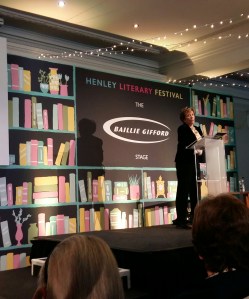
#EventReview Anne De Courcy at Henley Literary Festival 2019

This is a longer version of a review that first appeared on the Henley Standard website. It is based on notes I took during the event and my own recollections. Any errors in recording views expressed during the discussion are my own.

20191003_144417-1There was a packed house in the Finlay Suite of Phyllis Court to hear Festival favourite Anne De Courcy talk about her latest book, Chanel’s Riviera. Subtitled Life, Love and the Struggle for Survival on the Cote d’Azur, 1930 – 1944, Anne described her book as a biography of the Riviera.
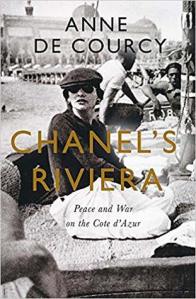
The book opens as Chanel’s long love affair with the Duke of Westminster is ending. During the course of their relationship she’d acted as hostess at his society events and been responsible for decorating some of his houses. Anne explained, their friendship had brought the glamorous Chanel a lot, enabling her to leave behind her humble beginnings. Abandoned by her father at the age of eleven, she was brought up in a convent. It was a strict life, cut off from the outside world and where the palette was overwhelmingly black and white. Anne found it remarkable that Chanel did not become institutionalized but managed to be an original.

On leaving the convent at eighteen, Chanel and her cousin were apprenticed to a military tailor. There she encountered many young officers, eventually moving in with one of them as a ‘second string mistress’. She learned to ride and, unwilling to wear the huge hats that were fashionable at the time, she took a plain boater and trimmed it herself. Soon others were asking her to make ones for them. Later, Chanel met and lived with a young Englishman who provided the financial support for her to open a millinery shop and subsequently move into dressmaking.

Anne talked about how the Duke of Westminster pursued Chanel for months, sending her gifts and jewellery. Chanel took her time to say yes as, by that time, she was a well-known, independent woman. However, Chanel made her ‘real’ money through the development of her scent. Up until then “nice” women only used floral scents but Chanel wanted to create something different. Introduced to a famous parfumier, she selected from the samples he presented to her the fifth. Anne recalled Chanel’s saying that you should always put scent where you want to be kissed, joking that it seemed to her to ‘leave quite a lot of doors open’.

It was from the Duke of Westminster’s yacht that Chanel first spotted the piece of land where she would build her villa, La Pausa. It was the first thing she owned outright herself, demonstrating Anne considered that Chanel had surmounted her past as a ‘kept woman’. The design of the villa was based on convent cloisters and Chanel set out to make it look old, for example importing aged olive trees.

Illustrated with photographs from the book, Anne’s talk showcased her detailed knowledge of her subject as she mentioned some of the famous figures who flocked to the Riviera in its heyday during the 1930s. These included artists such as Picasso, writers Ernest Hemingway, Somerset Maugham, H G Wells and Jean Cocteau as well as Winston Churchill. In 1933, in the wake of the book burnings in Germany and Austria, a number of German Jewish writers arrived on the Riviera leading to it being referred to as ‘Weimar on Sea’.

In 1936, Wallis Simpson and the then Edward VIII arrived on the Riviera. Because of rumours of a bomb plot, they were lent a yacht and it was during that cruise that they were first publicly photographed together as a couple. [Those interested in learning more about Wallis Simpson can read my review of Untitled: The Real Wallis Simpson, Duchess of Windsor by Anna Pasternak.] Anne described some of the other colourful figures who made the Riviera their home such as renowned society hostess Maxine Elliott, and Lord and Lady Furness (the latter the owner of a pet cheetah).

Initially, talk of war was dismissed by the residents of the Riviera. ‘We have the Maginot Line’ was the constant refrain, referring to the line of forts along France’s border with Germany. Anne described how the atmosphere changed following the outbreak of war. Many refugees from Northern Europe, including Jews fleeing persecution, sought refuge on the Riviera and, with the fall of France in 1940, food shortages caused by the diversion of supplies to Germany made life really tough. Despite this and the urging of the British and American consulates, the residents of Cannes and Antibes were reluctant to leave not least because it was a cheap place to live. Soon the black market was flourishing and the resistance movement grew despite the presence of paid informers.

Anne revealed how, during the war, Chanel had a German lover partly in the hope she could get help for her nephew who was a prisoner of war. Addressing the accusations of collaboration that have been made against Chanel, Anne rejected the notion that Chanel spied for Germany arguing that she would have had information of little value. In fact, Chanel didn’t even know the architect who designed La Pausa had joined the resistance, hidden a transmitter in the basement and was involved in helping Jews to escape. Above all, said Anne, Chanel wanted to survive.

Chanel marked the liberation of Paris in 1944 by opening her store and giving a bottle of her iconic perfume to every US soldier. This kept her free from the retaliation meted out to others accused of collaboration. She left for Switzerland the same year which is the point at which Anne’s book ends having given us a vivid picture of Chanel as a self-sufficient, independent woman with considerable business acumen despite her difficult childhood.

Responding to audience questions, Anne argued Chanel’s success as a designer was because she recognized early on that the best advertisement for her clothes was for them to be seen being worn by women of style. In response to another question about whether Chanel ever felt lonely, Anne said, although she had brothers, sisters and nephews whom she supported financially, she felt Chanel relied most on her circle of friends. Asked what she thought Chanel would make of her brand today, Anne said she’d probably approve of the pieces reminiscent of her early designs. However, being always impeccably turned out, she didn’t believe Chanel would think much of the fashion for ‘bed hair’! Finally, Anne revealed she is currently in negotiations for her next book (provisionally titled Five Love Affairs and a Friendship) about writer and heiress, Nancy Cunard and set in the 1920s.

A knowledgeable and thoroughly entertaining speaker, I can see Anne De Courcy making many more return visits to Henley Literary Festival.


Chanels RivieraAbout the Book

Far from worrying about the onset of war, the burning question on the French Riviera in 1938 was whether one should curtsy to the Duchess of Windsor.

Featuring a sparkling cast of historical figures, writers and artists including Winston Churchill, Daisy Fellowes, Salvador Dalí, the Windsors, Aldous Huxley and Edith Wharton – and the enigmatic Coco Chanel at its heart – Chanel’s Riveria is a sparkling account of a period where such deep extremes of luxury and terror had never before been experienced.

From the glamour of the pre-war parties and casinos, to Robert Streitz’s secret wireless transmitter in the basement of La Pausa – Chanel’s villa that he created – while Chanel had her German lover to stay during the war, Chanel’s Riveria explores the fascinating world of the Cote d’Azur elite in the 1930s and 1940s, enriched with original research that brings the lives of both rich and poor, protected and persecuted, to vivid life.

contributor-anne-de-courcyAbout the Author

Anne de Courcy is the author of thirteen widely acclaimed works of social history and biography, including The Husband Hunters, The Fishing Fleet, The Viceroy’s Daughters and Debs At War.

In the 1970s she was Woman’s Editor on the London Evening News and in the 1980s she was a regular feature-writer for the Evening Standard. She is also a former features writer and reviewer for the Daily Mail.  She lives in London SW3. (Photo credit: Publisher author page)

Connect with Anne

Website