
New arrivals
China Blue (Dudley Sisters Saga #3) by Madalyn Morgan (paperback, giveaway prize)
At the beginning of World War II, Claire Dudley joins the WAAF. She excels in languages and is recruited by the Special Operations Executive to work in German occupied France with Captain Alain Mitchell, of the RCAF, and the French Resistance. Against SOE rules Claire falls in love. The affair has to be kept secret. Even after her lover falls into the hands of the Gestapo, Claire cannot tell anyone they are more than comrades.
As the war reaches its climax, Claire fears she will never again see the man she loves.
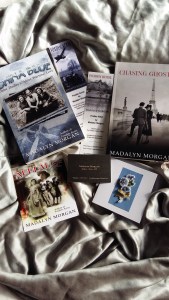
Chasing Ghosts (Dudley Sisters Saga #6) by Madalyn Morgan (paperback, giveaway prize)
1949 – After receiving treatment for shell shock in Canada, Claire’s husband disappears. Has Mitch left her for the woman he talks about in his sleep? Or is he on the run from accusations of wartime treachery? Claire goes to France in search of the truth, aided by old friends from the Resistance.
(Chasing Ghosts is book 6 in the Dudley Sisters Saga, but is the sequel to book 3, China Blue.)
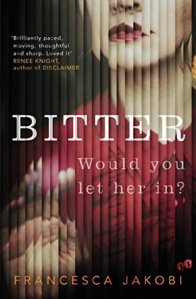 Bitter by Francesca Jakobi (ebook)
It’s 1969, and while the summer of love lingers in London, Gilda is consumed by the mistakes of her past. She walked out on her beloved son Reuben when he was just a boy and fears he’ll never forgive her.
When Reuben marries a petite blonde gentile, Gilda takes it as the ultimate rejection. Her cold, distant son seems transformed by love – a love she’s craved his entire adult life. What does his new wife have that she doesn’t? And how far will she go to find out? It’s an obsession that will bring shocking truths about the past to light . . .
Bitter is a beautiful and devastating novel about the decisions that define our lives, the fragility of love and the bond between mother and son.
 The Doll Factory by Elizabeth Macneal (eARC, NetGalley)
London. 1850. The Great Exhibition is being erected in Hyde Park and among the crowd watching the spectacle two people meet. For Iris, an aspiring artist, it is the encounter of a moment – forgotten seconds later, but for Silas, a collector entranced by the strange and beautiful, that meeting marks a new beginning.
When Iris is asked to model for pre-Raphaelite artist Louis Frost, she agrees on the condition that he will also teach her to paint. Suddenly her world begins to expand, to become a place of art and love.
But Silas has only thought of one thing since their meeting, and his obsession is darkening…
Pre-order The Doll Factory from Amazon UK
 The Sentence is Death (Hawthorne #2) by Anthony Horowitz (eARC, NetGalley)
“You shouldn’t be here. It’s too late . . . “
These, heard over the phone, were the last recorded words of successful celebrity-divorce lawyer Richard Pryce, found bludgeoned to death in his bachelor pad with a bottle of wine – a 1982 Chateau Lafite worth £3,000, to be precise.
Odd, considering he didn’t drink. Why this bottle? And why those words? And why was a three-digit number painted on the wall by the killer? And, most importantly, which of the man’s many, many enemies did the deed?
Baffled, the police are forced to bring in Private Investigator Daniel Hawthorne and his sidekick, the author Anthony, who’s really getting rather good at this murder investigation business.
But as Hawthorne takes on the case with characteristic relish, it becomes clear that he, too, has secrets to hide. As our reluctant narrator becomes ever more embroiled in the case, he realizes that these secrets must be exposed—even at the risk of death . . .
Pre-order The Sentence is Death (Hawthorne #2) from Amazon UK
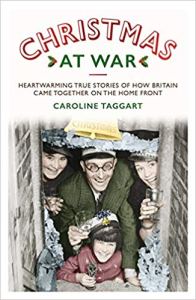 Christmas at War by Caroline Taggart (proof copy courtesy of John Blake and Readers First)
No turkey. No fruit to make a decent pudding. No money for presents. Your children away from home to keep them safe from bombing; your husband, father and brothers off fighting goodness knows where. How in the world does one celebrate Christmas?
That was the situation facing the people of Britain for six long years during the Second World War. For some of them, Christmas was an ordinary day: they couldn’t afford merrymaking – and had little to be merry about. Others, particularly those with children, did what little they could.
These first-hand reminiscences tell of making crackers with no crack in them and shouting ‘Bang!’ when they were pulled; of carol-singing in the blackout, torches carefully covered so that no passing bombers could see the light, and of the excitement of receiving a comic, a few nuts and an apple in your Christmas stocking. They recount the resourcefulness that went into makeshift dinners and hand-made presents, and the generosity of spirit that made having a happy Christmas possible in appalling conditions.
From the family whose dog ate the entire Christmas roast, leaving them to enjoy ‘Spam with all the trimmings’, to the exhibition of hand-made toys for children in a Singapore prison camp, the stories are by turns tragic, poignant and funny. Between them, they paint an intriguing picture of a world that was in many ways kinder, less self-centered, more stoical than ours. Even if – or perhaps because – there was a war on.
Pre-order Christmas at War from Amazon UK
On What Cathy Read Next last week
Blog posts
Monday – I published my review of crime novel The Last Thread by Ray Britain.
Tuesday – I hosted a stop on the blog tour for The Golden Orphans by Gary Raymond, posting my review of this literary thriller set in Cyprus. This week’s Top Ten Tuesday topic was Villains and I gave my list a John Buchan theme.
Wednesday – WWW Wednesday is the opportunity to share what I’ve just finished reading, what I’m reading now and what I’ll be reading next plus have a good old nose around what other bloggers are reading. I published my review of another of the events I attended at this year’s Henley Literary Festival – Anne Youngson and A J Pearce talking about their debut novels, Meet Me at the Museum and Dear Mrs. Bird.
Thursday – I joined the blog tour for The Senator’s Assignment by Joan E. Histon, publishing my review of this historical mystery set in Ancient Rome. I also published my review of the final event I attended at this year’s Henley Literary Festival – Diane Setterfield talking about her forthcoming book, Once Upon a River.
Friday – Today’s review was of a book I read during my recent break in Cornwall, a historical fiction novel set partly in Cornwall and the Scilly Isles, False Lights by K. J. Whittaker.
On What Cathy Read Next this week
Currently reading


Planned posts
- Book Review: A Ration Book Christmas by Jean Fullerton
- Book Review: Paris Echo by Sebastian Faulks
- Book Review: The Thirteenth Tale by Diane Setterfield
- Book Review: The Magick of Mister Lilly by Tobsha Learner
- Buchan of the Month/Book Review: Witch Wood by John Buchan
- Blog Tour/Book Review: Paris in the Dark by Robert Olen Butler
- Blog Tour/Book Review: The Glorious Dead by Tim Atkinson
- Book Review: Gothic Tales by Elizabeth Gaskell
- Blog Tour/Extract: Cottage on a Cornish Cliff by Kate Ryder
- Blog Tour/Book Review: The Word for Freedom by Angela Clark
- Blog Blitz: A Different Kind of Fire by Suanne Schafer
- Blog Tour/Book Review: Miss Marley by Vanessa Lafaye

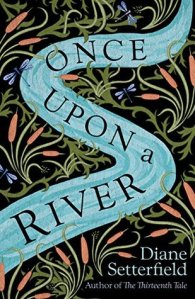
 Could there be a more fitting location to hear author Diane Setterfield talk about her forthcoming book Once Upon a River than sailing aboard The Hibernia along the River Thames, the setting of the book? Set in the 1870s, the book involves the unexpected arrival of a four- year-old girl at an inn on the Thames where locals gather to tell stories on winter evenings.
 Once back at Hobbs Boat Yard, I and other members of the audience stepped ashore clutching our precious (signed) proof copies of Once Upon a River. I found Diane a fascinating speaker and I’m really looking forward to reading Once Upon a River and sharing my review as part of the blog tour for the book in December. Finally, I’d like to give a shout-out to Hannah Beckerman for her perceptive questions, clearly derived from a thoughtful and thorough reading of the book.
 About the Book
 About the Author

