

In honour of Nonfiction November, I’ve chosen John Buchan’s biography of the Roman Emperor Augustus as my Buchan of the Month. You can find out more about the project and my reading list for 2019 here. What follows is an introduction to Augustus. I will be publishing my review of the book later this month.
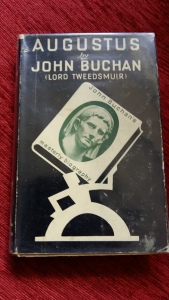 Augustus was published by Hodder & Stoughton in the UK and by Houghton Mifflin in the US in October 1937.
Buchan (by this time, Lord Tweedsmuir) started work on the book soon after his arrival in Canada following his appointment as Governor-General. Janet Adam Smith, Buchan’s first biographer, records how when he had completed his official duties and ‘disposed of the day’s chores, he would turn at once to the biography of Augustus’. Buchan received long distance help with research for the book from two friends: Hugh Last, Professor of Ancient History at Oxford (where Buchan had studied) and Roberto Weiss. The latter looked out newly published material, checked references and later oversaw the book’s translation into Italian.
Professor Last was suitably impressed with the finished product, remarking that the book ‘puts us so-called experts as much in your debt for its demonstration of the way in which Augustus should be treated as it does the larger public’, going on to describe it as ‘by far the best general interpretation of its subject’. The book was greeted with approval by many other historians.
David Daniell praises Buchan as a painstaking historian and a ‘modern interpreter who had a powerful sense of the future’. Buchan himself was conscious of the parallels with contemporary events given he was working on the book at the same time as Europe was witnessing the rise of Mussolini and Hitler. In the preface to the book he writes: ‘The convulsions of our time may give an insight into the problems of the early Roman empire which was perhaps unattainable by scholars who lived in easier days‘. Buchan even sent a copy of Augustus to President Roosevelt, saying ‘I hope it may interest you for many of his problems are your own’.
At the end of the book, Buchan points out similarities between the two ages: ‘Once again the crust of civilization has grown thin, and beneath can be heard the muttering of primeval fires. Once again many accepted principles of government have been overthrown, and the world has become a laboratory where immature and feverish minds experiment with unknown forces.‘ (The concept of the thin crust of civilization was one Buchan had previously explored in his adventure novels, notably The Power-House.)
Despite its positive reception by historians, Augustus sold only 5,000 copies in the UK in the first year of its publication. By 1960, that figure had reached 36,000 boosted by the release of a cheap edition in 1942.
My Buchan of the Month for December will be the final Richard Hannay adventure, The Island of Sheep.
Sources:
Janet Adam Smith, John Buchan: A Biography (OUP, 1985 [1965])
David Daniell, The Interpreter’s House: A Critical Assessment of John Buchan (Nelson, 1975)
Kenneth Hillier and Michael Ross, The First Editions of John Buchan: A Collector’s Illustrated Biography (Avonworld, 2008)

 Nonfiction November has commenced – and, yes, I do know it’s still October.


 What Cathy Read Next...