
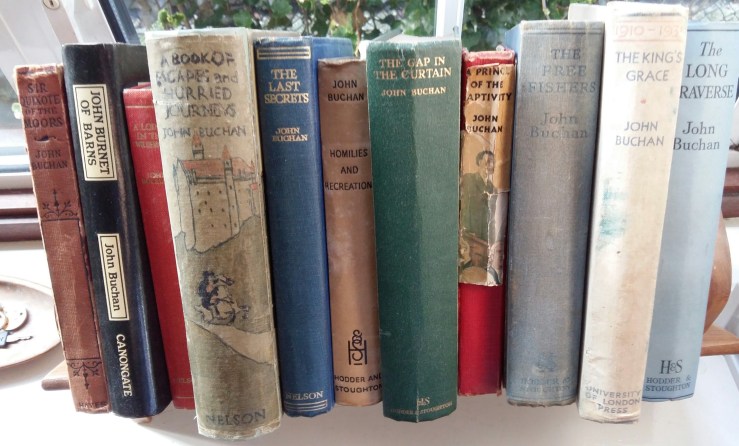
 My Buchan of the Month for August is A Prince of the Captivity. It was published in the UK by Hodder & Stoughton on 6th July 1933 and in the US by Houghton Mifflin on 23rd August 1933. My copy (pictured right) is a later Nelson edition from September 1935 with its rather tatty dust jacket. It is some years since I read the book but it is one of my favourites of Buchan’s novels, not least for one thrilling part set in the Arctic.
Janet Adam Smith, Buchan’s first biographer, compares the book’s melodramatic opening in which Adam Melfort is found guilty of a crime he did not commit to A E W Mason’s The Four Feathers. She observes the book is full of topics of concern to Buchan, such as leadership and the relationship between different social classes. However, she finds his “thriller equipment” inadequate for exploring such issues. For her, the book only gathers energy in the last section, recalling in theme and tone Buchan’s earlier novel, The Half-Hearted.
Buchan scholar David Daniell describes A Prince of the Captivity as John Buchan’s “longest and most complicated novel” and says that, according to Buchan’s wife, Lady Tweedsmuir, the book was written out of concern “something was very wrong in Europe”. (Ursula Buchan, the author’s granddaughter and latest biographer, makes a similar point when she observes that A Prince of the Captivity has been called “almost certainly the first anti-Nazi popular novel”.) Although David Daniell feels the book does not really hang together because it contains too many ideas that are taken up and then dropped, he praises the section set in the Arctic (which I mentioned earlier) as “among the best things Buchan did”.
Andrew Lownie claims the book’s storyline was inspired by the real life experiences of Major Cecil Cameron whom it is likely Buchan met in 1914. He agrees with other commentators that A Prince of the Captivity contains many familiar elements such as “the liberating nature of the Scottish countryside, a hero able to speak several languages… the undercurrent of Calvinism”.
Although Lownie argues the book’s “didactic nature” and “poorly conceived characterization” put off readers, it did receive a warm response from some. In a letter to a friend, T E Lawrence enquired, “Did you read his latest?” going on to describe Buchan’s books as “like athletes racing: so clean-lined, speedy, breathless”.
According to figures collated by Janet Adam Smith, A Prince of the Captivity sold 83,000 hardback copies up to 1960 and a further 35,000 of the Pan paperback edition up to 1965. Look out for my review of the book later this month.
Sources:
Janet Adam Smith, John Buchan: A Biography (OUP, 1985 [1965])
Ursula Buchan, Beyond The Thirty-Nine Steps: A Life of John Buchan (Bloomsbury, 2019)
David Daniell, The Interpreter’s House: A Critical Assessment of John Buchan (Nelson, 1975)
Kenneth Hillier and Michael Ross, The First Editions of John Buchan: A Collector’s Illustrated Biography (Avonworld, 2008)
Andrew Lownie, John Buchan: The Presbyterian Cavalier (Constable, 1995)

 Top Ten Tuesday is a weekly meme created by The Broke and the Bookish and now hosted by Jana at
  This week’s topic is Books That Should Be Adapted Into Movies. I’ve picked ten books that I think would make great films or TV series, with one or two casting suggestions for good measure. Links from each title will take you to my review.
 When I reviewed
  These next two – The Unlikely Pilgrimage of Harold Fry and The Music Shop – are a bit of a cheat because I learned from watching a recent online interview with Rachel Joyce that she is working on screenplays for both of them.
 Because it’s set over the course of only a few days, I think
  I can’t call myself a John Buchan fan without suggesting one of his books for the small or big screen treatment. I’d go with


 What Cathy Read Next...