My Buchan of the Month for September is The Magic Walking Stick, one of the few books John Buchan wrote for children. It’s a book I don’t own a physical copy of and which I haven’t read. It seems I’m not alone in that respect as the biographies of Buchan I usually consult when putting together blog posts like this have little, if anything, to say about the book.
Andrew Lownie feels it shares with Buchan’s Huntingtower trilogy (Castle Gay, Huntingtower and The House of the Four Winds) a preoccupation with monarchists and republicans. He notes a large part of the book is devoted to the rescue by Bill (the young hero of the book) of Prince Anatole, heir to the throne of Gracia. Ursula Buchan, John Buchan’s granddaughter and latest biographer, believes the book grew out of the stories her grandfather used to tell his children during country walks.
The Magic Walking Stick was published in the UK by Hodder & Stoughton on 24th October 1932 and in the US by Houghton Mifflin two days later. The book is dedicated to Carola, Margaret and Jeremy, the children of his sister-in-law, Margaret (known as Marnie).
A note by the author states, “The germ of this story was contained in a contribution of mine to Lady Cynthia Asquith’s volume Sails of Gold”. Buchan had known Cynthia Asquith since he was at Oxford. She was the sister-in-law of his friend, Raymond Asquith, who was killed in the First World War. Sails of Gold, an anthology of short stories for children contributed by various authors, was published in 1927. The Magic Walking Stick was also serialized in St. Nicholas, an American magazine for children, between December 1933 and April 1934.
Look out for my review of the book later this month.
Sources:
Ursula Buchan, Beyond The Thirty-Nine Steps: A Life of John Buchan (Bloomsbury, 2019)
Kenneth Hillier and Michael Ross, The First Editions of John Buchan: A Collector’s Illustrated Biography (Avonworld, 2008)
Andrew Lownie, John Buchan: The Presbyterian Cavalier (Constable, 1995)
Category: Discussion posts
#6Degrees Of Separation: From Rodham by Curtis Sittenfield to Foe by J.M. Coetzee
It’s the first Saturday of the month which means it’s time for 6 Degrees of Separation!
Here’s how it works: a book is chosen as a starting point by Kate at Books Are My Favourite and Best and linked to six other books to form a chain. Readers and bloggers are invited to join in by creating their own ‘chain’ leading from the selected book.
Kate says: Books can be linked in obvious ways – for example, books by the same authors, from the same era or genre, or books with similar themes or settings. Or, you may choose to link them in more personal or esoteric ways: books you read on the same holiday, books given to you by a particular friend, books that remind you of a particular time in your life, or books you read for an online challenge. Join in by posting your own six degrees chain on your blog and adding the link in the comments section of each month’s post. You can also check out links to posts on Twitter using the hashtag #6Degrees
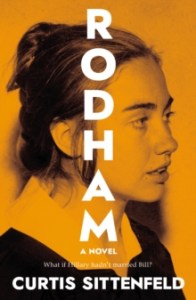
This month’s starting book is Rodham by Curtis Sittenfeld in which the author imagines what might have happened had Hilary Rodham NOT married Bill Clinton.
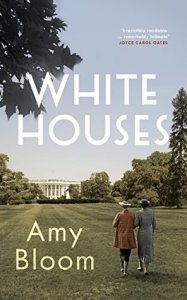
Given she DID marry Bill Clinton and become First Lady, my first link in the chain is to another First Lady, Eleanor Roosevelt. White Houses by Amy Bloom tells the story of the friendship between Eleanor and reporter, Lorena Hickok.
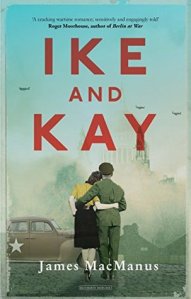
A book which involves an extra-marital relationship with a future occupant of the White House, namely Dwight D. Eisenhower, is Ike and Kay by James MacManus. It’s a fictionalized account of the real-life affair between Eisenhower and his wartime driver, Kay Summersby.
Back to another First Lady, this time Jacqueline Kennedy. In her latest book, The Second Marriage, Gill Paul tells the story of the relationship between Jackie Kennedy and Aristotle Onassis.
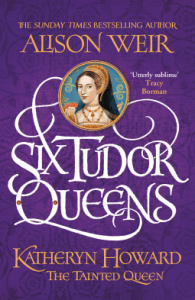
If we’re talking multiple marriages, then we need look no further than King Henry VIII of England. In the latest book in her Six Tudor Queens series, Katheryn Howard: The Tainted Queen, Alison Weir explores the tragic life of wife number five.
A character mentioned (briefly) in the book is Thomas Cromwell, the subject of Hilary Mantel’s monumental trilogy. Like the first book in the series, Wolf Hall, its successor, Bring Up The Bodies, won the Man Booker Prize. In doing so, Mantel became the first woman to win the prize twice. (Will she make it three in a row this year?)
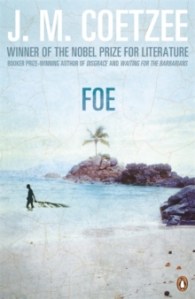
The first author to win the prize twice, though, was J.M. Coetzee (in 1983 and again in 1999). His novel Foe, which I studied as part of my Open University English MA (you know, intertextuality and all that) is a reinvention of the story of Daniel Defoe’s Robinson Crusoe.
This month we’ve travelled from 1,600 Pennsylvania Avenue to a desert island via some matrimonial shenanigans. Where did your chain take you?