

Hosted by Taking on a World of Words, this meme is all about the three Ws:
- What are you currently reading?
- What did you recently finish reading?
- What do you think you’ll read next?
Why not join in too? Leave a comment with your link at Taking on a World of Words and then go blog hopping!
Currently reading
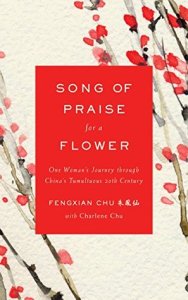 Song of Praise for a Flower: One Woman’s Journey through China’s Tumultuous 20th Century by Fengxian Chu with Charlene Chu (ebook, courtesy of the authors)
For nearly two decades, this manuscript lay hidden in a Chinese bank vault until a long-lost cousin from America inspired 92-year-old author Fengxian Chu to unearth it.
Song of Praise for a Flower traces a century of Chinese history through the experiences of one woman and her family, from the dark years of World War II and China’s civil war to the tragic Great Leap Forward, Cultural Revolution, and beyond. It is a window into a faraway world, a sweeping epic about China’s tumultuous transformation and a harrowing yet ultimately uplifting story of a remarkable woman who survives it all and finally finds peace and tranquility.
 Memory Hold-the-Door by John Buchan (hardcover)
John Buchan, 1st Baron Tweedsmuir (1875-1940) completed his autobiography not long before his death. A highly accomplished man, his was a life of note. Although now known by many chiefly as an author, he was also an historian, Unionist politician and Governor General of Canada.
Although he stated that it was not strictly an autobiography, Memory Hold-the-Door provides a reflective, personal account of his childhood in Scotland, his literary work from his time at Oxford University to the famous Hannay and Leithen stories and his extensive public service in South Africa, Scotland, France in the Great War, and Canada. Of great interest are his accounts of key contemporary figures, including Lord Grey, Lord Haldane, Earl Balfour, Lord Haig, T.E. Lawrence and King George V.
Recently finished (click on title for review)
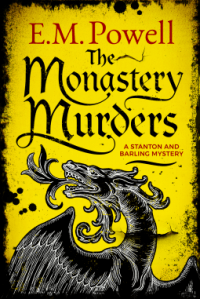 The Monastery Murders (Stanton & Barling #2) by E. M. Powell (ebook, courtesy of Historical Fiction Virtual Book Tours)
Their lives are ones of quiet contemplation—and brutal murder.
Christmas Eve, 1176 – Brother Maurice, monk of Fairmore Abbey, awaits the night prayer bell. But there is only silence. Cursing his fellow brother Cuthbert’s idleness, he seeks him out – and in the darkness, finds him brutally murdered.
Summoned from London to the isolated monastery on the Yorkshire Moors, Aelred Barling, clerk to the King’s justices, and his messenger, Hugo Stanton, set about investigating the horrific crime. They quickly discover that this is far from a quiet monastic house. Instead, it seethes with bitter feuds, rivalries and resentments. But no sooner do they arrive than the killer strikes again – and again.
When Barling discovers a pattern to these atrocities, it becomes apparent that the murderer’s rampage is far from over. With everyone, including the investigators, now fearing for their lives, can Barling and Stanton unmask the culprit before more blood is spilled?
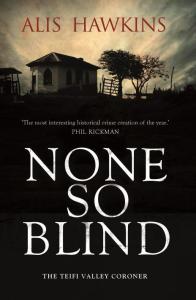 None So Blind (The Teifi Valley Coroner) by Alis Hawkins (ARC, courtesy of The Dome Press)
West Wales, 1850 – When an old tree root is dug up, the remains of a young woman are found. Harry Probert-Lloyd, a young barrister forced home from London by encroaching blindness, has been dreading this discovery.
He knows exactly whose bones they are.
Working with his clerk, John Davies, Harry is determined to expose the guilty, but the investigation turns up more questions than answers.
The search for the truth will prove costly. Will Harry and John be the ones to pay the highest price? (Review to follow 22nd November)
What Cathy (will) Read Next
 So Much Life Left Over by Louis de Bernières (hardcover)
A sweeping, heartbreaking novel following Daniel in his troubled marriage with Rosie as they navigate the unsettled time between the World Wars.
Rosie and Daniel have moved to Ceylon with their little daughter to start a new life at the dawn of the 1920s, attempting to put the trauma of the First World War behind them, and to rekindle a marriage that gets colder every day. However, even in the lush plantation hills it is hard for them to escape the ties of home and the yearning for fulfilment that threatens their marriage.
Back in England, Rosie’s three sisters are dealing with different challenges in their searches for family, purpose and happiness. These are precarious times, and they find themselves using unconventional means to achieve their desires. Around them the world is changing, and when Daniel finds himself in Germany he witnesses events taking a dark and forbidding turn.
By turns humorous and tragic, gripping and touching, So Much Life Left Over follows a cast of unique and captivating characters as they navigate the extraordinary interwar years both in England and abroad.
 A Light of Her Own by Carrie Callaghan (ebook, courtesy of Historical Fiction Virtual Book Tours)
In Holland 1633, a woman’s ambition has no place.
Judith is a painter, dodging the law and whispers of murder to try to become the first woman admitted to the Haarlem painters guild. Maria is a Catholic in a country where the faith is banned, hoping to absolve her sins by recovering a lost saint’s relic.
Both women’s destinies will be shaped by their ambitions, running counter to the city’s most powerful men, whose own plans spell disaster. A vivid portrait of a remarkable artist, A Light of Her Own is a richly-woven story of grit against the backdrop of Rembrandt and an uncompromising religion.

 How time flies because it’s time for another Classics Club spin. And not just any old spin but ‘an extra special, super-dooper CHUNKSTER edition’! This time, the wonderful people who run
 What Cathy Read Next...