About the Book
The Last Secrets is a detailed record of some of the main explorative achievements of the first two decades of the twentieth century and a fascinating glimpse into one the most exciting epochs for exploration.
Format: Hardcover (306 pages) Publisher: Thomas Nelson & Sons
Publication date: January 1937 [1923] Genre: NonFiction
Find The Last Secrets on Goodreads
My Review
My Buchan of the Month for May was The Last Secrets which was published in September 1923 by Nelson. My edition of the book is from 1937.
Subtitled ‘The Final Mysteries of Exploration’, The Last Secrets contains eight accounts of recently achieved feats of exploration. These include the first entry by outsiders to the previously hidden Tibetan city of Lhasa and the exploration of the inaccessible Ruwenzori mountain range in east Africa which had come to be identified as the legendary Mountains of the Moon. Buchan describes the latter as having “no fellows on the globe” and as “extravagances of Nature, moulded without regard to human needs.” There are moments of wry humour such as in the account of the 1910 expedition to the interior of New Guinea led by Cecil Rawling (more of whom later). Forced to rely on surplus stores from Shackleton’s Antarctic expedition, Buchan recounts how Rawling’s party experienced “the joys of bully-beef, pea-soup, and pickles under an equatorial sky”.
Buchan observes that early exploits were as much about finding trade routes and territorial acquisition as about geographical discovery for its own sake. He regrets what he sees as the tendency to once again prioritize the former over the latter. “The factors which have helped to make the modern world are mainly a desire for fame, a desire for knowledge, and a desire for riches; and woe betide the nation that forgets the first and second of these factors, and loses its soul in concentration upon the last of them.”
 As I was reading the book, I found myself making connections between some of the stories and later novels by John Buchan. For example, the chapter detailing the first attempts to reach the North Pole brought to mind an early part of A Prince of the Captivity in which its hero sets out on a rescue mission to Iceland during a freezing winter. Incidentally, the chapter on the North Pole also refers to the efforts to discover the fate of the explorer Sir John Franklin who disappeared along with his two ships and their crew while on his last expedition to the Arctic in 1845. This forms part of the storyline of a book I recently read, The Canary Keeper by Clare Carson.
The chapter ‘The Holy Cities of Islam’, in which a Mr Wavell travels in disguise to Mecca and Medina, seemed like something out of Buchan’s Greenmantle. Indeed at one point, noting Wavell’s careful prior study of Muslim customs, Buchan observes, “It is on such small things that the efficacy of a disguise depends”; words that could surely have come from the lips of that master of different identities, Sandy Arbuthnot.
Unsurprisingly, the chapter devoted to the ill-fated attempts by Sir Ernest Shackleton, Captain Scott and others to reach the South Pole is the longest in the book. Buchan goes out of his way to acknowledge the achievement of the Norwegian Amundsen in being the first to reach the South Pole, beating Scott and his team by only a few days.
The ninth and final chapter of the book details the attempts by Mallory and others to reach the summit of Everest, a feat that was still be achieved at the time Buchan was writing and which, sadly, he never lived to see. It’s no surprise that Buchan included the attempted conquest of Mount Everest in the book.
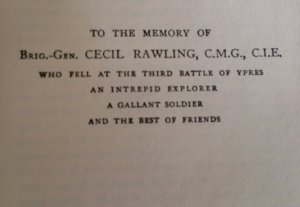 As I noted in my earlier post about the book, an expedition to Everest was one of John Buchan’s “cherished pipe-dreams”. He and Cecil Rawling, a friend of Buchan’s brother, Willie, had been planning an expedition to Everest but the outbreak of the First World War and Rawling’s own death in 1917 put an end to the plans, as did Buchan’s poor health once the war ended. The Last Secrets is dedicated to Cecil Rawling.
The Last Secrets is full of detail and clearly the product of much careful research. However, there are a couple of references to native peoples that represent very outdated and rather paternalistic points of view. Having said that, Buchan was an early supporter of the call for Mt. McKinley to revert to its original name of Denali. This finally happened only in 2015.
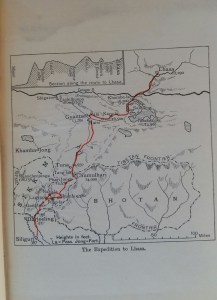 Despite the amount of detail, the book is immensely readable thanks to Buchan’s clear prose and obvious enthusiasm for his subject. There are wonderful and extremely helpful maps accompanying each chapter.
Clearly Buchan believed there was an intrinsic virtue and heroism associated with feats of exploration, observing, “A nation which is without its heroes is in a sad plight”. Indeed.
My Buchan of the Month for June is Homilies and Recreations, a collection of essays published in 1926. Look out for my blog post next week introducing the book and for my review later this month.
In three words: Detailed, well-researched, informative
Try something similar: A Book of Escapes and Hurried Journeys by John Buchan
Follow my blog via Bloglovin
 About the Author
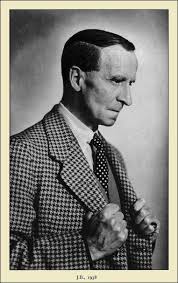
John Buchan (1875 – 1940) was an author, poet, lawyer, publisher, journalist, war correspondent, Member of Parliament, University Chancellor, keen angler and family man. He was ennobled and, as Lord Tweedsmuir, became Governor-General of Canada. In this role, he signed Canada’s entry into the Second World War. Nowadays he is probably best known – maybe only known – as the author of The Thirty-Nine Steps. However, in his lifetime he published over 100 books: fiction, poetry, short stories, biographies, memoirs and history.
You can find out more about John Buchan, his life and literary output by visiting The John Buchan Society website.

 When Are You Reading? 2020
 20 Books of Summer 2020
 What’s In A Name? 2020
 Buchan of the Month Reading Project

 What Cathy Read Next...