
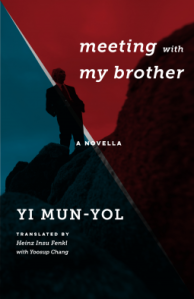
Review: Meeting with my Brother by Yi Mun-yol

meeting

Autobiographical account of the impact on one family of a divided nation

Publisher’s description: A sobering yet hopeful depiction of the volatile relationship between the divided Koreas. Yi, the narrator, is a South Korean university professor searching for his father who defected to the North at the outbreak of war. Instead he finds his half-brother and their tense meeting takes a surprising turn. This semi-autobiographical account upends the West’s assumptions about North Korean life.

My Review

This is my first experience of Korean literature and, although a slim volume, I found it quite a challenging read as it contains a great deal of detail about the history and politics of Korea, notably the separation of North and South Korea and prospects for reunification. There are a lot of allegorical features with characters representing particular aspects of ideological thought, such as Mr Reunification. Similarly the two brothers really represent the two parts of the divided nation. Only a small portion of the book covers the narrator’s meeting with his half-brother and, for me, these were the most successful aspects of the book with some interesting details of Korean tradition and rituals. The other parts I found quite dry. At times I felt the book verged on political essay rather than novel. What does comes across from the two brothers’ sharing of their experiences is that the people of each part of the divided Korea have suffered as a consequence of war, retribution (the law of “guilt by association”) and economic collapse. Ultimately, grief over their father’s death and this commonality of experience brings (albeit limited) reconciliation between the divided families.

I received an advance review copy courtesy of NetGalley and Columbia University Press.

Book facts: Publication date 4th April 2017, translated by Heinz Insu Fenkl with Yoosup Chang

My rating: 3 (out of 5)

In three words: Didactic, autobiographical, informative

About the Author

Yi Mun-yol was born in Seoul, South Korea in 1948 but the outbreak of the Korean War and his father’s defection to North Korea forced his family to move about until they settled in Yeongyang, his family’s ancestral seat.  He has written several novels and more than fifty novellas and short stories.

Book Review: The Executioner Weeps by Frederic Dard

executioner

How far would you go to protect the person you love?

About the Book

Publisher description: On a quiet mountain road near Barcelona, a woman steps out in front of a car. When the driver, well-known French artist Daniel Mermet, stops to come to her aid, he finds she is alive but without any memory of who she is or where she has come from. As he tries to help her remember her past, Daniel finds himself falling in love. Then secrets from the woman’s forgotten life start to come to light and he finds his new romance turning into a nightmare…


My Review

First published in 1956, The Executioner Weeps is a psychological thriller that poses the question: how far would you go to protect the person you love? When Daniel encounters the unknown woman, he is drawn both to her beauty and, in a strange way, to the fact that she remembers nothing of her past. In fact he contends: ‘I was living the dream that all men have: of loving woman without a past. A woman to whom we represent a new start’. In contradiction is his assertion that ‘There’s nothing more terrifying for a painter than a blank white canvas. It’s like a window that opens onto infinite possibilities. A window from which the most disturbing metamorphoses may emerge.’

This is the first of many links between the act of creating art and the uncovering of the mystery woman’s identity. Significantly, it is in the act of painting the woman that Daniel gets the first sense of something dark behind the attraction of her beauty and grace.

‘I had succeeded in capturing [her] most unguarded expression so well that I could read her character better in my painting than in her face. Now…I detected a bizarre glint [in her eye] which quite disconcerted me.’

Later he reflects that ‘It was strange how my artistic eye unconsciously picked out what had escaped my plain man’s eye.’

When Daniel starts to detect hints about the woman’s past and more worryingly, her memory shows signs of returning, he feels compelled to find out where she came from and how she came to be on the road on the night of their encounter. What he discovers will draw him into a ‘macabre vortex’ and a web of deceit that will have tragic consequences. You may never want to open a door in an empty house again!

I really enjoyed this dark, noir-ish thriller and introduction to the work of Frederic Dard.

I received an advance review copy courtesy of NetGalley and publishers, Pushkin Vertigo, in return for an honest review.


Book facts: 192 pages, publication date 28th March 2017, translated by David Coward

My rating: 5 (out of 5)

In three words: Psychological, taut, stylish

Try something similar…The Blue Room by George Simenon


About the Author

Frédéric Dard (born 29 June 1921, died 6 June 2000) was a prolific French writer primarily known for his crime novels featuring Detective Superintendent San-Antonio, who appeared in a hundred and seventy-five adventures. Using a number of pseudonyms, Dard also wrote psychological “novels of the night”, newspaper articles, plays and screenplays. He was a close friend of Georges Simenon. In accordance with his last wishes, Frédéric Dard was buried in the cemetery of Saint-Chef, in Isère, the village where he spent his childhood.