Buchan of the Month: Introducing…Greenmantle

Buchan of the Month

Greenmantle is the fourth book in my John Buchan reading project, Buchan of the Month. To find out more about the project and my reading list for 2018, click here.  If you would like to read along with me you will be very welcome – leave a comment on this post or on my original challenge post.
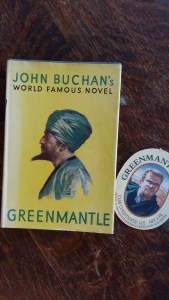
GreenmantleWhat follows is an introduction to the book (no spoilers!).  It is also an excuse to show off a picture of my 1950 Hodder & Stoughton edition of Greenmantle complete with dust jacket.  I will be posting my review of the book later in the month.

Although Buchan did not see active military service in World War One, he visited the Western Front on a number of occasions.  In May 1915 he was there as a special correspondent for The Times and in October the same year, this time in uniform, as a Lieutenant in the Intelligence Corps.  In June 1916 he was appointed Director of the Department of Information.   In between, during the first half of 1916, he worked on Greenmantle, his second novel featuring the character Richard Hannay.
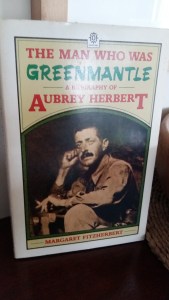
The Man Who Was GreenmantleCharacters and events in Greenmantle draw strongly on real life events.  For example, the character of Sandy Arbuthnot was inspired by Aubrey Herbert.  In her book The Man Who Was Greenmantle, Margaret FitzHerbert reports that, on learning of Herbert’s death in 1923, Buchan wrote to a friend “I drew Sandy in Greenmantle from him”.  Aubrey Herbert’s wife had recognised the similarity when Greenmantle first appeared in 1916, noting “I must confess I prefer my Aubrey to his Sandy but I daresay it’s like him.”  She sent a copy of Buchan’s book to Herbert, who was in Salonika at the time.  Reportedly his only comment was “He brings in my nerves all right doesn’t he?”

The plot of Greenmantle involves the uncovering of a German plot to incite an Islamic uprising in the Middle East that will cause Britain and its allies to divert troops from the Western Front.  The action moves from wartime Germany, through Europe to Constantinople as Hannay and his comrades seek to disrupt the plot.  The book features a cryptic code, plenty of disguises, narrow escapes, a bit of homoeroticism and a formidable female character.

Like Buchan’s earlier adventure stories, Greenmantle first appeared in instalment form.  It was serialised weekly in Land and Water magazine between 6th July and 9th November 1916.  Originally a magazine about sporting country life, in 1914 Land and Water switched its coverage to World War One under the editorship of Hilaire Belloc.

Greenmantle was published in novel form by Hodder & Stoughton on 26th October 2016.  Priced at six shillings, by the following March it had sold 34,000 copies.  Buchan’s biographer, Janet Adam Smith, reports that by 1960 combined sales of the Nelson and Hodder & Stoughton editions had reached 368,000, meaning that Greenmantle actually outsold its now more famous predecessor, The Thirty-Nine Steps.  Furthermore, the Pan paperback edition of Greenmantle published in 1952 had sold 200,000 copies by 1965.  Buchan’s advance for Greenmantle was £200 so, even taking into account royalties, Buchan’s publishers got a good deal.

David Daniell, author of The Interpreter’s House: A Critical Assessment of the Works of John Buchan, puts Greenmantle up alongside Mr Standfast as one of Buchan’s greatest books.  However, Daniell admits that one reviewer called Greenmantle ‘a daft sort of book’ that was ‘about two parts mad, but the third part was uncommonly like inspiration’.  I leave you, dear reader, to decide which of them is right.

Sources:

David Daniell, The Interpreter’s House: A Critical Assessment of the Work of John Buchan (Nelson, 1975)
Kate Macdonald, John Buchan: A Companion to the Mystery Fiction (McFarland, 2009)
Janet Adam Smith, John Buchan: A Biography (OUP, 1985 [1965])
Margaret FitzHerbert, The Man Who Was Greenmantle: A Biography of Aubrey Herbert by (OUP, 1985)


Buchan of the Month: Mr. Standfast by John Buchan

Buchan of the Month

JohnBuchanThrillersAbout the Book

“First we must go through the Valley of the Shadow…And there is the sacrifice to be made…the best of us.”

It is 1917 and Richard Hannay is brought out of the battlefield to perform the desperate task of tracking down and destroying a network of German spies.  Hannay’s opponent is Moxon Ivery, the bland master of disguise, who seeks to outwit Hannay and he and his agents are pursued through England, Scotland, France and Switzerland.

For its pace and suspense, its changes of scene, and thrilling descriptions of the last great battles against the Germans, Mr Standfast offers everything that has made its author so enduringly popular.

Format: Paperback (354 pp.)        Publisher: Oxford University Press
Published: 1993 [1919]                  Genre: Thriller, Adventure

Purchase Links*
Amazon.co.uk  ǀ  Amazon.com  ǀ Hive.co.uk (supporting UK bookshops)
*links provided for convenience, not as part of any affiliate programme

 Find Mr. Standfast on Goodreads


My Review

Mr. Standfast is the third book in my Buchan of the Month reading project.  For a spoiler-free introduction to Mr. Standfast, including details of its first publication and context, click here.  To find out more about the project and my reading list for 2018, click here.

Before I say any more, I’ll confess that Mr. Standfast is a book I’ve read many times before and it happens to be one of my favorite Buchan books (alongside Sick Heart River, which I shall be reading later this year).  For me, it has everything: a mystery, some thrilling set pieces, great characters, numerous locations, a touch of romance and some chilling scenes on the battlefields of World War One France.  I always get a bit tearful at the end.  As well as being a very entertaining book, Mr. Standfast explores some serious themes – courage, fortitude, sacrifice.

Since the title refers to one of the characters in John Bunyan’s The Pilgrim’s Progress, it’s probably no surprise that Mr. Standfast has a number of allusions and references to Bunyan’s work.  The Pilgrim’s Progress was an important text for Buchan and it informs many of the themes in Mr. Standfast mentioned above.  Full disclosure: my dissertation for my MA in English from The Open University was on the subject of the influence of The Pilgrim’s Progress on John Buchan’s books.  Don’t worry, I’m not going to test your patience by quoting from it extensively.  However, just a few thoughts on the connections between the two texts…

In his autobiography Memory-Hold-The-Door, Buchan attributes his regard for The Pilgrim’s Progress to ‘its picture of life as a pilgrimage over hill and dale, where surprising adventures lurked by the wayside, a hard road with now and then long views to cheer the traveller and a great brightness at the end of it’.   The reference to the journey being ‘over hills and dales’ acknowledges that life brings moments of difficulty and challenge as well as ease, involving either physical or mental effort. The  journey features ‘surprising adventures’ – the use of the word ‘adventures’ rather than ‘experiences’ suggesting that these will be exciting episodes – but these ‘lurk’ by the wayside.  There is a sense of the unexpected, of danger in the choice of the word ‘lurk’.  All of these elements I feel are apparent in Mr. Standfast.

As well as having thematic influences, The Pilgrim’s Progress, as a physical object, plays a role in Mr. Standfast.  It acts variously as a prize, a code-book and a source of moral comfort.

For example, The Pilgrim’s Progress is one of Peter Pienaar’s few cherished possessions; with the Bible, it acts as a source of comfort during his captivity in a German prisoner-of-war camp.  Pienaar, one of the most endearing characters in Mr. Standfast, is described as ‘puzzling over it’, using it as one of his ‘chief aids in reflection’ and for ‘self-examination’.  Peter searches The Pilgrim’s Progress for examples that he can apply to his own predicament.  Charmingly, Peter takes everything in The Pilgrim’s Progress literally and talks about the character Mr. Standfast ‘as if he were a friend’.  Arguably, Peter’s identification with the characters in The Pilgrim’s Progress in part inspires his actions at the end of the book.

For Richard Hannay, The Pilgrim’s Progress has a more practical and utilitarian function; he describes it as one of his ‘working tools’.  For example, it alerts Hannay to the fact that someone has searched his belongings as he observes ‘a receipted bill which I had stuck in The Pilgrim’s Progress to mark my place had been moved’.  Later, it provides a method of authenticating the character Hannay has adopted (he likes his disguises!).  Producing his copy of The Pilgrim’s Progress to the old postmistress of a Highland village, it creates a shared cultural connection between them as she comments, ‘I got it for a prize in the Sabbath School when I was a lassie’.

One of the most notable roles for The Pilgrim’s Progress in Mr. Standfast is as a means of communication between Hannay and his comrades.  This discourse operates at two levels: as a common language to express feelings, anxieties and hopes and, at a practical level, as a code for secret communications between the characters.  In particular, The Pilgrim’s Progress becomes a key part of the burgeoning relationship between Mary Lamington and Hannay.   At one point, Hannay sends a message of reassurance for Mary: ‘If you see Miss Lamington you can tell her I’m past the Hill Difficulty.  I’m coming back as soon as God will let me’.

There is a lot more I could say on the links between the two texts but I’ll just close by saying that Mr. Standfast is a great story even if you have no knowledge of The Pilgrim’s Porogress.  If, however, you are familiar with Bunyan’s work, you’ll have fun spotting other references and allusions.  I think Mr. Standfast is the best of Buchan’s Richard Hannay adventures and one of the finest books he wrote.

Follow my blog with Bloglovin

In three words: Thrilling, action-packed, moving


John BuchanAbout the Author

John Buchan (1875 – 1940) was an author, poet, lawyer, publisher, journalist, war correspondent, Member of Parliament, University Chancellor, keen angler and family man.  He was ennobled and, as Lord Tweedsmuir, became Governor-General of Canada.  In this role, he signed Canada’s entry into the Second World War.   Nowadays he is probably best known – maybe only known – as the author of The Thirty-Nine Steps.  However, in his lifetime he published over 100 books: fiction, poetry, short stories, biographies, memoirs and history.

You can find out more about John Buchan, his life and literary output by visiting The John Buchan Society website.