Buchan of the Month: Introducing…The Half-Hearted

Buchan of the Month

The Half-Hearted is the sixth book in my John Buchan reading project, Buchan of the Month. You can find out more about the project and my reading list for 2018 here.  If you would like to read along with me you will be very welcome – leave a comment on this post or on my original challenge post.

What follows is an introduction to the book (no spoilers!).  It is also an excuse to show off a picture of my (undated) Hodder & Stoughton edition of The Half-Hearted (without dust jacket unfortunately).  I will be posting my review of the book later in the month.
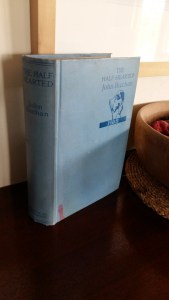

The HalfheartedThe Half-Hearted was written in 1899 and published in September 1900 by Isbister & Co Ltd. However, it had first appeared in serial form (in thirty-three parts) earlier that year in Good Words, a magazine also published by Isbister.  Hodder & Stoughton published a new edition of The Half-Hearted in 1920.

Buchan’s first contemporary novel, The Half-Hearted is dedicated to his friends, Raymond Asquith, Harold Baker and Cuthbert Medd.  Buchan’s first biographer, Janet Adam-Smith, believes its hero, Lewis Haystoun, owes much to Raymond Asquith.  The book features a very current issue in foreign affairs at the time, the so-called Great Game being played out between Britain and Russia in Central Asia and, in particular, the North-West Frontier of India (also the subject of Rudyard Kipling’s Kim).

In Lewis Haystoun, Buchan explores the idea that a life of easy pleasure may result in a man becoming ‘morally soft’.  As Lewis sets off into dangerous territory he feels, ‘At last he had found a man’s work.  He has never had a chance before.  Life had been too easy and sheltered; he had been coddled like a child; he had never really roughed it except for his own pleasure.  Now he was outside this backbone of the world with a task before him, and only his wits for his servant.’  It’s probable these were close to Buchan’s own views.

David Daniell describes The Half-Hearted as ‘an interestingly uneven novel’ and as A Lost Lady of Old Years ‘brought up to the present and turned upside-down and inside-out’.  (You can read my review of A Lost Lady of Old Years here.)  However, Daniell does admit that there are some ‘marvellous things’ in The Half-Hearted.  Why not join me in reading The Half-Hearted and see what you can find that is marvellous.  The book is also one of my #20BooksofSummer.

Sources:

David Daniell, The Interpreter’s House: A Critical Assessment of the Work of John Buchan (Nelson, 1975), pp.75-78
Janet Adam Smith, John Buchan: A Biography (OUP, 1985 [1965]), pp.98- 101

Buchan of the Month: A Lost Lady of Old Years by John Buchan


Buchan of the Month

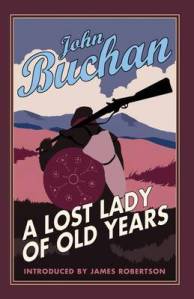
A Lost Lady of Old YearsAbout the Book

Set in Scotland in 1745, during the Jacobite Rebellion, this dark story of loyalty and betrayal on the road to Culloden Moor recounts the adventures of Francis Birkenshaw.

The Jacobite cause means nothing to him until a chance meeting with the beautiful Margaret Murray presents an opportunity for profit and adventure.

The fateful encounter marks the beginning of Francis’s involvement with John Murray of Broughton, an infamous traitor and turncoat.

Format: Paperback, ebook (224 pp.)    Publisher: Polygon
Published: 25 August 2012 [1899]        Genre: Historical Fiction

Purchase Links*
Amazon.co.uk  ǀ  Amazon.com  ǀ Hive.co.uk (supporting UK bookshops)
*links provided for convenience, not as part of any affiliate programme

Find A Lost Lady of Old Years on Goodreads


My Review

A Lost Lady of Old Years is the fifth book in my Buchan of the Month reading project.  You can find out more about the project plus my reading list for 2018 here.  It is one of the few books by John Buchan I’ve not read before.  I’m going to preface this review by stating that, in my opinion, A Lost Lady of Old Years is not the best book John Buchan ever wrote although, to be fair, it was published early in his writing career.  You can read a spoiler-free introduction to the book here.

Buchan paints a picture of a young man, Francis Birkenshaw, the son of a good family, who nevertheless finds himself unsure of his place in the world.  He falls prey to the lure of alcohol, women and the odd spot of fisticuffs in the local taverns.  His desire for adventure brings him close to the borders of criminality resulting in him having to make a speedy escape from his hometown, leaving behind the staid career that had been mapped out for him.

He decides to travel to France but events intervene, notably his meeting with the beautiful and virtuous Margaret Murray, wife of John Murray of Broughton, an influential supported of ‘Bonnie’ Prince Charlie.  Entrusted with an important task by Mrs Murray, he has a kind of epiphany inspired by her honour and virtue and begins to seek a different path in life.  Carrying out the task he has been entrusted with and what follows bring him in close proximity to influential people and dramatic events in Scottish history, such as the Battle of Culloden.

In the book’s dialogue, Buchan seeks to reproduce the Scottish mode of speech, including  local dialect words (‘kenspeckle’, ‘camsteery’ or ‘clanjamphray’ anyone?) with a bit of Gaelic thrown in for good measure.  This takes some getting used to and might prove problematic for some readers.  I think it would also help to have some prior knowledge of the history of that period, particularly the Jacobite Rebellion.  Mine was only sketchy so I did have to do some research after reading the book to check how close the story sticks to historical fact.  (As far as the main characters go – John Murray of Broughton, Lord Lovat, etc – the answer is pretty close, although Francis Birkenshaw is an entirely fictional character.)

In A Lost Lady of Old Years, Buchan explores themes that he would revisit in later books such as The Half-Hearted (next month’s Buchan of the Month), Mr. Standfast and Sick Heart River.  These themes of self-sacrifice, duty and courage we can perhaps trace back to his upbringing and the text that was so influential throughout his life, John Bunyan’s The Pilgrim’s Progress.  At the end of the book, both Francis and Margaret face a difficult moral choice between following their hearts or their consciences.  Choice made, Margaret reflects, ‘After the colours the sober grey, for you as well as me, Francis.’  Buchan would later revisit this period of history in his novel, Midwinter.

Follow my blog with Bloglovin

In three words: Dramatic, romantic, historical

Try something similar…Midwinter by John Buchan


John BuchanAbout the Author

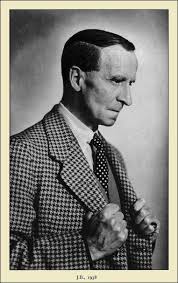
John Buchan (1875 – 1940) was an author, poet, lawyer, publisher, journalist, war correspondent, Member of Parliament, University Chancellor, keen angler and family man.  He was ennobled and, as Lord Tweedsmuir, became Governor-General of Canada.  In this role, he signed Canada’s entry into the Second World War.   Nowadays he is probably best known – maybe only known – as the author of The Thirty-Nine Steps.  However, in his lifetime he published over 100 books: fiction, poetry, short stories, biographies, memoirs and history.

You can find out more about John Buchan, his life and literary output by visiting The John Buchan Society website.