
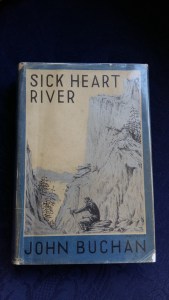
 About the Book
Lawyer and MP Sir Edward Leithen is given a year to live. Fearing he will die unfulfilled, he devotes his last months to seeking out and restoring to health Galliard, a young Canadian banker. Galliard is in remotest Canada searching for the ‘River of the Sick Heart’. Braving an Arctic winter, Leithen finds the banker and then his own health returns, yet only one of the men will return to civilization ….
Format: Hardcover (318 pp.) Publisher: Hodder & Stoughton
Published: March 1941 Genre: Fiction
Purchase Links*
Amazon.co.uk ǀ Amazon.com ǀ Hive.co.uk (supporting UK bookshops)
*links provided for convenience, not as part of any affiliate programme
Find Sick Heart River on Goodreads
My Review
Sick Heart River is the final book in my Buchan of the Month reading project (for 2018). (Buchan of the Month will return in 2019 with a new selection of books by John Buchan, both fiction and non-fiction.) It happens to be one of my favourite of his novels (along with Mr. Standfast).
Sick Heart River was Buchan’s last novel. In fact, he finished it only a fortnight before his death and it was published posthumously. Although Buchan cannot have known his own death was so close, there is definitely an elegiac quality to the book. Whilst writing Sick Heart River, Buchan had been completing his autobiography, Memory Hold-the-Door. Perhaps the process of recalling the experiences of earlier days, the loss of old friends and taking stock contributed to the reflective, meditative sense the reader gets from Sick Heart River.
Diagnosed with tuberculosis, a legacy of his experiences in the First World War, and with no prospect of recovery, Sir Edward Leithen seeks a way to give purpose to the last few months of his life. When the task of finding Francis Galliard comes his way, via a mutual friend, initially he has no particular interest on a personal level in the object of his search. Leithen undertakes the task purely to prevent himself lapsing into self-pity or suffering the slow demise he fears. As he tells Galliard later: ‘I wasn’t interested in you – I didn’t want to do a kindness to anybody – I wanted something that would keep me on my feet until I died. It wouldn’t have mattered if I had never heard the name of any of the people concerned. I was thinking only of myself, and the job suited me.’
Buchan is always good at descriptions of landscape and in the book he captures the harsh beauty of the landscape of northern Canada. However, he shows that what seems beautiful can also be deadly: ‘Leithen brooded over that mysterious thing, the North. A part of the globe which had no care for human life, which was not built to man’s scale, a remnant of that Ice Age which long ago had withered the earth.’ The reader witnesses Leithen’s desperate struggle to survive a Canadian winter alongside his companions – the Frizel brothers, Johnny and Lew, and their Hare Indian guides.
One of Buchan’s favourite texts, The Pilgrim’s Progress by John Bunyan, makes an appearance in the book, as it did in Mr. Standfast. However, in this case, The Pilgrim’s Progress is not the benign instrument that assists Richard Hannay to achieve his mission, help him uncover mysteries and reveal insights, as it does in Mr Standfast. In Sick Heart River, it leads to a journey that risks the lives of Leithen and his companions. Lew Frizel, casting himself in the role of Christian in The Pilgrim’s Progress, initially believes the Sick Heart River to be ‘the River of the Water of Life, same as in Revelation’ where all his sins will be washed away. However, Lew’s quest to find the Sick Heart River is shown to be a false pilgrimage, a chimera. The Sick Heart River is not, as he imagined, the equivalent of the Land of Beulah or a gateway to Heaven but, as he tells Leithen, ‘the Byroad-to Hell, same as in Bunyan’.
The book explores some familiar themes of Buchan’s novels: fortitude, self-sacrifice, the link between bodily and spiritual health, the spirit of place, and the importance of being in touch with and true to your roots. As Sick Heart River reaches its conclusion, the world has once more been plunged into the calamity of another war. Remembering his experiences in the First World War, Leithen reflects, ‘It had been waste, futile waste, and death, illimitable, futile death. Now the same devilment was unloosed again’. (One of Buchan’s final acts as Governor General of Canada had been to authorise Canada’s declaration of war against Germany in September 1939.)
At the end of Sick Heart River, in an act of epic self-sacrifice and knowing the likely outcome, Leithen takes command of a task that will prove to be his final battle. As always, the book’s ending leaves me slightly teary.
In three words: Elegaic, moving, uplifting
Try something similar…A Prince of the Captivity by John Buchan
 About the Author
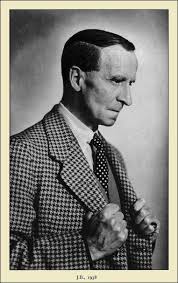
John Buchan (1875 – 1940) was an author, poet, lawyer, publisher, journalist, war correspondent, Member of Parliament, University Chancellor, keen angler and family man. He was ennobled and, as Lord Tweedsmuir, became Governor-General of Canada. In this role, he signed Canada’s entry into the Second World War. Nowadays he is probably best known – maybe only known – as the author of The Thirty-Nine Steps. However, in his lifetime he published over 100 books: fiction, poetry, short stories, biographies, memoirs and history.
You can find out more about John Buchan, his life and literary output by visiting The John Buchan Society website.


 What Cathy Read Next...