
 Top Ten Tuesday is a weekly meme created by The Broke and the Bookish and now hosted by Jana at That Artsy Reader Girl.
The rules are simple:
- Each Tuesday, Jana assigns a new topic. Create your own Top Ten list that fits that topic – putting your unique spin on it if you want.
- Everyone is welcome to join but please link back to The Artsy Reader Girl in your own Top Ten Tuesday post.
- Add your name to the Linky widget on that day’s post so that everyone can check out other bloggers’ lists.
- Or if you don’t have a blog, just post your answers as a comment.
This week’s topic is Inspirational/Thought-Provoking Book Quotes. As a John Buchan nerd, I couldn’t resist the opportunity to construct my list from some of his many books, fiction and non-fiction.
“A man may be tired of the country, but when he is tired of London he is tired of life.” Samuel Johnson in Midwinter
“Of all the good gifts of a beneficent Providence to men…I think that none excels a well-appointed inn.” Samuel Johnson in Midwinter
“[…]the true task of leadership is not to put greatness into humanity, but to elicit it, for the greatness is already there.” The King’s Grace
“A fool tries to look different: a clever man looks the same and is different.” Richard Hannay in The Thirty-Nine Steps
“Every man at the bottom of his heart believes that he is a born detective.” Edward Leithen in The Power-House
“To live for a time close to great minds is the best kind of education.” Memory Hold-The-Door
“I have been happy in many things, but all my other good fortune has been as dust in the balance compared with the blessing of an incomparable wife.” Memory Hold-the-Door
“It’s a great life, if you don’t weaken.” Mr. Standfast
“You think that a wall as solid as the earth separates civilisation from barbarism. I tell you the division is a thread, a sheet of glass.” Andrew Lumley in The Power-House
“He had never been lonely in his life before he met her, having at the worst found good company in himself; but now he longed for a companion, and out of all the many millions of the earth’s inhabitants there was only one that he wanted.” Jaikie in The House of the Four Winds


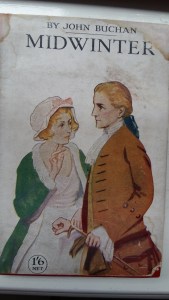 What follows is an introduction to Midwinter. It is also an excuse to show a picture of my Nelson edition of the book with its charming dust jacket. I will be posting my review of the book later in the month.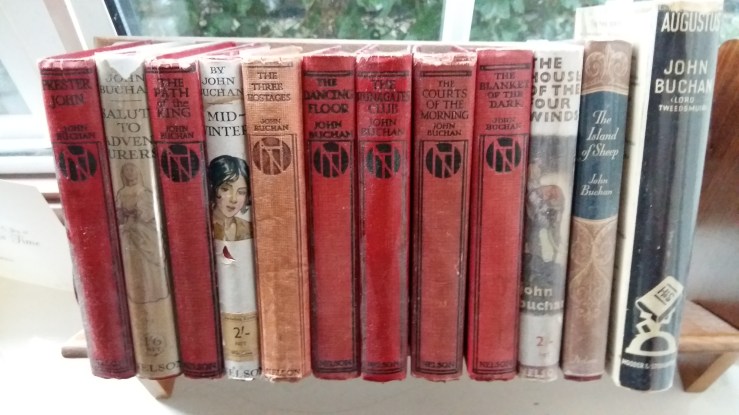

 What Cathy Read Next...