Buchan of the Month: Introducing The Three Hostages by John Buchan

buchan of the month 2019 poster

The Three Hostages is the fifth book in my John Buchan reading project, Buchan of the Month 2019.   You can find out more about the project and the books I read in 2018 here, and view my reading list for 2019 here.

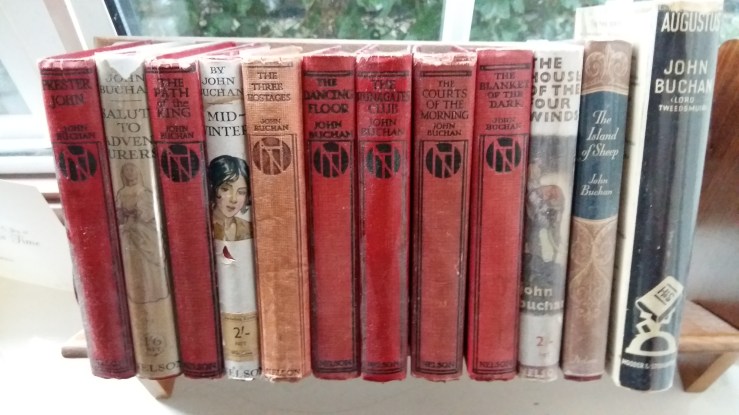
20190510_130630-1What follows is a (spoiler-free) introduction to The Three Hostages.  It is also an excuse to show my three different copies of the book: the original Hodder & Stoughton edition (sadly without dust jacket), the undated but later Nelson edition and the 1930 omnibus edition, The Four Adventures of Richard Hannay*, with its gorgeous dust jacket.  I will be publishing my review of the book later in the month.

* there would later be a fifth Hannay story, The Island of Sheep

As with earlier Buchan novels, The Three Hostages first appeared in serial form in the UK, in The London Graphic between 5th April and 9th August 1924, immediately before its publication by Hodder & Stoughton on 12th August 1924. In the United States it was serialized in Argosy All-Story Weekly before being published on 1st August 1924 by Houghton Mifflin, who had recently taken over as Buchan’s American publishers.

Like last month’s Buchan of the Month, Midwinter, The Three Hostages was written at Elsfield Manor, the country house in Oxfordshire John Buchan had purchased in 1919 as his family home.  His first biographer, Janet Adam Smith, notes that Buchan recorded in his journal that The Three Hostages was finished in May 1923. It was the latest example of the now annual ‘new Buchan’ the public had come to expect for their summer holiday reading.

The first Hannay adventure set after the First World War, Janet Adam Smith argues that The Three Hostages ‘plays on widespread post-war fears and uncertainties, the concern at the shattering of old regimes, at the fragility of the new’. David Daniell sees it as a ‘contest of wits’ between Richard Hannay, plucked from his idyllic life at Fosse Manor (clearly a double for Elsfield) and an antagonist whom Daniell describes as Buchan’s ‘most Luciferian villain’.

Like his other adventure stories (or as Buchan termed them, his ‘shockers’) The Three Hostages enjoyed considerable commercial success.  Janet Adam Smith reports that in the UK it sold just under 30,000 copies in its first year after publication and had combined sales by 1960 (for the Hodder & Stoughton edition and the later Nelson edition) of 216,000 copies.  A further 175,000 copies of the Penguin paperback edition were sold between 1956 and 1964.

Sources:

David Daniell, The Interpreter’s House: A Critical Assessment of the Work of John Buchan (Nelson, 1975)

Janet Adam Smith, John Buchan: A Biography (OUP, 1985 [1965])

Kenneth Hillier and Michael Ross, The First Editions of John Buchan: A Collector’s Illustrated Biography (Avonworld, 2008)
buchan of the month 2019

Buchan of the Month/Book Review: Midwinter by John Buchan

buchan of the month 2019 poster

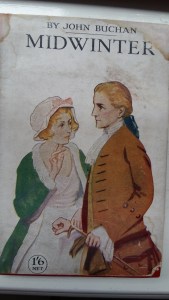
MidwinterAbout the Book

In 1745, Bonnie Prince Charlie’s rebel army is marching south into England. Alastair Maclean, one of the Prince’s most loyal supporters, is sent ahead to carry out a secret mission.

He is befriended by two extraordinary men-Dr. Samuel Johnson, an aspiring man of letters, and the shadowy figure known only as “Midwinter”.

Format: Hardcover (288 pp.)    Publisher: Thomas Nelson & Son
Published: [1923]   Genre: Historical Fiction

Purchase Links*
Amazon.co.uk  ǀ  Kobo 
*links provided for convenience, not as part of any affiliate programme

Find Midwinter on Goodreads


My Review

Midwinter is the fourth book in my Buchan of the Month reading project for 2019.  You can find out more about the project and my reading list for 2019 here.  You can also read my spoiler-free introduction to Midwinter here.

Midwinter was written at Elsfield Manor, the country house in Oxfordshire which John Buchan purchased in 1919 as his family home.  The book features Dr. Samuel Johnson who, in real life, walked out from Oxford to have tea with Mr. Francis Wise, a former owner of Elsfield, in the summer of 1754.    In Midwinter, Buchan indulges himself by imagining what Samuel Johnson may have been up to in the ‘missing years’ not documented by his biographer, James Boswell, using the literary conceit of some discovered documents as the basis for the story.

The book’s hero is Alastair Maclean (no, not that one), a young soldier pursuing intelligence duties in support of Bonnie Prince Charlie.  Like John Buchan, Alastair is Scottish but sees something of his homeland in the landscape of Oxfordshire.

In my earlier blog post about the book, I noted that Kate MacDonald had described Midwinter as a ‘Buchan mystery thriller’ but with a historical setting.  I wasn’t sure if I agreed with that description at the time but, having read the book, I absolutely see what she was getting at.  In Midwinter, there are many of the elements readers have come to expect in a spy thriller: narrow escapes for the hero who is often a hunted man not knowing who to trust; the use of codewords, secret networks and disguises; and the race against time to save the day.  A ‘damsel in distress’ in the person of the fragrant Claudia Norreys adds an element of romantic adventure to the book.

I must also mention some great descriptions of food in the book such as the following gargantuan meal enjoyed by General Olgethorpe: “…he ate heartily of everything – beefsteak pie, roast sirloin, sheep’s tongues, cranberry tarts and a London bag-pudding – and drank a bottle of claret, a quart of ale, and the better part of a bottle of Madeira’.  As well as wondering (like me) what on earth a ‘London bag-pudding’ is, you may also marvel at the General’s capacity for alcohol as the author assures us that he ‘did not become garrulous, nor did the iron restraint of his demeanour relax’.

Kate MacDonald also comments that the eponymous (Amos) Midwinter might be a grown-up Puck taken from Kipling’s Puck of Pook’s Hill.   Indeed he is a mix between a tinker and a pixie, a charismatic figure who can seemingly travel at will without detection and conjure up assistance from the band of like-minded individuals who style themselves ‘The Naked Men’.  With their ability to move, track and observe unseen, they embody the spirit of what Midwinter refers to as ‘Old England’.  Asked by Alastair, “Where is this magic country?”, Midwinter replies, “All around you – behind the brake, across the hedgerow, under the branches.  Some can stretch a hand and touch it – to others it is a million miles away”.

Midwinter is a lively historical adventure story by the end of which Samuel Johnson has been persuaded that his future lies as a man of letters and Alastair has been forced to make a fateful decision between his loyalty to the cause and the aforementioned damsel.  Could that decision, the author poses to the reader, have changed the course of history?

May’s Buchan of the Month is The Three Hostages, the fourth book featuring the exploits of Richard Hannay. Look out for my spoiler free introduction to the book shortly and my review towards the end of the month.

Follow my blog with Bloglovin

In three words: Lively, historical, adventure

Try something similar: Huntingtower by John Buchan (read my review here)


John BuchanAbout the Author

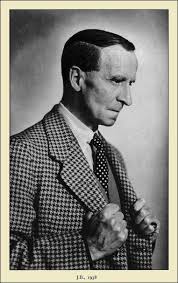
John Buchan (1875 – 1940) was an author, poet, lawyer, publisher, journalist, war correspondent, Member of Parliament, University Chancellor, keen angler and family man.  He was ennobled and, as Lord Tweedsmuir, became Governor-General of Canada.  In this role, he signed Canada’s entry into the Second World War.   Nowadays he is probably best known – maybe only known – as the author of The Thirty-Nine Steps.  However, in his lifetime he published over 100 books: fiction, poetry, short stories, biographies, memoirs and history.

You can find out more about John Buchan, his life and literary output by visiting The John Buchan Society website or by reading the excellent new biography of the author by his granddaughter Ursula Buchan, Beyond the Thirty-Nine Steps.

buchan of the month 2019