#BookReview Ariadne by Jennifer Saint @RandomTTours @Wildfirebks

Graphic 3

Welcome to today’s stop on the blog tour for Ariadne by Jennifer Saint. My thanks to Anne at Random Things Tours for inviting me to participate in the tour and to Wildfire for my digital review copy via NetGalley.
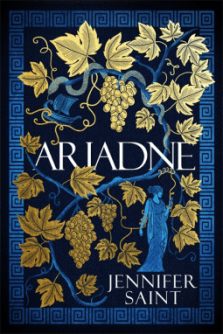

AriadneAbout the Book

As Princesses of Crete and daughters of the fearsome King Minos, Ariadne and her sister Phaedra grow up hearing the hoofbeats and bellows of the Minotaur echo from the Labyrinth beneath the palace. The Minotaur – Minos’s greatest shame and Ariadne’s brother – demands blood every year.

When Theseus, Prince of Athens, arrives in Crete as a sacrifice to the beast, Ariadne falls in love with him. But helping Theseus kill the monster means betraying her family and country, and Ariadne knows only too well that in a world ruled by mercurial gods – drawing their attention can cost you everything.

In a world where women are nothing more than the pawns of powerful men, will Ariadne’s decision to betray Crete for Theseus ensure her happy ending? Or will she find herself sacrificed for her lover’s ambition?

Ariadne gives a voice to the forgotten women of one of the most famous Greek myths, and speaks to their strength in the face of angry, petulant Gods.

Format: Hardcover (400 pages)    Publisher: Wildfire
Publication date: 29th April 2021 Genre: Historical Fiction

Find Ariadne on Goodreads

Purchase links
Bookshop.org
Disclosure: If you buy a book via the above link, I may earn a commission from Bookshop.org, whose fees support independent bookshops

Hive | Amazon UK
Links provided for convenience only, not as part of an affiliate programme


My Review

The first thing that drew me to this book was that I was fortunate enough to visit the site of Knossos on a holiday to Crete many years ago. I was also intrigued by the idea of a book that puts its titular heroine, Ariadne, centre stage in the retelling of the myth of the Minotaur.

A recurring theme of the book is the male domination of society and the imbalance of power between men and women. As Ariadne observes, women – including her own mother, Pasiphaë – are blamed and punished for the actions of men, both mortal and divine.  In fact, it’s not quite as simple as that because, as the book shows, mortal women also suffer at the hands of female Gods.  For example, Ariadne ponders on Athena’s actions in punishing Medusa for her seduction by Poseidon: ‘She must punish the girl who was so shameless as to be overpowered by Poseidon… So Medusa had to pay for Poseidon’s act. It made no sense at all.’  

Arguably, the book illustrates the misuse of power per se. For example, Ariadne observes that her brother, the Minotaur, for whom she shows a touching pity when he’s a baby, becomes a display to the world of her father Minos’s dominance. Similarly Minos keeps Daedalus a virtual prisoner on Crete because of his genius for invention and to prevent his knowledge of the secrets of the labyrinth beneath the palace falling into the hands of others.

The author draws the reader into the stories of Ariadne and Phaedra, showing how each in their different way attempt to find their identity and gain some control over their lives.  For Phaedra, used as a political bargaining chip by her brother after the death of Minos in order to secure peace with Athens, it’s about gaining what knowledge she can of the workings of the Athenian state and using that to her advantage.  For Ariadne, living alone in exile on Naxos, it’s about finding the courage and determination to survive. As she says defiantly, ‘I was not Minos’ captive daughter; I was not Cinyras’s trade for copper; nor was I Theseus’s diversion between heroic feats of glory.  Somehow I had survived them all and here I was, free of them at last’.  She does survive, albeit with the help of the male God, Dionysus. In fact, both Ariadne and Phaedra are destined ultimately to be disillusioned, let down and deceived by men who don’t deserve them.

Alongside the stories of Ariadne and Phaedra, there are references to other characters from Greek mythology, such as Medea, Jason and Heracles. At nearly 400 pages, Ariadne is a chunky read but if some sections move at a rather leisurely pace, there are plenty of scenes that are full of energy and drama. For example, the description of a descent into the Underworld.

Although I was aware of the story of Ariadne up to the point of the slaying of the Minotaur and was vaguely aware that she spent time on Naxos, I knew nothing about events in her life thereafter. I had also never heard of her sister, Phaedra, or her mother, Pasiphae. (I obviously should have paid more attention during my Classical Studies lessons at school!) I think this lack of knowledge hampered my ability to fully judge what degree of imagination the author has brought to her retelling of the story of Ariadne. This may also explain why, whilst full of admiration for the superb quality of the writing, my feelings about Ariadne do not quite match the wild – dare I say, Dionysian – enthusiasm of other readers. However, for lovers of Greek mythology, Ariadne is a book I can definitely recommend. And wouldn’t it be great to be reading it on a beach in Crete?

In three words: Emotional, assured, immersive

Try something similar: The Silence of the Girls by Pat Barker

Follow this blog via Bloglovin


Jennifer Saint Author picAbout the Author

Jennifer Saint grew up reading Greek mythology and was always drawn to the untold stories hidden within the myths. After thirteen years as a high school English teacher, sharing a love of literature and creative writing with her students, she wrote Ariadne, her first novel, which tells the legend of Theseus and the Minotaur from the perspective of Ariadne – the woman who made it happen. Jennifer is now a full-time author, living in Yorkshire, England, with her husband and two children. She is working on her second novel, another retelling of ancient myth.

Connect with Jennifer
Website | Twitter | Facebook | Instagram

Ariadne Bt Poster

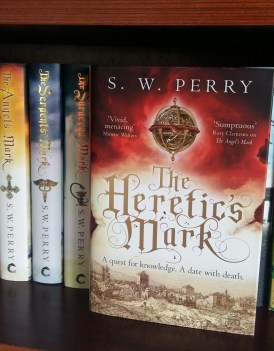
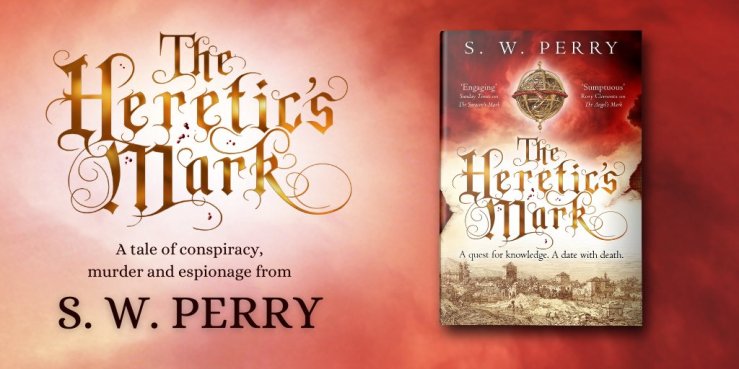
#BookReview The Heretic’s Mark by S. W. Perry @CorvusBooks

The Heretic's Mark

Welcome to today’s stop on the blog tour for The Heretic’s Mark by S. W. Perry, the fourth book in the Jackdaw Mysteries series. My thanks to Kate at Corvus for inviting me to take part in the tour and to Readers First for my advance review copy.


The Heretic's MarkAbout the Book

The Elizabethan world is in flux. Radical new ideas are challenging the old. But the quest for knowledge can lead down dangerous paths.

London, 1594. The Queen’s physician has been executed for treason, and conspiracy theories flood the streets. When Nicholas Shelby, unorthodox physician and unwilling associate of spymaster Robert Cecil, is accused of being part of the plot, he and his new wife Bianca must flee for their lives. With agents of the Crown on their tail, they make for Padua, following the ancient pilgrimage route, the Via Francigena. But the pursuing English aren’t the only threat Nicholas and Bianca face.

Hella, a strange and fervently religious young woman, has joined them on their journey. When the trio finally reach relative safety, they become embroiled in a radical and dangerous scheme to shatter the old world’s limits of knowledge. But Hella’s dire predictions of an impending apocalypse, and the brutal murder of a friend of Bianca’s forces them to wonder: who is this troublingly pious woman? And what does she want?

Format: Hardcover (448 pages)  Publisher: Corvus
Publication date: 1st April 2021 Genre: Historical Fiction, Crime, Mystery

Find The Heretic’s Mark (The Jackdaw Mysteries #4) on Goodreads

Purchase links
Bookshop.org
Disclosure: If you buy a book via the above link, I may earn a commission from Bookshop.org, whose fees support independent bookshops

Hive | Amazon UK
Links provided for convenience only, not as part of an affiliate programme


My Review

S. W. Perry’s novels featuring physician Nicholas Shelby and tavern owner Bianca Merton have fast become one of my favourite historical mystery series. I’ve loved all three previous books – The Angel’s Mark, The Serpent’s Mark and The Saracen’s Mark. Although The Heretic’s Mark is the fourth in the series, the author has ensured it can be enjoyed by new readers and established fans alike thanks to brief recaps of events from previous books and sketches of the main characters.

Aside from Nicholas and Bianca, amongst those making a return appearance are Rose and Ned Monckton, now charged with overseeing the rebuilding of the Jackdaw tavern following its dramatic destruction at the end of the previous book. Such is Ned’s gratitude to both Bianca and Nicholas for the new life they’ve made possible, that Ned decides to try to discover the person responsible for denouncing Nicholas as a co-conspirator in a plot against the Queen.

No historical mystery set in the reign of Elizabeth I would be complete without a member of the Cecil family featuring in the plot and in this case it’s Sir Robert Cecil. Nicholas is hoping that having treated Cecil’s son, he may be able to call on Cecil’s help should it be needed. However, perhaps you can never be quite sure with one of the Cecils.

As fans of the series have come to expect, the book vividly conjures up the sights, sounds – and smells – of 16th century London. However, the need to seek refuge from their unknown enemy allows the author to transport Nicholas and Bianca to a whole new landscape. Having travelled across the Narrow Sea to Den Bosch in Brabant, two significant events occur. Firstly, Nicholas catches sight of Hieronymus Bosch’s triptych, The Last Judgment, and is a witness to a brutal attack. Secondly, he and Bianca encounter a strange young woman, Hella Mass, whose joins them on their arduous journey along the pilgrim route towards Italy.

In Hella, the author has created an enigma, possibly a monster, but most certainly an unforgettable character. Is she a latter day Cassandra whose predictions of impending doom are destined to be ignored, a delusional young woman damaged by her traumatic experiences who should be pitied not reviled, or a skilled manipulator and charlatan? You’ll have to read the book to find out. Whichever it is, there’s certainly no love lost between Hella and Bianca who quickly tires of Hella’s predictions, especially when she believes them to have turned personal. As Bianca observes, ‘There is only so much a woman with blisters on her feet, who’s sure she stinks of mule, and has a mountain range ahead of her to cross, can suffer with equanimity.

Although initially the result of a forced departure from England, before long Nicholas finds himself enjoying the journey through Europe. ‘Here, on the path down to the northern shore of Lake Geneva, the air is sharper, more bracing even than a tub of cold Thames water, more cleansing than the stinking fug he breathes in the narrow lanes of London.’ And for Bianca, the journey gives her the freedom to practice her Catholic faith openly.

Alongside the account of Nicholas and Bianca’s journey, there are regular updates on the progress of Ned’s investigation back in London. Another storyline involves Bianca’s cousin, Bruno Barrani, who has a bold scheme to acquire an object that he hopes will bring him both wealth and powerful patronage. The arrival of Nicholas and Bianca in Padua, the city of Bianca’s birth, sees the convergence of a number of plot lines as result of which dramatic events ensue. To borrow from the musical Kiss Me Kate, it’s not so much a case of “I’ve come to wive it wealthily in Padua” as “I’ve come to knife them steathily in Padua“.

A multitude of twists and turns had me at more than one than point silently entreating the author, ‘No! You can’t end a chapter like that!’  The book builds to a wonderfully dramatic climax that makes full use of the historic sites of Padua and the city’s traditions. And I’ll freely admit the closing chapters left me a little tearful.

Fans of the series will be delighted to learn The Heretic’s Mark is another historical page-turner from the pen of S. W. Perry.  And to readers looking for a new historical mystery series to follow, I can only say ‘Get thee to a bookshop’.  I, for one, can’t wait for the next instalment.

In three words: Gripping, atmospheric, dramatic

Try something similar: Rags of Time by Michael Ward

Follow this blog via Bloglovin


S W Perry Author PictureAbout the Author

S. W. Perry was a journalist and broadcaster before retraining as an airline pilot. He lives in Worcestershire with his wife.

Connect with S. W. Perry
Website | Twitter | Facebook

The Heretic's Mark