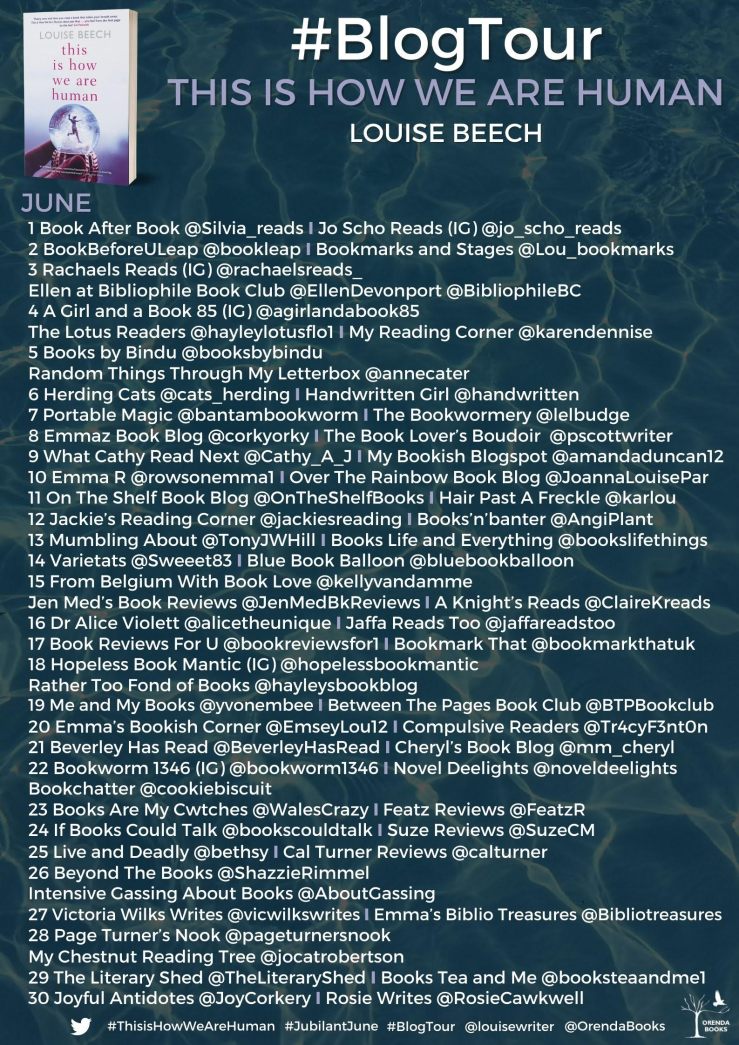
#BookReview This Is How We Are Human by Louise Beech @Orenda Books @RandomTTours

Welcome to today’s stop on the blog tour for This Is How We Are Human by Louise Beech. My thanks to Anne at Random Things Tours for inviting me to take part in the tour and to Orenda Books for my digital review copy. Do check out the banner at the bottom of this post to see all the fabulous book bloggers taking part in the tour and sharing their thoughts on the book.
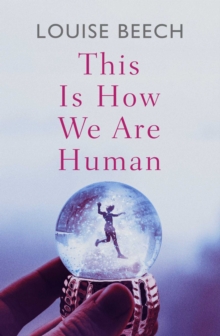

This Is How We Are HumanAbout the Book

Sebastian James Murphy is twenty years, six months and two days old. He loves swimming, fried eggs and Billy Ocean. Sebastian is autistic. And lonely. Veronica wants her son Sebastian to be happy, and she wants the world to accept him for who he is. She is also thinking about paying a professional to give him what he desperately wants.

Violetta is a high-class escort, who steps out into the night thinking only of money. Of her nursing degree. Paying for her dad’s care. Getting through the dark.

When these three lives collide, and intertwine in unexpected ways, everything changes. For everyone.

Format: Paperback (300 pages)    Publisher: Orenda Books
Publication date: 10th June 2021 Genre: Contemporary Fiction

Find This Is How We Are Human on Goodreads

Purchase links
Bookshop.org
Disclosure: If you buy a book via the above link, I may earn a commission from Bookshop.org, whose fees support independent bookshops

Publisher | Hive | Amazon UK
Links provided for convenience only, not as part of an affiliate programme


My Review

It takes an author of rare talent and emotional dexterity to tackle the story at the heart of This Is How We Are Human without it feeling insensitive, unrealistic or maudlin. Fortunately, this is Louise Beech we’re talking about who seems to have the unerring ability to draw a reader into a story so that they feel they actually know the characters.

And, as it happens, the story has personal meaning for Louise. As she explains, “Though This is How We Are Human is fiction, the premise was inspired by my friends, 20-year-old Sean, who is autistic, and his mum Fiona. Fiona had spoken to me about how much Sean longed to meet a girl and have sex. No one talks about this, she said – the difficulties navigating romance often faced by those on the spectrum. It ’s an issue that I wanted to explore. Fiona and Sean encouraged me and guided me through the book; Sean regularly consulted on dialogue, rightly insisting that his voice was heard, was strong, and was accurate. I cannot thank my extraordinary friends enough for their help and support.”

Sebastian is definitely a character I won’t forget in a hurry. After all, I know his precise age, his favourite music and how he likes his eggs cooked. And how could one not feel for his mother Veronica, who loves her ‘beautiful, complex, challenging, difficult, wonderful boy’ and just wants the best for him. But trying to do your best for someone you care about can get very complicated.

There were frequent occasions in the book when I felt sad for Sebastian and for Veronica. But, if anything, I felt saddest for the young woman we know as Violetta because of the many emotional and moral dilemmas she faces and because, at the point where it looks as if everything should start to go right for her, suddenly just the opposite looks likely.

If you’re looking for a reading experience that will encompass tears of sadness one moment and tears of joy the next – with a few chuckles in between – then This Is How To Be Human is the book for you. And although I’m not as clever as Sebastian, let me have a go…

Knock, knock
Who’s there?
Justin
Justin who?
Justin love with this latest book by Louise Beech

By the way, although This Is How To Be Human is not published in paperback until tomorrow, once you’ve grabbed yourself a copy there’s no need to wait until 7.30pm to start reading it (with or without goggles).

In three words: Heart-breaking, tender, heart-warming

Try something similar: Maria in the Moon by Louise Beech

Follow this blog via Bloglovin


Louise Beech Author PhotoAbout the Author

Louise Beech is an exceptional literary talent, whose debut novel How To Be Brave was a Guardian Readers’ Choice for 2015. The follow-up, The Mountain in My Shoe was shortlisted for Not the Booker Prize. Both of her previous books Maria in the Moon and The Lion Tamer Who Lost were widely reviewed, critically acclaimed and number-one bestsellers on Kindle. The Lion Tamer Who Lost was shortlisted for the RNA Most Popular Romantic Novel Award in 2019. Her 2019 novel Call Me Star Girl won Best magazine Book of the Year, and was followed by I Am Dust.

Her short fiction has won the Glass Woman Prize, the Eric Hoffer Award for Prose, and the Aesthetica Creative Works competition, as well as shortlisting for the Bridport Prize twice. Louise lives with her husband on the outskirts of Hull, and loves her job as a Front of House Usher at Hull Truck Theatre, where her first play was performed in 2012.

Connect with Louise
Website | TwitterGoodreads

This Is How BT Poster

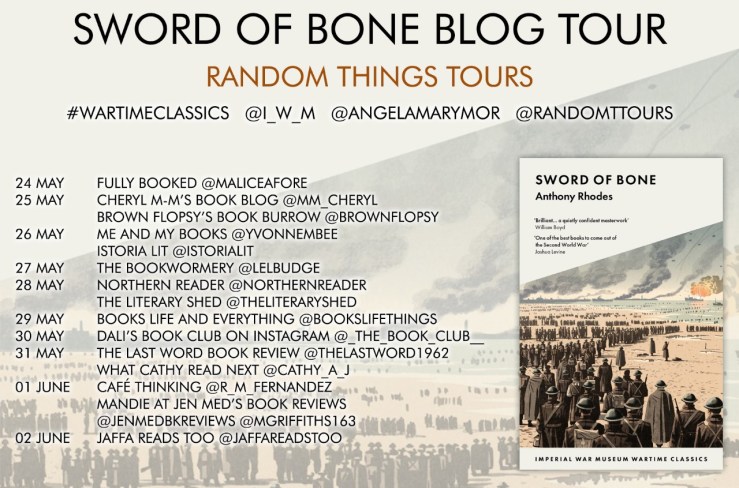
#BookReview Sword of Bone by Anthony Rhodes @RandomTTours @I_W_M

Sword of Bone BT Poster

Welcome to today’s stop on the blog tour for Sword of Bone by Anthony Rhodes, one of the latest additions to the Imperial War Museum’s fabulous Wartime Classics series of rediscovered wartime classics. My thanks to Anne at Random Things Tours for finding me a place on the tour and to the Imperial War Museum for my advance review copy.


Sword of Bone CoverAbout the Book

It is September 1939. Shortly after war is declared, Anthony Rhodes is sent to France, serving with the British Army. His days are filled with the minutiae and mundanities of army life – friendships, billeting, administration – as the months of the “Phoney War” quickly pass and the conflict seems a distant prospect.

It is only in the spring of 1940 that the true situation becomes clear; the men are ordered to retreat to the coast and the beaches of Dunkirk, where they face a desperate and terrifying wait for evacuation.

Format: Paperback (236 pages)                 Publisher: Imperial War Museum
Publication date: 20th May 2021 [1942]   Genre: Fiction, WW2

Find Sword of Bone on Goodreads

Purchase links
Bookshop.org
Disclosure: If you buy a book via the above link, I may earn a commission from Bookshop.org, whose fees support independent bookshops

Publisher | Hive | Amazon UK
Links provided for convenience only, not as part of an affiliate programme


My Review

First published in 1942, Sword of Bone is based on the author’s own wartime experiences including the evacuation of Dunkirk which took place between 27th May and 4th June 1940. The evacuation has come to be regarded as a seminal moment in the Second World War; indeed, it is often described as ‘the miracle of Dunkirk’, arguably something of a misnomer since, although hundreds of thousands of men were rescued, thousands more were left behind along with tons of equipment.

As usual, the introduction by Imperial War Museum historian, Alan Jeffreys, provides fascinating background information about the author, the book and its historical context. Describing Sword of Bone as a ‘lightly fictionalised memoir’, he argues the book is very much in the tradition of the war novels published in the 1920s dealing with the First World War, such as Siegfried Sassoon’s Memoirs of an Infrantry Officer.

The first part of the book covers Rhodes’s time in charge of an advance party sent to France with the task of finding quarters and sourcing equipment for the main division of the Royal Engineers which is to follow. Describing his role as ‘buyer, distributor, and journeyman’, he is fortunate to be assigned Georges de Treil as his French liaison officer.  Amongst his many attributes is Georges’s seeming acquaintance with the maître d’hôtel of every restaurant in the area.  As well as enticing Rhodes into some risky escapades, he introduces him to French customs such as the correct way to enjoy cheese and wine.

On 10th May 1940, the ‘Phoney War’ comes to an end as Rhodes learns of the invasion of Belgium and Holland, and the bombing of Arras. Reminding me a little of what has been revealed recently about the UK’s handling of the Coronavirus pandemic, Rhodes is amazed to discover that no plans exist for destroying the bridges across the strategically important River Dyle.  Shortly afterwards he has his first experience of an early morning air raid which leaves him lying naked on the floor of his billet ‘covered in dust and shaving soap’.  From that point on, the reality of war is vividly evoked, including the ‘double speak’ which sees the retreat of British forces described in news reports as ‘a strategic withdrawal according to plan’.

The book really comes alive in the final chapters which describe the chaos and confusion of the evacuation of the British Expeditionary Force from the beaches of Dunkirk, by which time ‘the Boche are everywhere’. To experience it in visual form, I recommend the film Dunkirk. The 1958 version would be my preference but then I’m a sucker for war films of the 1940s and 1950s. As it happens, given we’re close to the anniversary of the evacuation, the film was shown yesterday (30th May 2021) on BBC2 and is available via the BBC iPlayer for a limited time. There is also a touching moment in the 1942 film In Which We Serve starring Noel Coward (who also wrote the screenplay) when the crew of the fictional H.M.S. Torrin, having taken part in the evacuation, watch the soldiers they have rescued and returned safely to England leave the ship.

Having been picked up by a trawler, Rhodes arrives back in Dover; the line ‘In this way it ended’ from the final chapter perfectly summing up the reportage style of this fascinating book.

In three words: Authentic, detailed, fascinating

Try something similar: The Miracle of Dunkirk by Walter Lord

Follow this blog via Bloglovin


About the Author

Anthony Rhodes (1916–2004) served with the British Army in France during the so-called ‘Phoney War’ and was evacuated from Dunkirk in May 1940 – he based Sword of Bone on these experiences. After the conflict, Rhodes enjoyed a long academic and literary career and wrote on various subjects, including covering the 1956 Hungarian Revolution for the Daily Telegraph and producing well-regarded histories of the Vatican. He died in 2004.

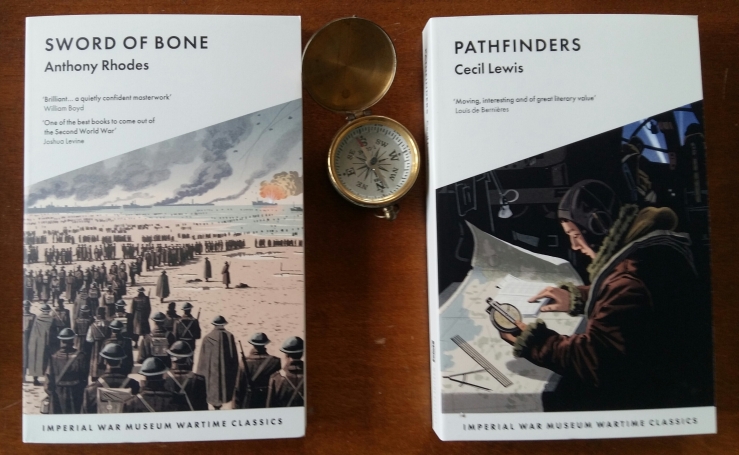
Pathfinders Sword of Bone