Book Review – Sword of the War God by Tim Hodkinson @AriesFiction @TimHodkinson

Welcome to today’s stop on the blog tour for Sword of the War God by Tim Hodkinson. My thanks to Andrew at Head of Zeus for inviting me to take part in the tour and for my review copy. Do check out the review by my tour buddy for today, Sue at Brown Flopsy’s Book Burrow.


About the Book
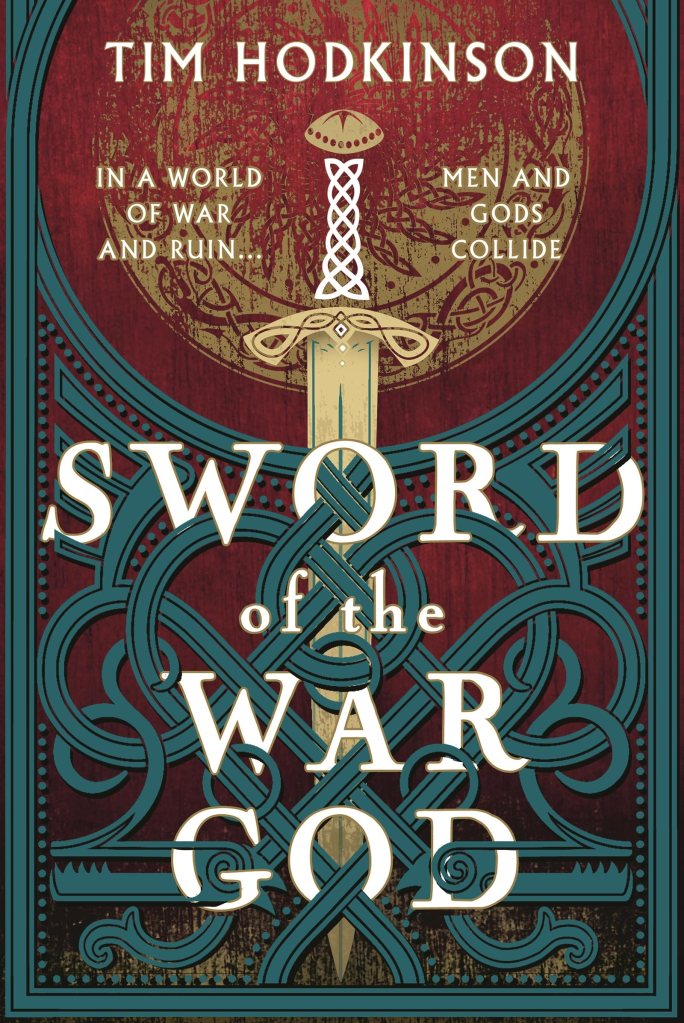
Book cover of Sword of the War God by Tim Hodkinson

In a world of war and ruin, men and gods collide.

436 AD. The Burgundars are confident of destroying Rome’s legions. Their forces are strong and they have beaten the Romans in battle before. But they are annihilated, their king killed, his people scattered. Their fabled treasure is lost. For Rome has new allies: the Huns, whose taste for bloodshed knows no bounds.

Many years later, the Huns, led by the fearsome Attila, have become the deadliest enemies of Rome. Attila seeks the Burgundars’ treasure, for it includes the legendary Sword of the War God, said to make the bearer unbeatable.

No alliance can defeat Attila by conventional means. With Rome desperate for help, a one-eyed old warlord from distant lands and his strange band of warriors may have the answers… but oaths will be broken and the plains of Europe will run with blood before the end.

Format: Hardback (608 pages) Publisher: Head of Zeus
Publication date: 11th April 2024 Genre: Historical Fiction, Adventure

Find Sword of the War God on Goodreads

Purchase Sword of the War God from Bookshop.org [Disclosure: If you buy books linked to our site, we may earn a commission from Bookshop.org, whose fees support independent bookshops]


My Review

In Sword of the War Gods, the author has taken the conflicts between the declining Roman Empire and its enemies and added a generous helping of Norse and Germanic mythology to create a thrilling historical adventure. Figures who have inspired authors and composers like Richard Wagner feature in the book: there are Swan Maidens, a mysterious one-eyed figure calling himself Wodnas and the women of the Valkyrjur known as ‘the Choosers of the Slain’ led by Brynhild.

To describe the book as action-packed is something of an understatement. Right from the outset, the reader is plunged into the bloody battle that results in the near annihilation of the Burgundars by the combined forces of the Roman army and their allies, the Huns. To be fair, it’s the Huns who are responsible for most of the destruction, using their deadly skills on horseback to launch wave after wave of attacks, killing without mercy. ‘The air was filled with a deafening cacophony of men and horses screaming, steel clashing on steel and the thudding of hooves. Arrow-riddled corpses and severed body parts lay all around.’

Hagan, son of the Burgundar King’s champion, is one of the few survivors of the battle, spared only by agreeing to join the Roman army, an army by this stage made up mostly of warriors from tribes the Romans have defeated. Fast forward six years and Hagan has gained much from his time in the army, honing his ability with sword and spear, experiencing first-hand the discipline needed in the shield wall and developing some impressive scouting skills. Yet a question mark remains over his parentage. Just what is the significance of the unusual amulet he retrieved from the dead body of his mother?

With Rome’s power on the wane, enter the infamous Attila the Hun whose hordes have been cutting a swathe through the former Empire and beyond. The cursory dispatch of his brother in order to become sole king of the Huns is just one indicator of the coldheartedness of a man described as ‘the Devil incarnate. Cruel, vicious, greedy. Utterly ruthless.’ Attila’s a man who has no compunction about having people die in the most horrific ways, his only grumble being when they make too much noise in the process.

There is a saying that ‘my enemy’s enemy is my friend’. For Rome, the only prospect of defeating the Huns seems to rest upon it convincing former enemies, such as the Visigoths, to join them in an alliance against the Huns. Hagan plays his part here, discovering in the process that he is not as alone in the world as he thought. He also acquires a delightfully singular and resourceful companion.

The climactic battle scene with which the book concludes immerses the reader in the sights and sounds of conflict. You can almost visualise it playing out in front of you as you watch from the sidelines. (You wouldn’t want to be any closer than that.) It’s bloody, it’s brutal but it’s utterly compelling.

Sword of the War God is a thrilling historical adventure peopled with memorable characters and woven through with myth and legend.

I highly recommend checking out Tim’s website where he’s been blogging about some of the key characters in the book, including their historical or legendary inspiration.

In three words: Action-packed, immersive, gripping
Try something similar: The Emperor’s Shield by Gordon Doherty


About the Author

Author Tim Hodkinson

Tim Hodkinson grew up in Northern Ireland where the rugged coast and call of the Atlantic Ocean led to a lifelong fascination with Vikings and a degree in Medieval English and Old Norse Literature. Tim’s more recent writing heroes include Ben Kane, Giles Kristian, Bernard Cornwell, George R.R. Martin and Lee Child. After several years in the USA, Tim returned to Northern Ireland, where he lives with his wife and children.

Connect with Tim
Website | Twitter/X | Facebook

Book Review – Hungry Ghosts by Kevin Jared Hosein

About the Book

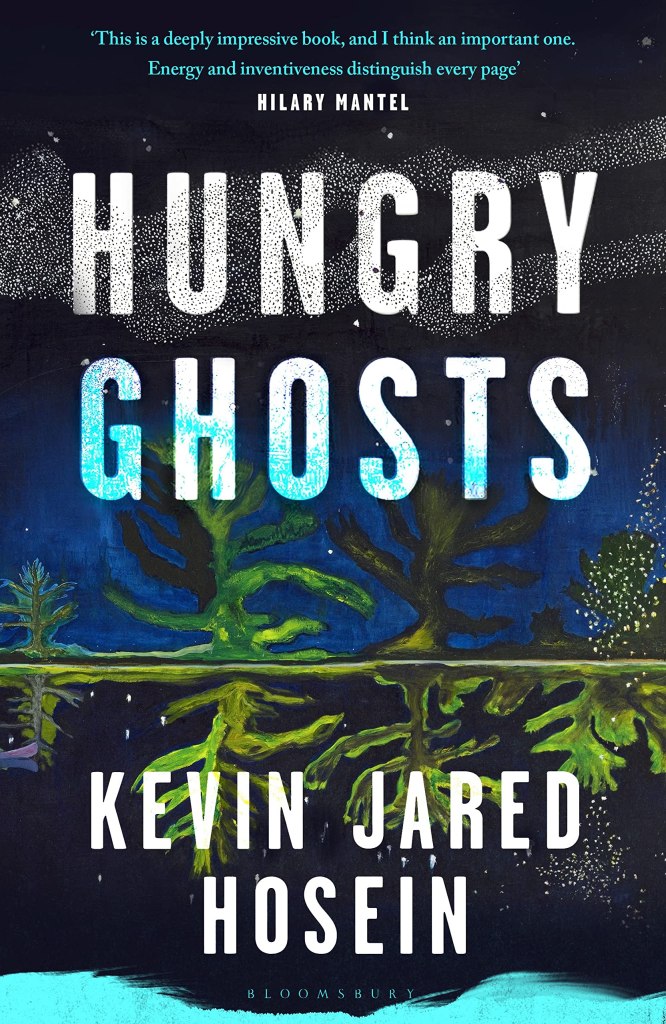
Book cover Hungry Ghosts by Kevin Jared Hosein

The music was still playing when Dalton Changoor vanished into thin air…

On a hill overlooking Bell Village sits the Changoor farm, where Dalton and Marlee Changoor live in luxury unrecognisable to those who reside in the farm’s shadow. Down below is the barrack, a ramshackle building of wood and tin, divided into rooms occupied by whole families. Among these families are the Saroops – Hans, Shweta, and their son, Krishna, who live hard lives of backbreaking work, grinding poverty and devotion to faith.

When Dalton Changoor goes missing and Marlee’s safety is compromised, farmhand Hans is lured by the promise of a handsome stipend to move to the farm as watchman. But as the mystery of Dalton’s disappearance unfolds their lives become hellishly entwined, and the small community altered forever.

Format: Hardback (352 pages) Publisher: Bloomsbury
Publication date: 16th February 2023 Genre: Historical Fiction

Find Hungry Ghosts on Goodreads

Purchase Hungry Ghosts from Bookshop.org


My Review

As well as being a BBC2 Between the Covers book club pick and being longlisted for The Walter Scott Prize for Historical Fiction 2024, Hungry Ghosts is one of the books on the longlist for the Swansea University Dylan Thomas Prize 2024. The shortlist will be announced on Thursday 21st March 2024.

Hungry Ghosts has been described as ‘a mesmerising novel about violence, religion, family and class’ and as ‘biblical in scope and power’. I wouldn’t disagree with either of these although the comparison that came to my mind was a Shakespearean tragedy such is the story of cruelty, revenge, betrayal, hate and lust that unfolds.

The novel focuses on four main characters: Hansraj Saroop and his wife, Shweta; their son, Krishna; and Marlee, the wife of rich businessman Dalton Changoor whose disappearance remains an unresolved mystery for much of the book but is also the catalyst for a chain of events that will bring far-reaching consequences. Other characters, such as Krishna’s cousin, Tarik, and Lata, the daughter of one of the families who share the Saroop’s cramped living space, play important roles in the story. They are not just shadowy figures in the background but are vividly brought to life. Robinson, one of the other workers on the Changoor estate, was a character that particularly stuck in my mind. If there’s anything close to ‘a good man’ in the book, he’s a candidate.

As we learn, many of the characters have experienced violence and cruelty in their lives, often as children at the hands of their fathers. They carry the legacy of those experiences in their actions: sometimes perpetuating them, sometimes seeking to rise above them. Loss – of parents, of children – is a persistent backdrop to the characters’ lives. One loss in particular is a source of grief that Shweta lives with daily but which Hansraj seems unwilling or unable to acknowledge. It’s a ‘hungry ghost’ that feeds upon her every day.

Many of the characters seek to better themselves and to get more from life than what fate has dealt them so far, which in most cases is not very much. Shweta longs for a house of her own that she doesn’t have to share with other families, that offers more privacy than a flimsy partition and that doesn’t leak when it rains. Krishna, an intelligent young man, knows the local school cannot provide the education that will allow him to forge a life beyond the village. He resents the prejudice directed at his family and is frustrated at his father’s seeming acceptance of it. Marlee is one person who has made a new life for herself but it has come at a cost. There will be a cost to others as well.

The story may be bleak but the writing is anything but. You get the sense that every sentence has been thought about and lovingly crafted. The author has an obvious love of language, including some unfamiliar words (‘rufescent’ ‘thaumaturgy’ ‘eutrophic’ ) that had me reaching for the dictionary.

Hungry Ghosts has scenes that are harrowing and difficult to read but the sheer power of the narrative propels you through them. I can see why it has garnered so much praise.

My thanks Henrietta at Midas PR for inviting me to be part of the blog tour celebrating the books on the Swansea University Dylan Thomas Prize 2024 longlist and to Bloomsbury Publishing for my review copy.

Swansea University Dylan Thomas Prize

In three words: Intense, powerful, moving
Try something similar: Fortune by Amanda Smyth


About the Author

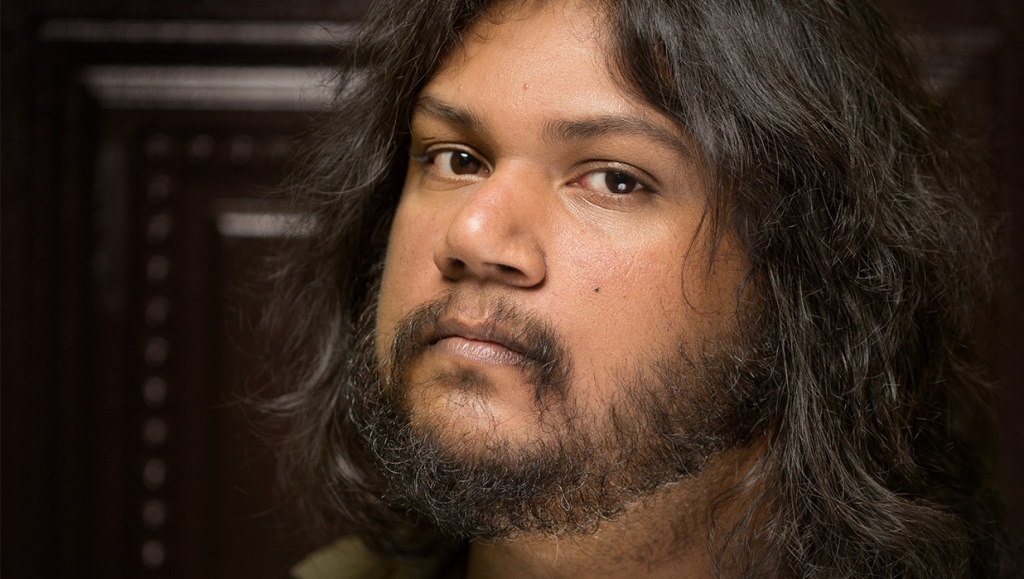
Author Kevin Jared Hosein
Photo credit: Mark Lyndersay

Kevin Jared Hosein is a Caribbean novelist. He has also worked as a secondary school Biology teacher for over a decade. He was named overall winner of the Commonwealth Short Story Prize in 2018, and was the Caribbean regional winner in 2015. He has published two books: The Repenters and The Beast of Kukuyo. The latter received a CODE Burt Award for Caribbean Young Adult Literature, and both were longlisted for the International Dublin Literary Award. His writing, poetry, fiction and non-fiction have been published in numerous anthologies and outlets. He lives in Trinidad Tobago.

Connect with Kevin
X | Instagram