#BookReview Kyiv by Graham Hurley @HoZ_Books

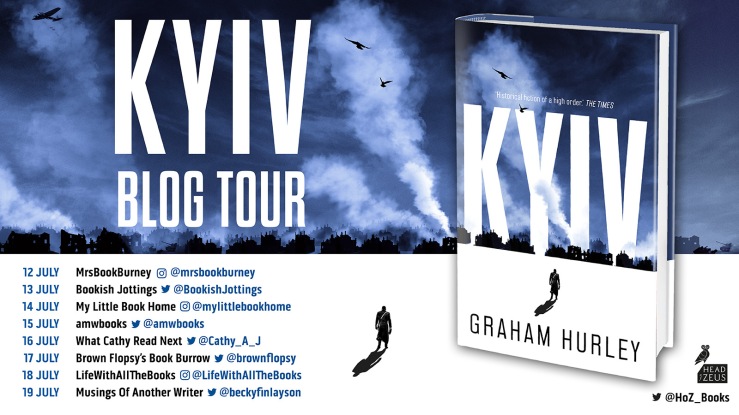
KYIV blog tour banner_V1

Welcome to today’s stop on the blog tour for Kyiv by Graham Hurley, his latest WW2 thriller set against the backdrop of Operation Barbarossa, the German code name for the invasion of Russia. My thanks to Lauren at Head of Zeus for inviting me to take part in the tour and for my digital review copy via NetGalley.
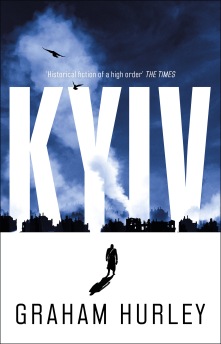

Hurley_KYIV_HBAbout the Book

On Sunday 22nd June 1941 at 03.05, three-and-a-half million Axis troops burst into the Soviet Union along a 1,800-mile front to launch Operation Barbarossa. The southern thrust of the attack was aimed at the Caucuses and the oil fields beyond. Kyiv was the biggest city to stand in their way.

Within six weeks, the city was under siege. Surrounded by Panzers, bombed and shelled day and night, Soviet Commissar Nikita Krushchev was amongst the senior Soviet officials co-ordinating the defence. Amid his cadre of trusted personnel is British defector Bella Menzies, once with MI5, now with the NKVD, the Soviet secret police.

With the fall of the city inevitable, the Soviets plan a bloody war of terror that will extort a higher toll on the city’s inhabitants than the invaders. As the noose tightens, Bella finds herself trapped, hunted by both the Russians and the Germans.

As the local saying has it: life is dangerous – no one survives it.

Format: Hardcover (416 pages) Publisher: Head of Zeus
Publication date: 8th July 2021 Genre: Historical Fiction, Thriller

Find Kyiv on Goodreads

Purchase links
Bookshop.org
Disclosure: If you buy a book via the above link, I may earn a commission from Bookshop.org, whose fees support independent bookshops

Hive | Amazon UK
Links provided for convenience only, not as part of an affiliate programme


My Review

I really enjoyed Last Flight to Stalingrad, the first book in Graham Hurley’s Spoils of War series. Although part of the same series, Kyiv can definitely be read as a standalone.

The setting is the city we today know as Kiev, the capital of Ukraine, and once again the author blends historical fact and fiction into the storyline. For example, Kim Philby, who it’s clear knows how to bowl a googly, makes an early appearance and Guy Burgess turns up soon afterwards. However, the two main characters, Isobel (Bella) Menzies and Tam Moncrieff are fictional.

In alternating chapters, the book charts events over the course of several weeks starting in September 1941. We follow Bella as she travels to Kiev alongside Ilya Glivenko (known as The Pianist) who is overseeing the transport of a mysterious cargo to that city from Britain. And we witness the attempts by Bella’s lover, intelligence officer Tam, to unearth more information about Bella. In the process, he uncovers evidence, in true John le Carré style, about possible moles at the heart of the British intelligence operation.

With the benefit of hindsight, the reader won’t find it hard to identify likely individuals, but for Tam it means following his instincts. There’s a terrific scene that put me in mind of the exploits of Richard Hannay, the hero of John Buchan’s adventure novels, in which Tam attempts to surreptitiously follow a man he suspects may be a traitor through the streets of London. ‘Moncrieff had spent many years stalking deer in the mountains… the subtle arts of staying upwind, of moving carefully from cover to cover, of closing on the prey’. Despite this experience, Tam finds himself outfoxed and, it becomes apparent, in danger.  Indeed, as Bella observes at one point, “The world is always more complicated than you think”.

For Bella, her time in Kyiv is one of new experiences including being hustled from one safe place to another in order to escape the attentions of Stalin’s secret police, and adopting a new identity courtesy of the enigmatic Larissa. Unfortunately, once Russian forces quit the city and are replaced by a German army of occupation, Bella experiences first-hand what the SS are capable of although, to provide balance, the author demonstrates that not every German supported the extreme acts of violence perpetrated by the Nazi regime. There is one scene in particular that, as a woman, I found hard to read and another that is shocking because of its sheer scale. It’s as Yuri, one of Bella’s Ukranian contacts, had warned: “…everything will change. Everything. Here. In the city. Everywhere. We love the Russians going, but we should be careful what we wish for.”

It’s clear the depth of research that has gone into the book, whether that’s recreating the club-like atmosphere of MI5’s Central Registry in St. Albans, the discomfort of an overnight flight aboard a Halifax, or the streets of the besieged Kyiv as German bombs rain down.

In Kyiv, the author has created an unflinching picture of the chaos, confusion and horror of war, and its long legacy – physical, emotional and psychological – for those who live through it.

In three words: Compelling, authentic, powerful

Try something similar: Hitler’s Secret (Tom Wilde #4) by Rory Clements

Follow this blog via Bloglovin
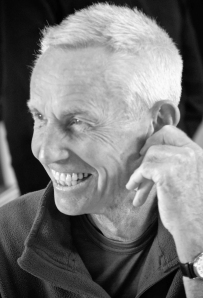

Graham Hurley
Photo credit: Laura Muños

About the Author

Graham Hurley is the author of the acclaimed Faraday and Winter crime novels and an award-winning TV documentary maker. Two of the critically lauded series have been shortlisted for the Theakston’s Old Peculier Award for Best Crime
Novel. The first Wars Within novel, Finisterre, was shortlisted for the Wilbur Smith Adventure Writing Prize.

Connect with Graham
Website | Twitter | Goodreads

#BookReview The Book of Echoes by Rosanna Amaka @RandomTTours

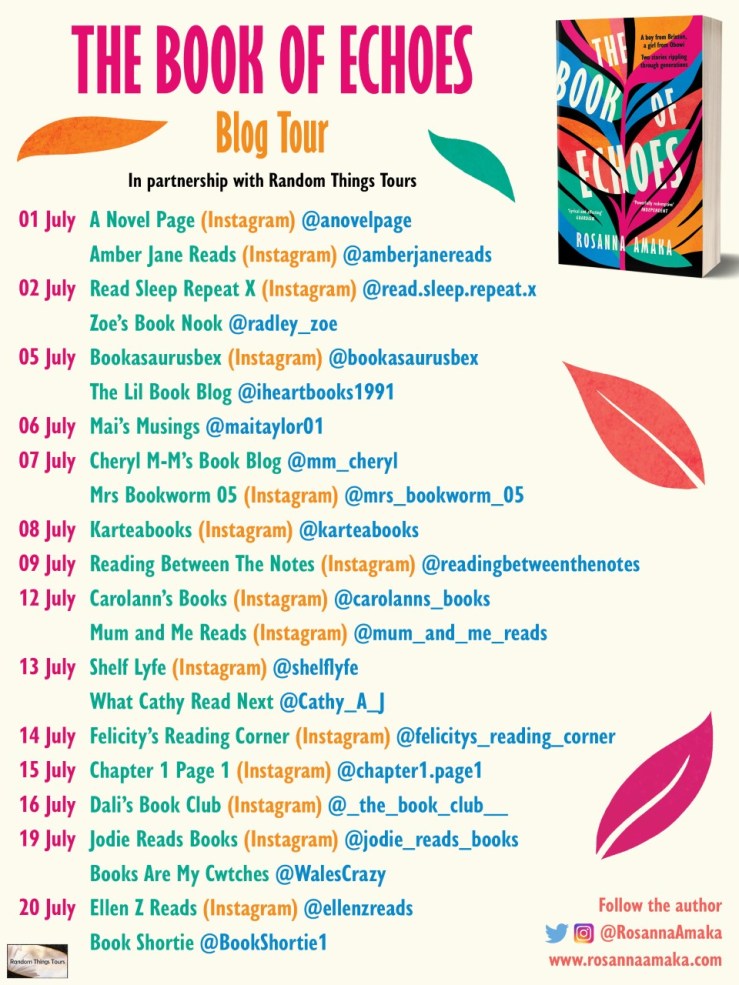
Book of Echoes BT Poster

Welcome to today’s stop on the blog tour for The Book of Echoes by Rosanna Amaka. My thanks to Anne at Random Things Tours for inviting me to take part and to Doubleday for my digital review copy.


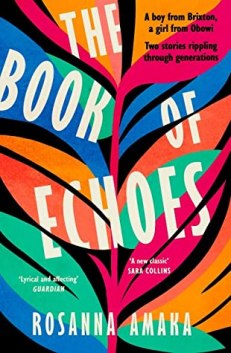
The Book of Echoes PBAbout the Book

Brixton 1981. Sixteen-year-old Michael is already on the wrong side of the law. In in his community, where job opportunities are low and drug-running is high, this is nothing new. But when Michael falls for Ngozi, a vibrant young immigrant from the Nigerian village of Obowi, their startling connection runs far deeper than they realise.

Narrated by the spirit of an African woman who lost her life on a slave ship two centuries earlier, her powerful story reveals how Michael and Ngozi’s struggle for happiness began many lifetimes ago.

Through haunting, lyrical words, one unforgettable message resonates: love, hope and unity will heal us all.

Shortlisted for the HWA Crown Debut Award
Shortlisted for the Royal Society of Literature Christopher Bland Prize
Shortlisted for the Authors’ Club Best First Novel Award

Format: Paperback (384 pages) Publisher: Black Swan
Publication date: 1st July 2021 Genre: Contemporary Fiction

Find The Book of Echoes on Goodreads

Purchase links
Bookshop.org
Disclosure: If you buy a book via the above link, I may earn a commission from Bookshop.org, whose fees support independent bookshops

Hive | Amazon UK
Links provided for convenience only, not as part of an affiliate programme


My Review

My first thought when reading the opening pages of this book was ‘Wait a minute, I thought it was set in the 1980s not the beginning of the 19th century?’.  I’ll confess my second thought was ‘What an earth is going on here?’. In fact, the opening pages are the reader’s introduction to the book’s (omniscient) narrator, the spirit of a long dead African woman uprooted from her village and sent as a slave to a sugar plantation in Jamaica. There was a lyrical, dreamlike quality to this section and her subsequent commentaries on the events she witnesses are rendered with a wisdom born of centuries spent observing human nature.

As well as serving as the book’s narrator, she also provides a link between events of the past and those in Brixton from the 1980s onwards. Drawing upon the echoes of the book’s title, she makes comparisons between the Brixton riots and the slave revolt she witnessed two hundred years earlier in Jamaica. As she observes, ‘I understand what being under siege can do to a person… I know it echoes inside them, that recognition of freedom being taken away as that baton of pain is passed on.’ Indeed, the idea that, depressingly, nothing much has changed when it comes to the treatment of black people is one the book frequently illustrates.

That mention of a baton is just one of a number of instances of its use as a metaphor for the concept of certain attitudes and character traits being passed between generations. For example, we learn that Michael’s reluctance to become a father is born out a fear of passing on the mental instability of his brother, Simon, or the lack of commitment of his father. And the hard-working attitude of Michael’s sister, Marcia, is also attributed to the legacy of earlier generations: ‘But the truth of it was in the blood, that desire, that wanting to heal, handed down from an ancestor who foraged in the bush, searching for plants to heal, who sat upon a ship in sheer despair heading to the new world, that baton of survival successfully passed on.’

The book switches, in several chapter-long chunks, between the experiences of Michael growing up in Brixton and of Ngozi, first in Nigeria and then in London. There are also brief interludes in which the reader learns a little of the harrowing story of the spirit narrator, including how she came to meet her fellow spirit, the man she calls Wind.

Michael is a complex character. On the one hand, his devotion to his sister Marcia and his determination, following the death of their mother, to find a way to continue funding Marcia’s education, is heartwarming. It’s this that leads him into risky and illegal ventures alongside his friend, Devon. On the other hand, Michael is promiscuous and has a surprising and rather unsettling attitude towards forming relationships with black women, as if he’s consciously trying to deny his own heritage. I found Ngozi a much easier character to like. Her story is particularly compelling as she searches for a way to fund her own education and support her family in Nigeria. Despite one setback after another, she retains her determination to achieve a better life for herself.

Both Ngozi and Michael experience personal loss, are forced to take on responsibilities at an early age, and witness scenes they cannot easily forget. The convergence of their two storylines when it finally occurs – have patience, dear reader – may not be unexpected, trailed as it is in the book description, but illustrates one of the other themes in the book, that of turning points. These turning points include chance encounters, decisions taken or choices made – the forks in the road, as it were – that determine future life courses.

The author creates a great sense of place whether that’s the bustling streets of Lagos, described as a city that ‘comes at you in surround sound’, or daily life in the community of south London. The latter includes a recognition of the contribution of the Windrush generation, exemplified by Michael’s Aunt Eliza and Uncle Fred. The rhythm of Nigerian speech, including use of vernacular words and phrases, is also much in evidence.

Usually the inclusion of an element of magical realism in a book would make me nervous but the way the author has used it, along with the book’s blend of historical and contemporary fiction, made The Book of Echoes a story which really lingers in the memory.

In three words: Colourful, imaginative, immersive

Try something similar: From A Low and Quiet Sea by Donal Ryan

Follow this blog via Bloglovin


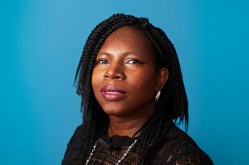
Rosanna Amaka Author picAbout the Author

Rosanna Amaka began writing The Book of Echoes twenty years ago to give voice to the Brixton community in which she grew up. Her community was fast disappearing – as a result of gentrification, emigration back to the Caribbean and Africa, or simply with the passing away of the older generation. Its depiction of unimaginable pain redeemed by love and hope was also inspired by a wish to understand the impact of history on present-day lives. Rosanna Amaka lives in South London. This is her first novel.

Connect with Rosanna
Website | Twitter | Instagram