BlogTour #BookReview Daughters of War (Daughters of War 1) by Dinah Jefferies @RandomTTours @fictionpubteam

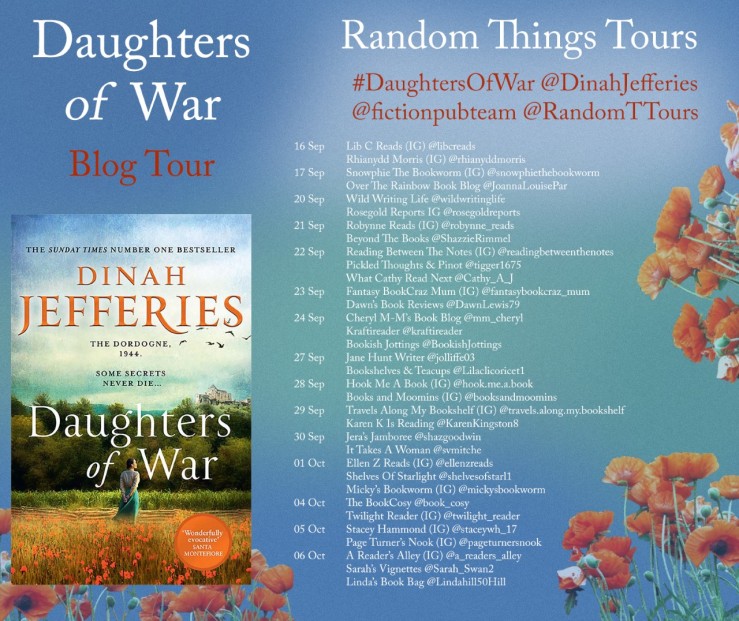
Daughters of War BT Poster

Welcome to today’s stop on the blog tour for Daughters of War by Dinah Jefferies, the first in a new series set in World War 2 occupied France. My thanks to Anne at Random Things Tours for inviting me to participate in the tour and to HarperCollins for my digital review copy.
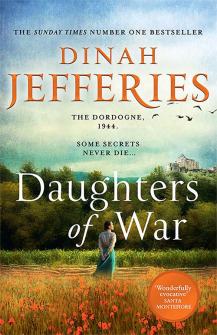

Daughters of War CoverAbout the Book

France, 1944. Deep in the river valley of the Dordogne, in an old stone cottage on the edge of a beautiful village, three sisters long for the end of the war.

Hélène, the eldest, is trying her hardest to steer her family to safety, even as the Nazi occupation becomes more threatening. Élise, the rebel, is determined to help the Resistance, whatever the cost. And Florence, the dreamer, just yearns for a world where France is free.

Then, one dark night, the Allies come knocking for help. And Helene knows that she cannot sit on the sidelines any longer. But bravery comes at a cost, and soon the sisters’ lives become even more perilous as they fight for what is right. And secrets from their own mysterious past threaten to unravel everything they hold most dear…

Format: Paperback (544 pages)              Publisher: HarperCollins
Publication date: 16th September 2021 Genre: Historical Fiction

Find Daughters of War (Daughters of War #1) on Goodreads

Purchase links
Bookshop.org
Disclosure: If you buy a book via the above link, I may earn a commission from Bookshop.org, whose fees support independent bookshops

Hive | Amazon UK
Links provided for convenience only, not as part of an affiliate programme


My Review

Told in alternating chapters from the point of view of Hélène, Élise and Florence, the author carefully delineates the three sisters’ personalities. Hélène is sensible, cautious and feels a keen sense of responsibility towards her younger sisters in the absence of their mother. Élise is impulsive, courageous but at times heedless of the risks to which she exposes herself and her sisters. Florence is sensitive, caring and has an instinctive feeling for the natural world.  At first, the sisters lead a charmed life, tucked away in their cottage and fortified by the food Florence seems to be able to create out of nothing.  They are also fortunate to have, or have come into their lives, three handsome men who offer them practical help, reassurance and often a little bit more.

It is Hugo, the local doctor, and his wife Marie, who initially experience the realities of life under the Nazis. However, everything also changes for the sisters following a brutal encounter (the nature of which may be triggering for some) which is quite different in tone from that of the book so far.  In fact, this event signals a change to a much more dramatic storyline during which the author explores in minute detail how each of the sisters respond emotionally to the often traumatic experiences they witness. The revelation concerning their mother towards the end of the book, although resolving a mystery signalled early on, may not come as that much of a surprise to the observant reader but does bring unexpected complications.

What the book does particularly well is convey the realities of life under German occupation: the violence of the Vichy-supporting Milice, the fear of reprisals for acts of sabotage by the Resistance, the shortages of food and fuel.  It’s a time of distrust, divided loyalties and uncertainty about what tomorrow might bring.  After all, how can you plan for the future when you don’t even know if you’ll be there to see it? ‘The world was cracking and splintering deep in its bowels. And people were falling through the cracks, never knowing which of them was going to meet their fate.’

Another strength of the book is its descriptions of the landscape of the Dordogne, a gift surely to the area’s tourist board.  So, through the eyes of the sisters, the reader is given a picture of ‘the languid twists of the river’ from which can be seen castles perched on high cliffs and fortified hilltop towers with old stone walls.

The first in a planned trilogy, in the concluding chapters of Daughters of War the author lays the groundwork for a number of possible story arcs in subsequent books.

In three words: Romantic, sweeping, dramatic

Try something similar: The Girl From Vichy by Andie Newton

Follow this blog via Bloglovin


Dinah Jefferies Author PicAbout the Author

Dinah Jefferies began her career with The Separation, followed by the number 1 Sunday Times and Richard and Judy bestseller, The Tea-Planter’s Wife. Born in Malaysia, she moved to England at the age of nine. As a teenager she missed the heat of Malaysia, which left her with a kind of restlessness that led to quite an unusual life. She studied fashion design, went to live in Tuscany where she worked as an au-pair for an Italian countess, and there was even a time when
Dinah lived with a rock band in a ‘hippie’ commune in Suffolk.

In 1985, the death of her fourteen-year-old son changed everything and she now draws on the experience of loss in her writing. She started writing novels in her sixties and sets her books abroad, aiming to infuse love, loss and danger with the extremely seductive beauty of her locations.

Connect with Dinah
Website | Twitter | Facebook
Daughters of War Graphic

#BlogTour #Extract The Garfield Conspiracy by Owen Dywer @midaspr @libertiespress

Welcome to today’s stop on the blog tour for The Garfield Conspiracy by Owen Dywer which was published on 7th September by Liberties Press. I’m delighted to be able to bring you an extract from the book. My thanks to Sofia at Midas PR for inviting me to take part in the tour. Do be sure to check out the reviews by the other book bloggers taking part in the tour.


The Garfield ConspiracyAbout the Book

Richard Todd, an award-winning writer, is outwardly successful but inwardly plagued by uncertainties. Worst of all, he can’t seem to write anymore. When a bright young editor, Jenny Lambe, arrives on his doorstep to work with him on his latest book, about the assassination of US president James Garfield, his life is sent spinning off in a new direction.

President Garfield was killed by Charles Guiteau, who was tried and hanged for the murder. But was he acting alone, or was there a more sinister force at work? Richard hears Guiteau’s voice in his head, and as his relationship with Jenny deepens, he is visited by other characters in the drama. Are they helping Richard solve the mystery surrounding Garfield’s murder – or pushing him further towards the edge?

A remarkable, disturbing portrait of a middle-aged man torn between his carefully constructed life and new adventures which may beckon, in the present and the past, from one of Ireland’s most exciting emerging authors.

Format: Paperback (256 pages)            Publisher: Liberties Press
Publication date: 7th September 2021 Genre: Contemporary Fiction

Find The Garfield Conspiracy on Goodreads


Extract from The Garfield Conspiracy by Owen Dwyer

“It was a queer, sultry summer, the summer they electrocuted the Rosenbergs.” Richard, picking up Jenny’s copy of The Bell Jar, read its opening sentence aloud. Aware of his weakness for distraction, he threw it on to the armchair and returned his attention to the laptop. Following some time considering the eternity of its dark grey screen, he turned it on. This he did with a sense of achievement, for having done something.

The terror of hearing Guiteau the previous day had sent him running back to bed. Once safely under the duvet, he pressed his hands over his ears and tried to expel the voice from his head. The memory of the conversation – for Guiteau could not talk directly to him under the “bed is safe” rule – kept replaying itself over and over, at varying speeds and volume. Eventually, and with mystifying suddenness, the loop stopped, and common-sense, creeping into the silence, told him the voice had not been real and therefore could not hurt him. Buoyed with this certainty, he had a shower and functioned normally for the rest of the day – which meant staring at daytime television until Jenny got home.

The Bell Jar was just another book now, in his collection, though at the time of its purchase, this small paperback had been a well-thought-through instrument of seduction. How had Leonard Cohen put it? “Seems so long ago.” Picking up his notebook with a sigh, he began to read the half-page of mangled prose he had written that morning. With neither the conviction to scrap it nor the energy to sift through it for something salvageable, he sat reading it softly to himself, returning to the beginning as soon as he had finished. Twenty minutes passed on the clock on the bottom of the screen, before his concentration was broken by the shadow of a crow passing over the skylight, followed by the clattering of its claws on the rooftiles. With the delicacy of ritual, he slowly closed the book and replaced it on top of some printed pages of nonsense from the previous week, and returned his attention to the laptop. With another sigh, this one through his nose, he clicked open the photo-gallery. There, a growing collection of snaps of him and Jenny formed the beginning of a new history. Even her photos – those images of her smiling face – were enough to give him hope. Somewhere inside the muffled chambers of his conscience, he knew he was exploiting her youth: she was fresh; he was stale. Her future was like a colourful bunch of balloons in a bright blue sky; his, a used condom in a gutter. And he was feeding on her vivacity like a parasite, shrivelling her heart as he engorged his own.

“My dear chap.” It was the original American voice, with its slow edge of sadness. “You mustn’t be too hard on yourself.”

Richard turned, and this time there was someone in the armchair. Someone who looked like James Garfield. He was flipping through the pages of The Bell Jar but put the book down to look directly at Richard.

“Oh, I think I can be hard on myself, Mr President.” Richard began shaking, like a wounded beast.

“Please, you must call me James when we’re alone. And you must not be afraid. You have nothing to fear from me.”

Garfield filled the armchair with his imposing bulk, but his eyes were what captivated. Though tired and sunken, they emanated an intelligent steel-blue sympathy. “I’m afraid I’ve screwed everything up, James.”

“You are not the first.”

“No, I don’t suppose I am. Still, doesn’t stop the pain. It rings in my head like a bell.” Garfield nodded his great head slowly. “I too had a liaison, you know. Not dissimilar to your own.”

“I know. I came across it in Millard’s biography.”

“Yes,” he said distantly, rubbing a forefinger and thumb through his beard. “Milliard.” They proceeded to have a discussion about Destiny of the Republic. Garfield, though impressed with the book, was not comfortable with some aspects of the treatment of the “spoils” issue. Blaine, he felt, had been unfairly depicted, and he thought the complexity of Conkling’s personality had not been fully explicated. They settled presently into an agreeable silence, which was broken by Garfield.

“Yes, old fellow,” he said, eyes mellowing. “I too have known transgression. She, like your Jenny, was much younger, and very striking.”

“How did it come about?” Richard asked, not knowing what else to say.

“I was away from home at the time, and in truth my relationship with Lucretia was at a particularly low point.”

Though feeling awkward to hear such a revelation from someone he had just met, never mind someone of Garfield’s stature, Richard politely enquired: “What was the problem?”

“There is no need for you to feel uncomfortable, old boy. I’m pleased to have someone to talk to about this.”

It was evident Garfield was the type of person who rarely took offence and was happy to discuss any subject in a relaxed way, Richard was feeling more and more comfortable in his company. “Please,” he said, in his telephone voice. “Do go on.”

“When we were married at first, Crete was quite cold, you know. Like me, she came from a Church of Christ background, and her mind was so filled with the convoluted axioms and biblical interpretations of that religion, that she found it difficult to allow joy into her heart.”

“Did it manifest itself in the bedroom?” Richard was curious to know if the indifferent sex between himself and Valerie, after he had fallen for Jenny, was a universal consequence of the transition from one woman to another.

If that small taster has whetted your appetite, you can find purchase links below.


Publisher | Hive | Amazon UK
Links provided for convenience only, not as part of an affiliate programme

Follow this blog via Bloglovin


Owen DwyerAbout the Author

Owen Dwyer is a prize-winning short-story writer who has won the Hennessy Emerging Fiction Prize, the Silver Quill (twice), the Smiling Politely Very Very Short Story competition, the South Tipperary County Council Short Story competition and the Biscuit Fiction Prize, and has had stories published in Whispers and Shouts magazine. His previous novel, Number Games, was published to glowing reviews by Liberties Press in 2019, and follows The Cherry-picker (2012) and The Agitator (2004). Owen lives in Dublin with his wife and their three children. (Photo/bio credit: Publisher author page)

Connect with Owen
Twitter | Goodreads