
 Welcome to today’s stop on the blog tour for Crow Court by Andy Charman. My thanks to Anne at Random Things Tours for inviting me to take part in the tour and to Unbound for my digital review copy. Do check out the posts by my tour buddies for today, Peter at Peter Turns The Pages and Lizzie at chapmanschaptersandpages.
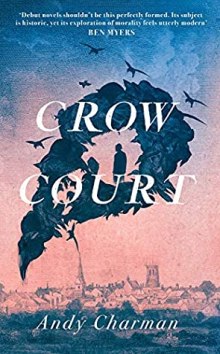 About the Book
Spring, 1840. In the Dorset market town of Wimborne Minster, a young choirboy drowns himself. Soon after, the choirmaster – a belligerent man with a vicious reputation – is found murdered, in a discovery tainted as much by relief as it is by suspicion. The gaze of the magistrates falls on four local men, whose decisions will reverberate through the community for years to come.
So begins the chronicle of Crow Court, unravelling over fourteen delicately interwoven episodes, the town of Wimborne their backdrop: a young gentleman and his groom run off to join the army; a sleepwalking cordwainer wakes on his wife’s grave; desperate farmhands emigrate. We meet the composer with writer’s block; the smuggler; a troupe of actors down from London; and old Art Pugh, whose impoverished life has made him hard to amuse.
Meanwhile, justice waits…
Format: Paperback (336 pages) Publisher: Unbound
Publication date: 3rd February 2022 Genre: Historical Fiction
Find Crow Court on Goodreads
Purchase links
Bookshop.org
Disclosure: If you buy a book via the above link, I may earn a commission from Bookshop.org, whose fees support independent bookshops
Hive | Amazon UK
Links provided for convenience only, not as part of an affiliate programme
My Review
A cross between a historical crime novel and a collection of short stories, Crow Court is inventive in structure and style. If, like me, you don’t get on with the first chapter which is written in the present tense using short, clipped sentences, do stick with it because, with a few exceptions, subsequent chapters are more conventional in style.
Set in the small Dorset town of Wimborne, the story unfolds over 20 years starting in 1840 with the murder of a choirmaster. If you’re looking for a conventional whodunnit, you won’t find it here. Crow Court is less about finding the solution to the murder of Matthew Ellis, Wimborne’s choirmaster, than the consequences of the event over the months and years that follow. In fact, although the reader knows that a murder has occurred, the rest of the locals don’t. They just know the choirmaster has disappeared. Since he was known locally as ‘Buggermaster’ and was thought to have caused the suicide of a choir boy, not many people are that bothered by his disappearance. However rumours are the currency of a small village and because of their actions or their connection to the choirmaster, four men come under suspicion.
What follows is a kind of 6 Degrees of Separation as various characters appear in a series of interlinked stories. Some of the connections are quite tenuous – they know someone who knew someone else who got their boots made by the village cordwainer – whilst others are more direct. It was fun spotting names that sounded familiar and then thinking, ‘Ah, I remember, he’s the brother of so-and-so’s friend’. Along the way, we learn quite a lot about Dorset life in the 1840s and 1850s, as well as about the local landscape.
One of the interesting features of the book is the way the author plays with different narrative styles. A good example is in the chapter, ‘The Third Person’. Divided into three parts, the first is written in the second person, the second in the first person and the final part – you guessed it – in the third person. And some of the stories, such as ‘Art’s Last Laugh’, feature Dorset dialect. (There’s a helpful glossary at the end of the book for those who don’t know a gawk hammer from a doughbeaked cowheart.)
Some of the stories border on digressions and could easily be read as standalone short stories. ‘The Voice O’ Strangers’ which describes the experience of a ferocious storm in the South Atlantic is one example. However there’s (just) enough of the mystery threaded through each of them, or connections with key characters, to maintain the reader’s interest and they are all carefully crafted. When the culprit is revealed I suspect I won’t be the only reader to go back and read the opening chapters again.
In three words: Inventive, engaging, characterful
Try something similar: The Western Wind by Samantha Harvey
Follow this blog via Bloglovin
 About the Author
Andy Charman was born in Dorset and grew up near Wimborne Minster, where Crow Court is set. His short stories have appeared in various anthologies and magazines, including Pangea and Cadenza. Crow Court is his first novel, which he worked on at the Arvon course at The Hurst in Shropshire in 2018. Andy lives in Surrey and is available for interview, comment and events.
Connect with Andy
Twitter

 Welcome to today’s stop on the blog tour for Sell Us The Rope by Stephen May. My thanks to Ceris at Sandstone Press for inviting me to take part in the tour and for my digital review copy via NetGalley.
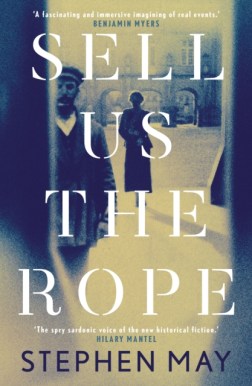 About the Book
 About the Author

 What Cathy Read Next...