
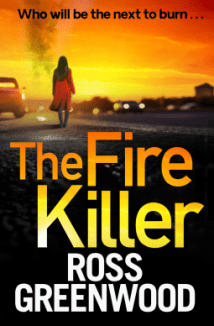
 Welcome to today’s stop on the blog tour for The Fire Killer (DI Barton #5) by Ross Greenwood. My thanks to Rachel at Rachel’s Random Resources for inviting me to take part in the tour and to Boldwood Books for my digital review copy via NetGalley. Do check out the posts by my tour buddies for today, Amanda at Ginger Book Geek and Stacey Hammond.
 About the Book
When DI Barton is asked to investigate a seemingly innocuous fire that kills, he believes it’s either children fooling around or a worrying racially motivated crime.
As he delves deeper into the case, he soon realises that there is a history of similar blazes spread out over many years, all within a close area. And after an idea is suggested by pathologist Mortis, Barton suspects he has the arsonist’s motives wrong.
When a night worker comes forward with a tip, Barton narrows down the suspects. Yet all of them act suspiciously and he knows for sure that one or more of them are lying. And when a huge house blaze shocks everyone, Barton fears the killer has lost all control.
Who is The Fire Killer? What will be next to burn?
Format: Ebook (365 pages) Publisher: Boldwood Books
Publication date: 30th May 2022 Genre: Crime
Find The Fire Killer (DI Barton #5) on Goodreads
Purchase links
Hive | Amazon UK
Links provided for convenience only, not as part of an affiliate programme
My Review
The Fire Killer is the first book I’ve read by Ross Greenwood and although it is the fifth in his DI Barton series I was immediately drawn into the story and quickly got to know the members of Barton’s team. Therefore I can reassure readers like myself who are new to the series that The Fire Killer can definitely be read as a standalone.
I liked the book’s structure. There’s an exciting opening scene that describe the events leading up to the culmination of the case before a shift back in time to a pivotal incident from ‘many years ago’. From that point on the story switches between Barton’s painstaking investigation into a series of cases of arson and the first person narrative of The Fire Killer. We know their background, witness their actions and the impulses that drive them but don’t know their identity. I had plenty of ideas but, thanks to the skill of the author, it wasn’t until near the end of the book that I finally twigged.
I really liked the relationship between Barton and Detective Sergeant Zander. They have a nice line in banter and bounce ideas off each other, contributing their different views of the investigation. It’s an investigation which, as Zander ruefully observes, turns out to be ‘an onion case’ with many layers each more bizarre than the last. In fact, as events unfold and they are left with more questions than answers, they wonder if they are investigating one case or two.
The investigation takes place against the backdrop of the Covid-19 lockdown. The empty streets and closed up shops create a real sense of atmosphere. And, as Barton observes, ‘Mankind didn’t need a virus to behave deplorably’. The book includes a number of damaged characters – there is one in particular who stands out – as well as individuals only too willing to feed off the vulnerabilities of others.
Barton comes across as an ‘old school’ policeman who’s grudgingly accepted that technology now plays a significant part in the detection of crime but regrets it takes some of the challenge out of it. The author gives us a neat in-joke when he has Barton despair at the difference between ‘real’ policing and what you see in TV dramas (or some crime fiction perhaps?). ‘A detective was sitting in a van, typing away at a computer, pulling up a variety of individuals’ call histories and credit-card statements. It was pure bullshit.’
I enjoyed the glimpses of Barton’s home life. The book sees him pondering his future given the toll his work has taken on him: the long hours, the missed family events. Equally, the dreadful things he has witnessed. Indeed, he will witness more in the course of this case. ‘He was proud to be a policeman, but he also knew he couldn’t do it forever, because each death left a mark.’ On the other hand, he recognises that his family’s love and support has provided a vital counterbalance. ‘When death surrounds you, life took on new meaning.’
The Fire Killer is an ingenious, well-crafted crime novel that kept me absorbed until the very last page.
In three words: Tense, gripping, suspenseful
Follow this blog via Bloglovin
 About the Author
Ross Greenwood is the bestselling author of ten crime thrillers. Before becoming a full-time writer he was most recently a prison officer and so worked every day with murderers, rapists and thieves for four years. He lives in Peterborough.
Connect with Ross
Newsletter | Twitter | Facebook | Instagram


 Today I’m delighted to be taking part in the blog tour to celebrate the special edition of After the Rising & Before the Fall by the acclaimed Irish historical novelist and poet, Orna Ross. It marks the centenary of the Irish Civil War of 1922/3 the events of which form the background to the books. Based on Orna’s own family history, the book was an instant bestseller when it was first published by Penguin Ireland 20 years ago. It has now been reissued by the author and is also being made available for the first time in audiobook format.
 And there’s also a giveaway (open internationally) with a chance to win a signed paperback copy of After the Rising & Before the Fall. Enter before 30th June 2022 by following this link
  About the Book
 About the Author
 What Cathy Read Next...