Blog Tour/Interview: The Dog Walker (The Detective’s Daughter #5) by Lesley Thomson

I’m delighted to host today’s stop on the blog tour for The Dog Walker by Lesley Thomson, the fifth instalment in the bestselling The Detective’s Daughter series. Lesley has kindly agreed to answer some questions about the book, its inspiration and her approach to writing.

Follow my blog with Bloglovin


TheDogWalkerCoverAbout the Book

A haunted house, a broken family and a body that has never been found. Stella and Jack must reawaken the secrets of the past in order to solve the mysteries of the present.

January, 1987. In the depths of winter, only joggers and dog walkers brave the Thames towpath after dark. Helen Honeysett, a young newlywed, sets off for an evening run from her riverside cottage. Only her dog returns. Twenty-nine years later, her husband has asked Stella Darnell, a private detective, and her sidekick Jack Harmon, to find out what happened all those years ago. But when the five households on that desolate stretch of towpath refuse to give up their secrets, Stella and Jack find themselves hunting a killer whose trail has long gone cold.

TheDogWalkerBook Facts

  • Format: Hardcover
  • Publisher: Head of Zeus
  • No. of pages: 400
  • Publication date: 6th April 2017
  • Genre: Crime

To purchase The Dog Walker from Amazon.co.uk, click here (link provided for convenience, not as part of any affiliate programme)


Q&A: Lesley Thomson, author of The Dog Walker

Without giving too much away, can you tell me a bit about The Dog Walker?

It’s a story of a place as much as of people. Five cottages near a dark lonely towpath beside the River Thames. The only people who go there at night are dog walkers and joggers. In 1987 a woman disappears and is presumed murdered. The crime is never solved. 29 years on the woman’s husband asks Jack and Stella to find out what happened to her. The story involves lots of scary scenes and a few dogs.

How did you come up with the idea for The Detective’s Daughter series and, in particular, the character of Stella?

A cleaner and a detective share something in common. Both encounter scenes of relative chaos and restore order. Both have a forensic eye for detail and get to enter a lot of different premises, legitimately. However, it struck me as interesting if the cleaner had a link to a detective yet was in contention with that role. Stella wanted to break away from her father so at eighteen refused to join the police. She struck out on her own as a cleaner. But as the series has progressed she grows closer to her dead father and accepts her ‘investigator’ heritage.

The Dog Walker is the fifth book in The Detective’s Daughter series.  What are the challenges of writing a series compared to a standalone novel?

There are not many. It’s a pleasure to revisit characters that develop with each novel. The main challenge is that previous books obviously set ‘facts’ in stone. Then again I like working within some boundaries; I have to dig deeper. Mainly though, a series gives me opportunities to develop less prominent characters, show the changes experience has wrought upon Jack and Stella over a longer story arc. One of these strands is the changing relationship between Stella and Jack and their personal journeys.

Are you a dog walker yourself?

I am. It’s how I came up with the idea. I walk my dog on dark early mornings in empty eerie places. One day it occurred to me that I assumed that the people I’d meet were other dog walkers and that therefore I was safe. But what if I was wrong?

You wrote a short story, The Runaway, about Stella’s childhood.  What was the motivation for this?

It was a chance to open a window into Stella’s past that in a novel would be a distraction from the story. I wanted to explore her early years – the seven year old Stella paid dearly for her parents’ break up – it has contributed to who she has become.

When writing, do you like to have the plot fully worked out or see where the story takes you?

Like Stella I’m a Spreadsheet Queen. I plot out the story, chapter by chapter, including who’s in each chapter, what happens and why. This plan will change as I write. I revisit the spreadsheet and add or takeaway proposed chapters. But I need to know the entire story before I start and this includes the final scene. Within the chapters things will happen that I hadn’t planned.

Do you have a special place to write or any writing rituals?

I write in a tiny study overlooking the Sussex Downs. Even when it’s grey and misty outside I have a long view and lots of light. I start at the same time every day, break for coffee at 11, lunch at 1 and a walk with the dog. Back after about an hour and then work until 5.30. I drink from a particular mug that I never use outside work time (you did ask). I could go on, but best that I don’t….

What other writers do you admire?

Many, but here’s a few: Wilkie Collins, The Brontës, Charles Dickens, Patricia Highsmith, Ruth Rendell and Ngaio Marsh. Contemporary: Elly Griffiths, Tana French, Michael Connelly, Kate Atkinson and Donna Tartt.

I know you teach creative writing.  What is the main piece of advice you give your students?

To get inside the story you’re telling, live and breathe it; believe in its truth. Write the story you want to read, not one you think others would like because how can you cover everyone’s tastes? Above all: keep writing.

What are you working on next?  Are there further cases waiting for Stella?

Yes there are. Stella and Jack move to the countryside to try to solve the murder of a young woman forty years ago. Living in a large old house in the middle of nowhere gradually, as the clues fall into place, they see that the murderer is still out there.

Thank you, Lesley, for those fascinating answers – especially the clues about the next The Detective’s Daughter book!


LesleyThomsonAbout the Author

Lesley Thomson grew up in west London. Her first novel, A Kind of Vanishing, won the People’s Book Prize in 2010. Her second novel, The Detective’s Daughter, was a #1 bestseller and sold over 500,000 copies. Lesley combines writing with teaching creative writing. She lives in Lewes with her partner.

Connect with Lesley

Website http://lesleythomson.co.uk/
Facebook https://www.facebook.com/LesleyThomsonNovelist?ref=tn_tnmn

Follow the tour
TheDogWalkerBlogTourBanner

Blog Tour & Guest Post: The Body in the Ice by A.J. MacKenzie

I’m delighted to be hosting today’s stop on the blog tour for The Body in Ice by A. J. MacKenzie, a historical mystery set on Romney Marsh, Kent.   You’re in for a real treat because I have a guest post by the authors entitled ‘Secrets of Romney Marsh’.   If any of you have visited Romney Marsh, you’ll know what a spooky place it can be!
Follow my blog with Bloglovin


TheBodyInTheIce2About the Book

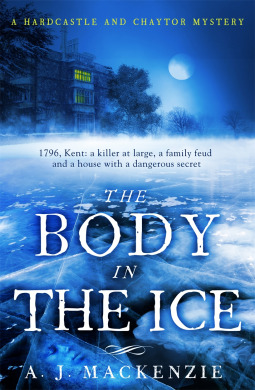
Christmas Day, Kent, 1796. On the frozen fields of Romney Marsh stands New Hall; silent, lifeless, deserted. In its grounds lies an unexpected Christmas offering: a corpse, frozen into the ice of a horse pond. It falls to the Reverend Hardcastle, justice of the peace at St Mary in the Marsh, to investigate. But with the victim’s identity unknown, no murder weapon and no known motive, it seems like an impossible task. Working along with his trusted friend, Amelia Chaytor, and new arrival Captain Edward Austen, Hardcastle soon discovers there is more to the mystery than there first appeared.  With the arrival of an American family torn apart by war and desperate to reclaim their ancestral home, a French spy returning to the scene of his crimes, ancient loyalties and new vengeance combine to make Hardcastle and Mrs Chaytor’s attempts to discover the secret of New Hall all the more dangerous. The Body in the Ice, with its unique cast of characters, captivating amateur sleuths and a bitter family feud at its heart, is a twisting tale that vividly brings to life eighteenth-century Kent and draws readers into its pages.

Book Facts

  • Format: Hardcover
  • Publisher: Bonnier Zaffre
  • No. of pages: 368
  • Publication date: 20th April 2017
  • Genre: Historical Fiction, Mystery

To purchase The Body in the Ice from Amazon.co.uk, click here (link provided for convenience, not as part of any affiliate programme)


Guest Post: ‘Secrets of Romney Marsh’

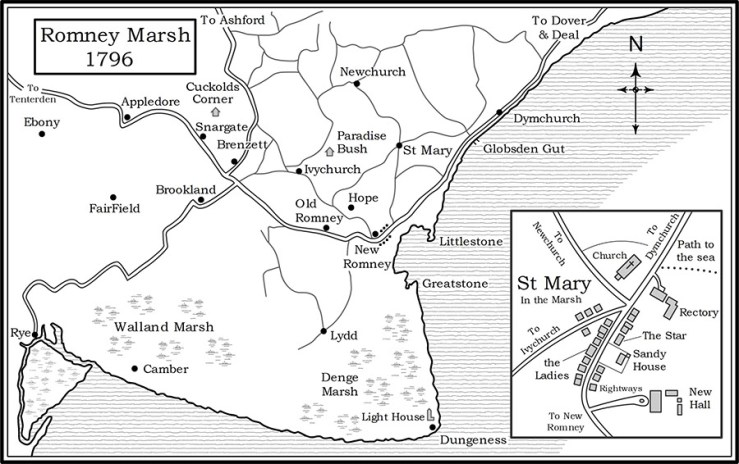
The landscape of Romney Marsh hasn’t changed that much over the years. There are more trees now, and fewer people. The ground is dryer, thanks to better drainage after the Royal Military Canal was built two centuries ago, and many fields are now ploughed. Of course you have to shut your eyes to the power station at Dungeness and the wind farm on the Guldford Levels. But apart from that, you can still stand and let the wind rush around you and listen to the murmur of the sea, just as Reverend Hardcastle and Mrs Chaytor did long ago. Many of the roads are now paved, but are still very narrow and bounded by drainage ditches and need to be negotiated with care. Bicycles are now more of a hazard than the wagons that slowed Mrs Chaytor down in The Body on the Doorstep.

One of the finest features of Romney Marsh are its churches. Built in the Middle Ages, when the Marsh grew rich and populous on the back of the wool trade, they range from intimate little buildings, barely larger than chapels, like St Clement’s at Old Romney or lonely St Thomas a Becket at Fairfield, to magnificent buildings rising like lighthouses above the flat lands. All Saints at Lydd at St Nicholas at New Romney are true landmarks, their tall towers visible for miles across the Marsh. So too is the smaller church at St Mary in the Marsh. One can imagine mariners at sea taking bearings on it and using it as a landmark.

More secretive and hard to find are the ruins of other churches, crumbling back into the ground. These churches were abandoned after the communities around them were laid waste by the Black Death and malaria, or ‘marsh fever’. Hope was one such village; the church of All Saints there is now no more than a few fragments of stone. (In The Body in the Ice, set two hundred years ago, we have given the ruined church rather more substantial walls.) Blackmanstone is a single fragment of wall, overgrown among the trees. If you stop on the roadside and look hard enough, you will eventually spot the few remaining stones of the church at Midley, next to a working farm.

Remants of Roman occupation of the area can also be glimpsed. All Saints Lydd has one wall surviving from an earlier Roman building. The settlement at Portus Lemanis looks over the marsh low on the hill at Lympne. Glimpses of re-used Roman carving and sculpture can be found in the corners of the Marsh’s churches.

Some secrets of the Marsh are now a matter for public pride. Go into a pub anywhere on the Marsh and the chances are it will boast a smuggling connection. In many cases – the Woolpack near Fairfield, the Ship in New Romney, the Star in St Mary in the Marsh – this is verifiably true. But two hundred years ago no one would have talked openly about smuggling in public; not with Customs snitches lurking and listening. Smuggling was an offence punishable by death. The smugglers and their families kept their mouths closed, and watched every stranger with suspicion.

One of the best kept secrets of the Marsh is also the most ghoulish. Hidden away below the chancel of St Leonard’s church in Hythe is an ossuary. One of only two in the country, the ossuary is a bone store, believed to have been created in the Middle Ages when bodies had to be removed from graves to make way for new burials. There are about 2,000 skulls in the ossuary, neatly arranged on wooden shelves, and around 8,000 other assorted bones.

Today the Marsh is green and peaceful, quiet and off the beaten track. Its landscape has been forged by men (and sheep) over many centuries. Its churches and its ruins hold many secrets; and some have yet to be discovered.
TheBodyintheIceMap


AJMackenzieAbout the Authors

A.J. MacKenzie is the pseudonym of Marilyn Livingstone and Morgen Witzel, a collaborative Anglo-Canadian husband-and-wife duo. Between them they have written more than twenty non-fiction and academic titles, with specialisms including management, medieval economic history and medieval warfare.  The original idea for The Body…series came when the authors were living in Kent, when they often went down to Romney Marsh to enjoy the unique landscape and the beautiful old churches. The authors now live in Devon.

Connect with the authors

Twitter  https://twitter.com/AJMacKnovels
Website http://www.ajmackenzienovels.com/
Facebook https://www.facebook.com/AJMacKenzienovels/
Pinterest https://uk.pinterest.com/bonnierzaffre/the-body-on-the-doorstep/?etslf=7279&eq=body%20on%20the%20

Follow the tour
TheBodyInTheIceTour