Blog Tour: Emperor by Andrew Frediani

Emperor BLOG TOUR BANNER

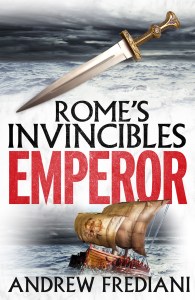
As regular followers of What Cathy Read Next will be only too aware by now, I love my historical fiction. One of my favourite time periods for historical fiction novels is Ancient Rome. Throw in a bit of political intrigue and I’m a happy reader. So I’m thrilled to be hosting today’s stop on the blog tour for Emperor, the latest in Andrew Frediani’s Rome’s Invincibles series.

I have a wonderful extract below to give you a taste of this thrilling third instalment in the story of Octavian and his rise to power.
Follow my blog with Bloglovin


EmperorAbout the Book

The battle for control of Rome continues. Will Octavian succeed in defeating the dangerous pirate Sextus Pompeius?

Octavian has defeated and killed Caesar’s assassins, but the road to absolute power is still long and treacherous. Threat now comes from Sextus Pompeius – a cunning pirate active along the Italian coasts, who terrorises Perugia’s citizens with his constant attacks. Octavian and his associates don’t have time to celebrate their victory in the final battle in the civil war before another even more bloody threat arises: the one presented by Sextus Pompeius at sea. The long campaign against the pirates proves frustrating, and often sees Octavian close to defeat and even death. Everything seems to conspire against him: his enemy appears to be receiving divine assistance, public opinion is against him, the soldiers lack confidence in their commander, and rebellion is just around the corner…

Format: ebook (398 pp.)                 Publisher: Aria
Published: 1st September 2017     Genre: Historical Fiction

Purchase Links*
Amazon.co.uk ǀ Kobo ǀ iBooks ǀ Google Play
*links provided for convenience, not as part of any affiliate programme

Purchase the previous books in the series from Amazon

Find Emperor on Goodreads


Extract from Emperor by Andrew Frediani

I

It was better not to get too close to the two severed heads that hung from the rostrum in the middle of the Forum.

By now, they were no more than lumps of decomposed, rotten flesh peeling from skulls, the orbs of the eyes empty, the remaining tufts of matted hair plastered to the cranium and the lips stretched out in a grim rictus of death.

A shiver of disgust went through Gaius Cilnius Maecenas as he contemplated the awful things.

He was surprised by the small crowd that had gathered around what was left of Brutus and Cassius, two assassins of Julius Caesar who had been killed at Philippi just over a month ago. It was extraordinary that people continued to go to the forum to watch them rot after they had already been there for a week.

He turned to Octavian. ““Why do you think they are attracted to these two disgusting trophies?” he asked. As he spoke, he felt a throb of pain in his side: it happened every time he spoke since he had been injured in Macedonia – and by a friend, not by the enemy.

“I was just wondering myself whether they come here on a pilgrimage out of some kind of veneration for the murderers of Caesar or whether they do it to express their contempt…” replied Octavian, who was also unwell and still weakened by the disease that had prevented him fighting in the first battle of Philippi. Yet, he had more than made up for that in the second, fighting on the front line despite not yet having fully recovered, but the effort of it had cost him dearly over the following weeks, and he had been taken ill while they were aboard the ship returning to Italy.

“Probably both, I would imagine,” remarked Agrippa, pointing to the heap of rubbish at the base of the Rostra beneath the two heads. “This stench isn’t the smell of decomposition. They come here to throw stuff at them…”

“Especially when they see that there are members of the triumvirate present,” added Salvidienus Quintus Rufus, the fourth member of the brotherhood that the young heir of Caesar had been assembling for the last two years with the aim of avenging his adoptive father and succeeding him in power. Rufus indicated a plebeian who threw a stone at the two heads, then looked round at them for approval. Soon afterwards a woman with a basket of vegetables hanging from her arm copied him, then smiled at the four men who, surrounded by their bodyguards, stood off to one side observing the scene. Not content, she then began to insult what remained of Brutus and Cassius and those nearby hastened to imitate her.

“It’s no coincidence that there are no senators about, then…” commented Maecenas. “These two are martyrs to freedom, as far as many of them are concerned and they would rather not compromise themselves by coming here. Quite apart from the fact that it would be beneath their dignity to shout insults or throw fruit – if there are actually any of them who hated Brutus and Cassius enough to do so, which I doubt.”

“Yes. If any of them have been here, then they’ve done so in disguise – perhaps dressed as commoners,” mused Agrippa. “And certainly not to insult them – to honour them, perhaps…”

“It remains to be seen just how strong this opposition in the Senate actually is. And what measures we will have to take in that regard,” said Rufus, who, as always, went straight to the point.

Maecenas was beginning to find it hard to tolerate the man. Just before the Battle of Philippi, the sect of Mars Ultor, which Octavian led with their assistance, had been on the verge of falling apart: rivalries, suspicions, failures and murders had compromised the mission that was the reason for the group’s very existence. And then at Philippi things had gone well, mainly, it had to be admitted – in private, at least – thanks to Mark Antony, the unwitting ally of the sect who had led Caesar’s armies to victory. It was thanks to that success that Octavian had been able to consolidate the group and resume his role as triumvir. There was still much to do, both in order to build the society that he and the other members of the sect desired and to finish avenging Julius Caesar and the other fallen members of his family.


Frediani_Andrew_400pxhAbout the Author

Andrew (Andrea) Frediani is an Italian author and academic. He has published several non-fiction books as well as historical novels including the INVINCIBLE series and the DICTATOR trilogy. His works have been translated into five languages.

Connect with Andrea

Website ǀ Facebook ǀ Goodreads

Connect with Aria

Website ǀ Facebook ǀ Twitter ǀ Instagram


Blog Tour/Review: The Smallest Thing by Lisa Manterfield

TheSmallestThingTourBanner-1

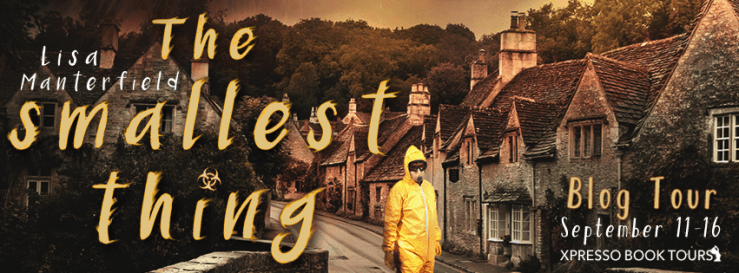
I’m delighted to host today’s stop on the blog tour for The Smallest Thing by Lisa Manterfield, a modern day re-telling of the story of the so-called ‘plague village’ of Eyam. You can read my review of this interesting and thought-provoking story below.

You can read the reviews of all the other bloggers on the tour via the tour schedule here.


TheSmallestThingAbout the Book

The very last thing 17-year-old Emmott Syddall wants is to turn out like her dad. She’s descended from ten generations who never left their dull English village, and there’s no way she’s going to waste a perfectly good life that way. She’s moving to London and she swears she is never coming back. But when the unexplained deaths of her neighbours force the government to quarantine the village, Em learns what it truly means to be trapped. Now, she must choose. Will she pursue her desire for freedom, at all costs, or do what’s best for the people she loves: her dad, her best friend Deb, and, to her surprise, the mysterious man in the HAZMAT suit? Inspired by the historical story of the plague village of Eyam, this contemporary tale of friendship, community, and impossible love weaves the horrors of recent news headlines with the intimate details of how it feels to become an adult – and fall in love – in the midst of tragedy.

Format: ebook (272 pp.), paperback (288 pp.)      Publisher: Steel Rose Press
Published: 18th July 2017                                           Genre: YA

Purchase Links*
Amazon.co.uk ǀ Amazon.com ǀ Barnes & Noble
*links provided for convenience, not as part of any affiliate programme

Find The Smallest Thing on Goodreads


My Review

The Smallest Thing was a slow burner for me as, until a good way into the book, I struggled to engage with the main character, Emmott Sydall. I guess I just found it difficult to think back to how I was as a teenager (it was a while ago!), believing the universe revolved around me and my plans, and rebelling against any seeming constraint placed upon them.

Initially, the arrival of the mysterious illness in the village and the quarantining of its inhabitants is more irksome than anything else to Emmott. It’s just an obstacle in the way of her plans to escape what she perceives as the boredom of village life for the bright lights and excitement of London.  However, the author quite cleverly shows us how Emmott develops and matures as the book progresses, as the impact of the illness becomes more significant and, especially, as it comes closer to home.

As the illness makes its seemingly inexorable progress, it’s fear that is now the primary emotion provoking unrest and suspicion amongst the villagers and threatening the once solid community spirit of the village. A quiet village that used to welcome only day trippers is transformed into a place of isolation tents, military barricades and workers in HAZMAT suits.

Given the restrictions and the decontamination protocols that the inhabitants are urged to adopt, Emmott finds it difficult to understand her Dad’s need to continue his outreach work in the community, concerned about the risk to which it exposes them. Only towards the end of the book does Emmott come to appreciate how much a simple act – the smallest thing, in fact – can mean to another person at a time of crisis. Her friendship – and perhaps something more – with Aiden, one of the medical staff helping the stricken villagers, provides an example of self-sacrifice that will leave a lasting impression on Emmott and sustain her through the ordeal.

The book is inspired by the so-called ‘plague village’ of Eyam where in 1665, in response to an outbreak of the plague, the villagers voluntarily cut themselves off from the outside world in order to prevent the spread of the disease. As well as being based in Eyam, The Smallest Thing is peppered with references to locations in the actual village, such as Cucklett Delf, and to its real life inhabitants such as Emmott Syddall and Reverend Mompesson. Where it departs is that, in the modern day story, it is outside forces in the form of the authorities who impose the quarantine on the village rather than the villagers choosing to do so themselves.

I found the details of the isolation and containment procedures really convincing and the information about how a virus of this kind would spread, peak and then burn out was fascinating, if chilling. It certainly brought home how devastating an outbreak of an illness for which there is no known cure could be, triggering thoughts of the recent Ebola epidemic in West Africa.

I received a review copy courtesy of the author and Xpresso Tours in return for an honest and unbiased review.

Follow my blog with Bloglovin

In three words: Dramatic, realistic, thought-provoking


LisaManterfieldAbout the Author

I’m Lisa Manterfield and I love telling stories. I’m a curious cat and I’m fascinated by human behaviour and what makes people tick. I love fish-out-of-water stories of ordinary people in extraordinary situations, especially if those situations delve into the unexplained. I love digging up nuggets of history—not the vast sweeping stories of events that changed the world, but the personal stories of people making their way through life while history happened around them. Like many of my characters, I grew up in the north of England. Although my hometown of Sheffield is a big city, I fell head-over-heels in love with the surrounding countryside and spent most of my early years outdoors. In school, I became my county’s orienteering champion, which means I was a whizz at navigating with a map and compass, and thrashing my way through mud and brambles.

These days, you’re more likely to find me riding my bike at the beach or running (slowly) the trails near my home in California. I’ve always loved adventure. My first expedition happened when I was two years old and I escaped through a gap in the fence around my family’s house. Ever since, I’ve loved exploring, whether that means heading into the woods for a hike, traveling to new countries, learning a new skill, or escaping into a great book. Some of my favorite adventures include hiking the Inca Trail in Peru, climbing a via ferrata in Italy, feeding a rhinoceros at the zoo, seeing elephants in the wild, performing in a play, teaching myself to play the bagpipes, learning to cook Indian food, canoeing down a river, and bicycling around Ireland.

Despite my love of adventure, most days you’ll find me in slippers, writing. In my house, I am the fixer of all things broken and guardian of the bathtub spiders. I’m lucky enough to share my home with my lovely husband, and Felicity, my seriously over-indulged (and very curious) cat.

Connect with Lisa

Website ǀ Facebook ǀ Twitter ǀ Instagram ǀ Goodreads ǀ Pinterest
buttonxbt