
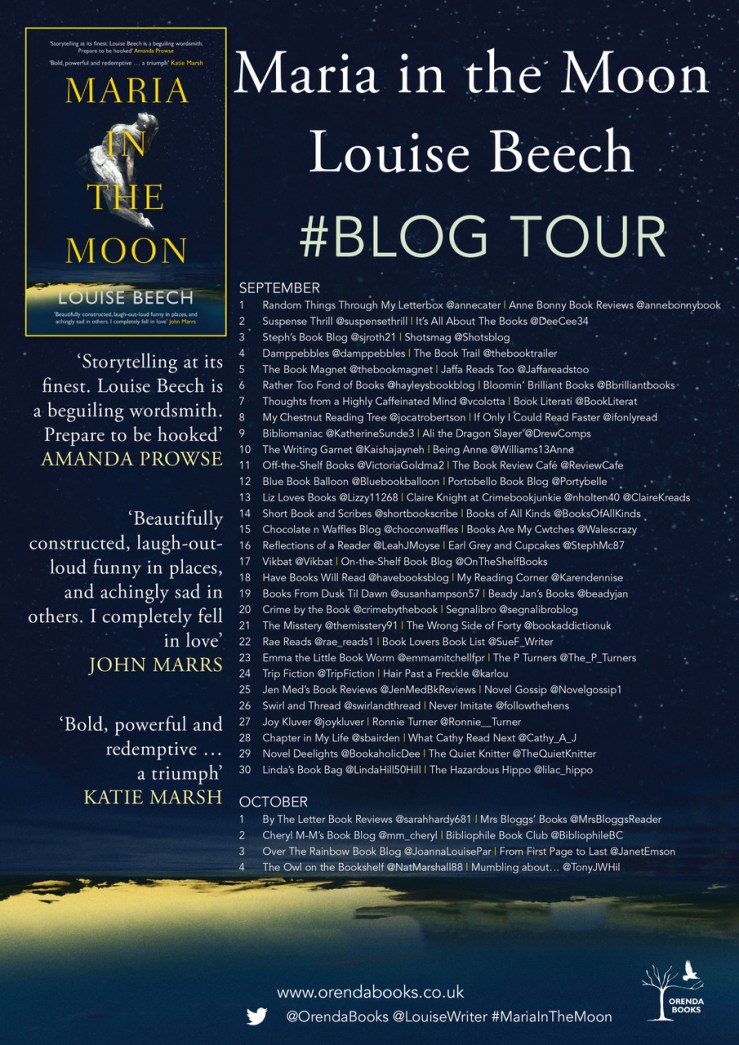
I’m thrilled that it’s finally my turn (along with the lovely Chapter in my Life) to host today’s stop on the blog tour for Maria in the Moon by Louise Beech. It seems like everywhere I’ve looked for about the past two months other book bloggers have been raving about this book. Do you know what? They were right. My first act after turning the last page – apart from having a little sniffle – was to move Louise’s previous two books (The Mountain in my Shoe and How To Be Brave) closer to the top of my TBR pile.
I received an advance reader copy courtesy of Anne at Random Things Through My Letterbox and publishers, Orenda Books, in return for an honest review.
 About the Book
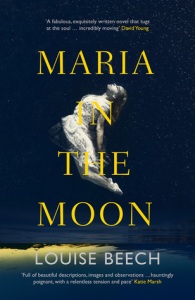
Long ago my beloved Nanny Eve chose my name. Then one day she stopped calling me it. I try now to remember why, but I just can’t.’
Thirty-one-year-old Catherine Hope has a great memory. But she can’t remember everything. She can’t remember her ninth year. She can’t remember when her insomnia started. And she can’t remember why everyone stopped calling her Catherine-Maria. With a promiscuous past, and licking her wounds after a painful breakup, Catherine wonders why she resists anything approaching real love. But when she loses her home to the deluge of 2007 and volunteers at Flood Crisis, a devastating memory emerges… and changes everything. Dark, poignant and deeply moving, Maria in the Moon is an examination of the nature of memory and truth, and the defences we build to protect ourselves, when we can no longer hide…
Format: Paperback (276 pp.) Publisher: Orenda Books
Published: 30th Sep 2017 Genre: Contemporary Fiction
Purchase Links*
Amazon.co.uk ǀ Amazon.com ǀ iBooks
*links provided for convenience, not as part of any affiliate programme
Find Maria in the Moon on Goodreads
10 Things I Loved About Maria in the Moon by Louise Beech
- Using the 2007 floods in Hull as a pivotal event. Having, thankfully, never experienced such a traumatic event personally, it really brought home to me the long term consequences for people affected. From practical things – like the length of time it takes to dry out a home or the shortage of trades people to carry out repairs – to less obvious things – like the sense of displacement, the trauma associated with having your home and personal space invaded, the loss of possessions with a sentimental value and the emotional scars that can persist for years afterwards. “The rain caused all sorts of problems.” He slurped his coffee. “People clearing out their ruined belongings remembered things long buried: affairs, given-up babies, secret abortions. We hear these stories every day.”
- The callers to Flood Crisis. I found their stories moving and Catherine’s response to their stories even more moving. Thank God, such resources exist and that people exist to volunteer to take on such roles. Their stories also form an extremely clever aspect to the book in a number of ways. For example, Catherine’s compulsion to listen to others’ problems, to fill her memory with details of their troubles, is a way to block out her own. ‘I remembered all the calls. While my memory discarded my own history, it had no trouble with people who needed me to remember.’
- The significance of names. That nothing is more annoying than deliberately getting someone’s name wrong every time you meet them (especially if they’re particularly annoying themselves – hello, Sharleen/Celine, we’re talking about you). That nothing is more embarrassing then referring to someone by the nickname you’ve secretly given them, especially if it’s rather cruel. That the meaning behind names is important – like whether you’re “Mum” or “Mother” – and that we are to a certain extent characterised (at least for ourselves) by our names. That certain words can trigger painful memories.
- The humour. The nicknames – Aunty Hairy, Jangly Jane, Condom Kath. Catherine’s banter with Christopher, which supports my theory that if you find someone with whom you share a sense of humour that’s a sign of a good relationship.
- The supporting cast. My particularly favourites were Catherine’s best friend, the outrageous Fern, and Catherine’s lovely Aunt Mary.
- The acute observation of the writing about everyday things. Like the ritual of formal family meals, when everyone’s trying not to say or do anything out of turn, but it won’t be long before someone does. ‘They were all in the dining room. Like actors in a weekly soap opera they’d assumed the usual positions: Mother at the top near the walnut cabinet that displayed her pottery creations, me next to Celine, Graham opposite us with his back against the wall where the Constable print hung. The best blue-and-white swirly china was being given its weekly outing, and a silk cloth hid the plain table.’ Like the kitchen drawers that can only be opened one at a time.
- The character of Catherine. Yes, she’s spiky, a bit scruffy, rude to her mother and step-sister, clumsy, moody, thoughtless at times. But who hasn’t put their foot in it by saying the wrong thing or making a joke at an inopportune moment or laughed without thinking or meaning to when you should have expressed sorrow or horror? And Catherine has a wonderfully witty sense of humour, resilience and fantastic empathy with the callers to the crisis line. Most of all, she’s unbelievably brave.
- It made me think. About the nature of memory. About the things we choose to remember, those we choose to forget and those things we’ve even forgotten that we’ve forgotten. “We forget nothing – memories are always there. We’re just afraid to look. But why? Fear is just fear. All we have to do is look, and we won’t be afraid.”
- The ending. After all the emotions the author put us through as readers, I reckon we deserved that ending. To my mind, the sign of a great book is when the characters live so vividly in your mind that you feel as invested in what happens to them as (whisper) your own family.
- Finally, I loved that Louise Beech took the time to name check so many book bloggers and reviewers in her Acknowledgments. But, really, she doesn’t need to thank us because the joy we get from reading books as wonderful as Maria in the Moon is thanks enough.
 About the Author
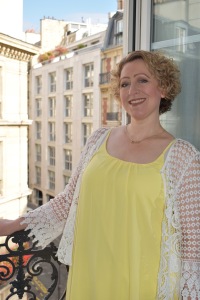
Louise Beech is an exceptional literary talent, whose debut novel How To Be Brave was a Guardian Readers’ Choice for 2015. The sequel, The Mountain in My Shoe, was shortlisted for Not the Booker Prize. Both books have been number one on Kindle, Audible and Kobo in USA/UK/AU. She regularly writes travel pieces for the Hull Daily Mail, where she was a columnist for ten years. Her short fiction has won the Glass Woman Prize, the Eric Hoffer Award for Prose, and the Aesthetica Creative Works competition, as well as shortlisting for the Bridport Prize twice and being published in a variety of UK magazines.
Louise lives with her husband and children on the outskirts of Hull – the UK’s 2017 City of Culture – and loves her job as a Front of House Usher at Hull Truck Theatre, where her first play was performed in 2012. She is also part of the Mums’ Army on Lizzie and Carl’s BBC Radio Humberside Breakfast Show.
Connect with Louise
Website ǀ Facebook ǀ Twitter ǀ Goodreads

 About the Book
 About the Author
 What Cathy Read Next...