Blog Tour/Excerpt: The Distance by Zoë Folbigg

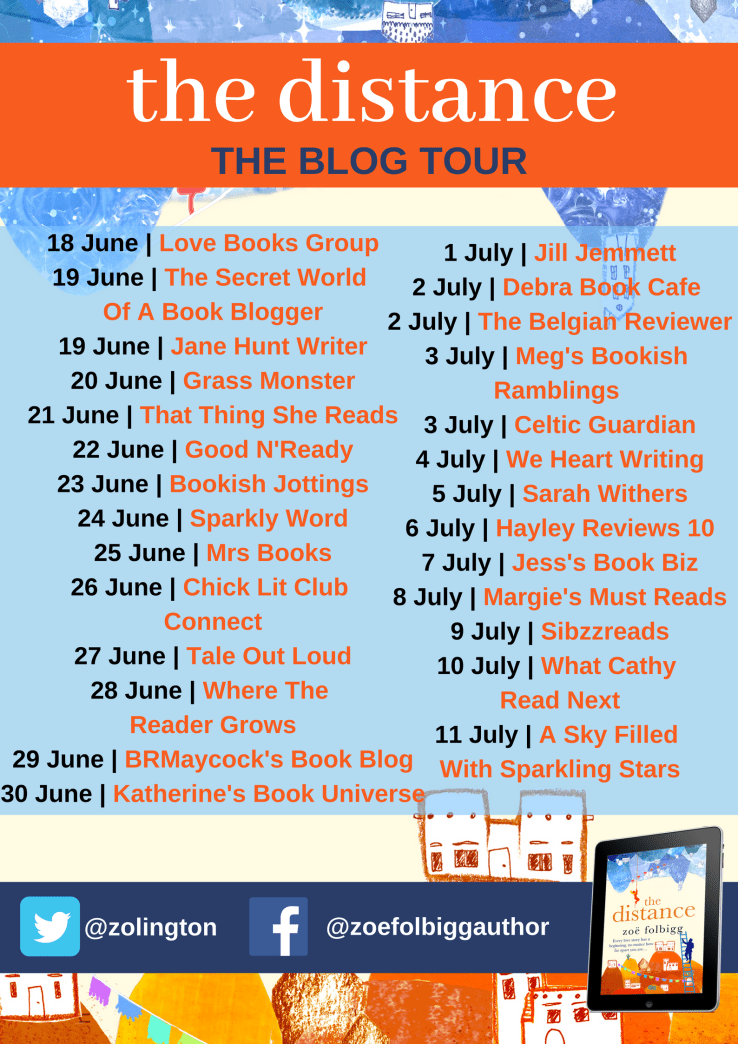
The Distance blog tour poster (1)

I’m delighted to be hosting today’s stop on the blog tour for The Distance by Zoe Folbigg, best-selling author of The NoteThe Distance is described as a ‘beautiful,  romantic  tale  of  finding  love  in  the  most  unexpected  places’.  It’s available now as an ebook and in paperback on 26th July 2018.

You can read an excerpt from the book below.
Follow my blog with Bloglovin


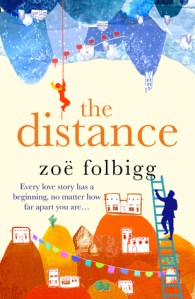
The DistanceAbout the Book

Under the midnight sun of Arctic Norway, Cecilie Wiig goes online and stumbles across Hector Herrera in a band fan forum. They start chatting and soon realise they might be more than kindred spirits. But there are two big problems: Hector lives 8,909km away in Mexico. And he’s about to get married.

Can Cecilie, who’s anchored to two jobs she loves in the library and a cafe full of colourful characters in the town in which she grew up, overcome the hurdles of having fallen for someone she’s never met? Will Hector escape his turbulent past and the temptations of his hectic hedonistic life and make a leap of faith to change the path he’s on?

Zoë Folbigg’s latest novel is a story of two people, living two very different lives, and whether they can cross a gulf, ocean, sea and fjord to give their love a chance.

Format: ebook, paperback (368 pp.)                                 Publisher: Aria
Published: 1st July (ebook), 26th July 2018 (paperback) Genre: Romance

Purchase Links*
Amazon.co.uk  ǀ  Kobo | iBooks | Google Play | Amazon.com  ǀ Hive.co.uk (supporting UK bookshops)
*links provided for convenience, not as part of any affiliate programme

Find The Distance on Goodreads


Excerpt: The Distance by Zoë Folbigg

Eight

June 2013, Day One

Cecilie wasn’t looking to cause trouble for herself the day she met Hector Herrera. She was in the library at 8 a.m., as usual, before chief librarian Fredrik came in at 8.30. The two of them would always chat quietly, genially, and be ready to open for 9 a.m. Cecilie always loved to hang out in the library before anyone else got there. It’s such a peaceful time of day. Dark in the winter; light all summer, the huge glass façade of the modernist four-storey building looks out onto the small grid of the town, the harbour, its bridges, its mountains beyond, the world below. Sometimes in winter Cecilie can see the Northern Lights through the window that rises all the way to the top floor. A green whisper arcing overhead, reminding her how isolated she is from the world she reads about in the books on the shelves.

That day, Cecilie didn’t go to the basement first, to sort out the children’s activity table. She didn’t put out the pencils and paper ready for the school trip, or the soft-back books and tambourines in anticipation of the baby rhyme-time session. That light and bright June morning, Cecilie got herself a milky coffee and went up the open staircase to the rows of computers on the first floor. She turned the machines on with a satisfying switch switch switch of the clean white sockets behind each terminal.

She looked up to the top floor, to the quiet reading and writing areas among the rows of books, but decided not to go up and turn the lights on, she didn’t want to draw attention to her private world in the public glass space. Anyway, it was June, and there was sufficient light night and day to not warrant them.

At the second terminal in, on the first row of machines, Cecilie leaned over the desk without sitting, typed in the staff login, and waited for a sand timer flipping over and over on itself to align her to another time. Another latitude she had no idea she would soon long for.

Switch switch switch. She stalked the library, awakening, opening, connecting, before coming back to the second terminal. She sat down at a screen, facing out over the Arctic Circle below her.

Cecilie tied her locks into a thick trunk running down her back and took a sip of milky white coffee, holding her cup with her thumbs threaded through holes in the wrist of her jumper. Cecilie went on her usual journey across the world: NRK for her news fix before the bundle of papers arrived. Facebook to see what friends who had set sail from this port town were up to, as far afield as Oslo, Edinburgh, San Francisco and Quito. Then her habitual look on NME to see what was going on in her favourite music sphere. At home Cecilie unwinds by playing the harp to an empty house, but picks herself up again to British synth-pop and electronica.

Depeche Mode played Leipzig last night.

Cecilie took a sip and sought out gig reviews, finding herself in a chatroom for other 80s electronica Anglophiles in no time. She thought she might scour the reviews, the forums, the chat, to find out about future concert dates that hadn’t yet been announced. She logged in and gave herself a moniker: Arctic Fox. With delicate hands that had dry pads for fingertips, she typed.

Arctic Fox: Anyone know if DM are coming to Scandinavia?

I Feel You: More likely Scandinavia than Mexico @arcticfox! Been too long since they came here.

Cecilie’s eyes widened and she marvelled at the world she was connected to. Like-minded music fans thousands of kilometres away.


Zoe FolbiggAbout the Author

Zoë Folbigg is a magazine journalist and digital editor, starting at Cosmopolitan in 2001 and since freelancing for titles including Glamour, Fabulous, Daily Mail, Healthy, LOOK, Top Santé, Mother & Baby, ELLE, Sunday Times Style, and Style.com. In 2008 she had a weekly column in Fabulous magazine documenting her year-long round-the-world trip with ‘Train Man’ – a man she had met on her daily commute. She has since married Train Man and lives in Hertfordshire with him and their two young sons. She is the bestselling author of The Note.

Connect with Zoë

Website  ǀ  Facebook ǀ  Twitter  ǀ  Instagram ǀ Goodreads

Blog Tour/Book Review: Call of the Curlew by Elizabeth Brooks

Along with my tour buddy, Novels and NonFiction, I’m delighted to be hosting today’s stop on the blog tour for Call of the Curlew by Elizabeth Brooks.  Many thanks to Anne at Random Things Tours for inviting me to join the tour and for Hannah Bright at Doubleday for my review copy.  You can read my review of this haunting and atmospheric book below.

Do check out the tour banner at the bottom of this post to see the other great book bloggers taking part in the tour.


Call of the CurlewAbout the Book

Virginia Wrathmell has always known she will meet her death on the marsh.

It’s New Year’s Eve 2015 and eighty-six year old Virginia Wrathmell feels like the end is upon her. As she looks out on the dark and desolate marshes that surround the house she’s lived in since she was young, Virginia is overcome with the memories of one winter that have stayed with her since childhood.

It’s New Year’s Eve 1939 and Virginia is eleven, an orphan arriving to meet her new parents at their mysterious house, Salt Winds, on the edge of a vast marsh. War feels far away out here amongst the birds and shifting sands – until the day a German fighter plane crashes into the marsh. The people at Salt Winds are the only ones to see it.

When her adopted father goes missing, and a mysterious stranger arrives in his place, Salt Winds becomes a very dangerous place to be. Virginia’s failure to protect the house’s secrets will leave her spending a lifetime dealing with the aftermath.

“The wind has dropped, but every now and then a gust will shiver in from the sea, carrying some fragment – a feather, a straw, a grain of sand, the scent of snow, the dainty bone of a bird – by way of an offering to the house.”

From the author:

“The location, Tollbury Marsh, came to me first, the story second. The marsh is a place on the edge of normal life, which seems flat and accessible to the uninitiated, but is actually full of dangers. I wanted to capture the strong and pervasive sense of place that I felt when reading The Woman in Black and Great Expectations.”

Format: Hardcover, ebook (320 pp.)    Publisher: Doubleday
Published: 28th June 2018                      Genre: Historical Fiction

Purchase Links*
Amazon.co.uk  ǀ  Amazon.com  ǀ Hive.co.uk (supporting UK bookshops)
*links provided for convenience, not as part of any affiliate programme

Find Call of the Curlew on Goodreads


My Review

Somehow it doesn’t seem quite right that I’ve been reading Call of the Curlew sitting in my garden in the bright sunshine.  The atmosphere of the book is such that it seems more suited to misty autumn nights, with the rain lashing down outside and the wind rattling the window panes.  Throw in some creaking floorboards, some footsteps in the attic and your reading experience would be complete.

Told in chapters that alternate between 2015 and the early years of the Second World War, Call of the Curlew has a haunting, mysterious quality.  Salt Winds, the old house at which orphan Virginia arrives in 1939 to join her adoptive parents, Lorna and Clem, occupies an isolated position on the marshes at the end of a long lane.

The author really gets inside the mind of ten-year old Virginia.  Initially, she’s concerned that she might be a disappointment to Lorna and Clem and be sent back to the orphanage (although she doesn’t think they do sale and return).  Virginia doesn’t understand everything she sees and hears in the house but she’s sensitive to the tension she detects between Lorna and Clem.  ‘Virginia liked it when they discussed everyday things: pots of tea and food prices and what needed doing in the garden.  It made them sound peaceful and close.  Anything bigger or more personal and they were on edge, like a couple of cats.’  Underlying everything, there’s an air of mystery, of secrets and things that can’t be spoken about.

Virginia also has a child’s literal interpretation of Clem’s warnings about the perils of setting foot on the marsh and the dangers that wait because of the shifting tides.  Virginia forms a touching relationship with Clem who seems better able to communicate with a child than Lorna.  Virginia’s relationship with Lorna is strained; Lorna always remains slightly distant and less openly affectionate.  Virginia has also acquired an acute sense of how to deal with certain situations: ‘Shutting up was almost always a clever move, she’d discovered, not just with Clem but with everyone.  People rarely object to a quiet child.’

From the very first time, Max Deering, a childhood friend of Clem, visits Salt Winds, ten-year old Virginia takes an instinctive dislike to him, sensing something unsettling about him she can’t put into words.  Her view of Max can’t help but affect the reader’s view of him, especially as the manner of his arrivals at the house conjured up thoughts for me of Mrs Danvers gliding in and out of shot in Hitchcock’s film version of Rebecca.  Virginia muses: ‘It was difficult to explain the car’s pull on her imagination – not without sounding silly – but there was something about its predatory grace that made it seem like a living thing.  The lane from Tollbury Point to Salt Winds was pitted with holes and bumps, but Mr Deering’s Austin 12 never seemed to mind. It just glided forwards, silent and slow, the way a shark glides over the ocean floor.’ 

I loved the author’s evocative, imaginative descriptions and eye for the smallest details when depicting a scene.   For example, as Virginia makes meticulous plans in response to what she believes is the sign she’s been waiting for, ‘She pictures the house, room by room, and plots the route of her farewell tour, mentally circling certain parts and crossing others out.’    Don’t you just love the idea of the ‘farewell tour’.  Or this description of the kitchen table: ‘The old tabletop rolled between them like a parchment map, grainy with longitude lines and knotty islands and uncharted territories.’  I can almost feel that under my fingers.

As the book progresses, it becomes apparent that some sort of tragedy occurred at Salt Winds which has haunted Virginia for the rest of her life and for which she feels, justifiably or not, responsible and for which she is convinced she will someday be called to make amends.  The enjoyment for the reader is finding out exactly the nature of the tragic event and the consequences that follow.

I thought the book was fabulous.  To my mind, in Call of the Curlew, Elizabeth Brooks gives Susan Hill (think The Woman in Black) and Sarah Waters (think The Little Stranger) a run for their money when it comes to creating a creepy, unsettling atmosphere.  I was also reminded at times of Daphne du Maurier’s Rebecca, and there is no higher praise in my book (pardon the pun).

I received a review copy courtesy of publishers, Doubleday, and Random Things Tours, in return for an honest and unbiased review.  Call of the Curlew is one of my 20 Books of Summer.

Follow my blog with Bloglovin

In three words: Spooky, atmospheric, haunting

Try something similar…The Vanishing of Audrey Wilde by Eve Chase (read my review here)


Elizabeth BrooksAbout the Author

ELIZABETH BROOKS grew up in Chester, and read Classics at Cambridge. She lives on the Isle of Man with her husband and children.

Elizabeth describes herself as a “Brontë nerd”.  Call of the Curlew is her homage to the immersive and evocative writing of Charlotte Brontë.

Connect with Elizabeth

Website  ǀ Twitter  ǀ Goodreads

Call of the Curlew Blog Tour Poster