
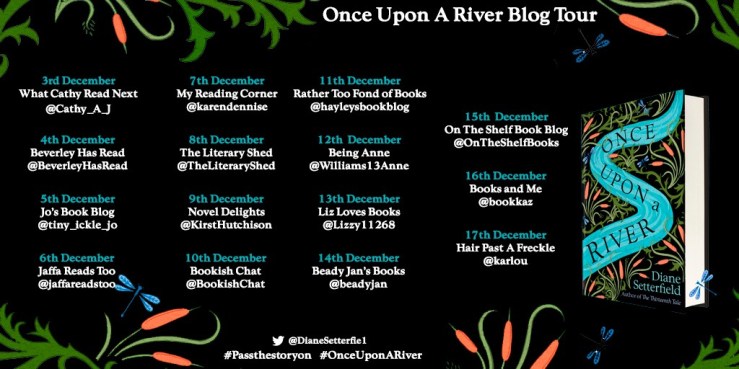
I’m thrilled to be kicking off the blog tour for Once Upon A River by Diane Setterfield. My grateful thanks to Doubleday and Henley Literary Festival for my (signed) proof copy of Once Upon A River and to Anne at Random Things Tours for inviting me to participate in the blog tour and for giving me the honour of the first stop. Do check out the tour banner at the bottom of this post so you can follow the other fabulous book bloggers taking part in the tour.
Once Upon A River is published tomorrow (4th December) in ebook format and in the US and Canada in hardback as well. It will be published in hardback in the UK on 17th January 2019.
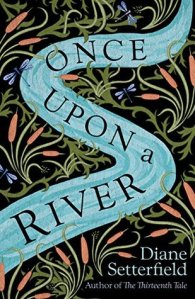 About the Book
A dark midwinter’s night in an ancient inn on the Thames. The regulars are entertaining themselves by telling stories when the door bursts open on an injured stranger. In his arms is the drowned corpse of a little child.
Hours later the dead girl stirs, takes a breath and returns to life.
Is it a miracle? Is it magic? Or can it be explained by science?
An exquisitely crafted multi-layered mystery brimming with folklore, suspense and romance, as well as with the urgent scientific curiosity of the Darwinian age, Once Upon a River is as richly atmospheric as Setterfield’s bestseller The Thirteenth Tale.
Format: Hardcover, ebook (432 pp.) Publisher: Doubleday
Published in UK: 4th December 2018 (ebook), 17th January 2019 (hardcover)
Genre: Historical Fiction, Mystery
Pre-order/Purchase Links*
Amazon.co.uk ǀ Amazon.com ǀ Hive.co.uk (supporting UK bookshops)
*links provided for convenience, not as part of any affiliate programme
Find Once Upon A River on Goodreads
My Review
The dramatic moment early in the book when an injured stranger arrives at the riverside Swan inn with what seems to be the lifeless body of a child sets in motion a search for answers to many questions. It’s a quest for the truth involving the weighing up of competing claims about the child’s identity, the resolution of previously unresolved mysteries and the seeming contradiction between scientific fact and perceived events. More than anything, it’s a yearning for a story that makes sense. Having witnessed the dramatic arrival, the regulars at the Swan, a place known for its storytelling, immediately begin to talk, ‘finding words to turn the night’s events into a story’.
The concept of story-telling forms a key part of the book. The telling of stories is shown to be variously a source of entertainment, a skill, a tradition handed down through the generations, a way of making a living or impressing others. The book explores how stories may be rooted in a geographical area or a period of history. What also emerges from the book is that stories can be a means of trying to make sense of things but that the ownership of stories can be transitory as they travel, mutate or are embellished in the retelling. And, who doesn’t crave to know how a story ends?
The richly drawn characters in the book embody all aspects of human nature – the good and the bad – and cleverly address the nature versus nurture debate. My favourite character was Rita. Independent minded and self-educated in nursing and midwifery, she has a logical, questioning approach to things using astute observation to analyse people and situations. She proves herself to be brave, resourceful and daunted only by very particular fears about one aspect of life.
The river, described at one point as ‘majestic, powerful, unknowable’, plays a central role in the book – almost becoming a character in its own right. I particularly loved the chapter ‘Tributaries’ in which the author cleverly uses the river as a model for introducing other characters into the story.
The river is frequently a source of metaphor too. For example, at one point a character finds himself hemmed in by a crowd of people – a ‘throng thickened to stagnation’ – until he eventually finds space and ‘a sluggish current’ that allows him to progress. A group of drinkers at the Swan, trying to make sense of events find their thoughts have ‘eddied round, discovered currents within currents, met counter currents.’ Another character, facing a moral dilemma, finds himself ‘no more able to direct the current of his life than a piece of debris can control the stream that carries it.’
The river is not the only elemental force in the book. The changing seasons, particularly the points of the year marked by the solstices and equinoxes, are the backdrop to pivotal moments in the book. Although set in the age of scientific discovery – Darwin’s theory of evolution, the dawn of the study of psychology and the human mind – the characters in the book come across things that seemingly can’t be explained by logic, facts or reason. Some choose to fall back on the supernatural and stories older than the one they are currently living through. At times, characters experience presentiments about future events which, as well as tapping into the supernatural aspect of the book, also create narrative tension.
In the breathless final chapters, a positive torrent of secrets is unleashed, the true nature of things becomes evident and natural instincts are proved correct. At the end, everything feels perfectly in balance with the rhythms of life from birth to death. Like the ebb and flow of the tide, if you like. (Sorry, these water metaphors are catching.)
I was lucky enough to hear Diane Setterfield talk about Once Upon A River at this year’s Henley Literary Festival, as it happens whilst sailing up the River Thames that is such an important part of the story. (You can read my write-up of the event here.) Hearing her talk about the book gave me additional insight into the themes it explores and resulted in a few ‘Ah, yes’ moments of recognition while I was reading it.
I think you can probably tell that I absolutely loved this book. To borrow a watery metaphor from the author, I was swept away by the story and the skill with which it was told. I closed Once Upon A River with a sigh of satisfaction, if I’m honest a little teary-eyed, and certain in the knowledge this will be one of my favourite books of the year. Right now, it’s definitely challenging for the top spot.
In three words: Magical, atmospheric, suspenseful
Try something similar…The Good People by Hannah Kent (read my review here)
 About the Author
Diane Setterfield’s bestselling novel, The Thirteenth Tale, was published in 38 countries, sold more than three million copies, and was made into a television drama scripted by Christopher Hampton, starring Olivia Colman and Vanessa Redgrave. Her second novel was Bellman & Black, and her new novel is Once Upon a River. Born in rural Berkshire, she now lives near Oxford, by the Thames.
Connect with Diane
Website ǀ Facebook ǀ Twitter ǀ Goodreads

 About the Book
 About the Author

 What Cathy Read Next...