
 Welcome to today’s stop on the blog tour for The Young Survivors by Debra Barnes which will be published on Thursday 23rd July 2020. My thanks to Fanny at Duckworth for inviting me to take part in the tour and for my proof copy.
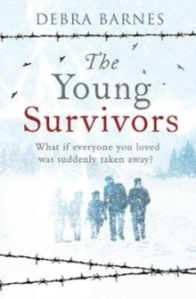 About the Book
What if everyone you loved was suddenly taken away?
When Germany invades France in the Second World War, the five Laskowski children lose everything: their home, their Jewish community and, most devastatingly, their parents who are abducted in the night. There is no safe place left for them to evade the Nazis, but they cling together – never certain when the authorities will come for what is left of them.
Inspired by the poignant, true story of the author’s mother, this moving historical novel conveys the hardship, the uncertainty and the impossible choices the Laskowski children were forced to make to survive the horrors of the Holocaust.
Format: Paperback (304 pages) Publisher: Duckworth
Publication date: 23rd July 2020 Genre: Historical fiction
Find The Young Survivors on Goodreads
Pre-order/Purchase links*
Amazon UK | Hive (supporting UK bookshops)
*links provided for convenience not as part of an affiliate programme
My Review
The Young Survivors concerns the children of the Laskowski family – eldest son, Pierre, his younger brothers, Samuel and Claude, and his two young sisters, twins Georgette and Henriette. Alternating between the first person narratives of Pierre, Samuel and occasionally Georgette, their experiences are related without any literary flourishes, reflecting both their youth and the fact they don’t always understand, at least to begin with, the full import or implications of the things they see and hear. Indeed, for the younger children, moving to a new place is often merely an opportunity for exploration or to make new friends.
Opening in 1938, initially the prospect of war seems a distant possibility despite the fact the family live in Metz, close to France’s border with Germany. They, like so many others, place their faith in the Maginot line. Only gradually do the youngsters become aware of the consequences of their Jewish faith as playground abuse by other children develops into more virulent anti-Jewish sentiment, fuelled by broadcasts of Hitler’s speeches, and then to legal restrictions on their daily lives. Forced to move to Sally, a village near Poitiers, it places them in the demarcation zone beyond Vichy France when the Germans invade.
Through the children’s faithful accounts of everything that happens to them, the book reveals how life in wartime France for Jewish families like the Laskowskis, whichever side of the demarcation line, becomes increasingly difficult and dangerous. The Vichy government collaborates in the implementation of anti-Jewish laws and the rounding up of Jews to meet German quotas. Only the courage of a few French men and women keeps the children safe, even if that does involve frequent moves. Nevertheless, they still suffer the anguish of separation and not knowing what has become of their parents.
As the end of the war approaches, there are increasingly dramatic scenes with narrow escapes and sudden changes of location. Yet when peace does finally come it does not necessarily bring an end to the challenges faced by the children. For me, it was at this point in the book that the author really captured the emotional and psychological toll of their experiences. In Samuel’s words: “The hope, the anticipation, the wait…and then the disappointment and despair”.
Pierre’s narrative gives the reader a picture of a young man with a keen sense of responsibility to protect his younger siblings. With the arrest of his mother and father, aunt and uncle, he’s suddenly thrust into the position of having to make potentially life or death decisions on behalf of others even as the world he knows crumbles around him.
The chapters narrated by Georgette I found especially poignant. As a twin, the threat of separation is even more overwhelming and, for such a young child, the hatred her family face is difficult for her to understand. “Without our parents to explain it to us, we had no idea what it was to be Jewish except it meant the Germans and many of the French hated us.” It was heart-warming to witness her enjoyment of simple, if rare, pleasures like a visit to the park or playing with her doll.
In war, there are rarely happy endings but in the final chapters the reader does at least get some answers to the questions raised in the prologue.
Books, even if works of fiction, that tell the stories of Holocaust survivors are often difficult to read. However, they are usually an inspiring testament to the resilience of the human spirit. The Young Survivors is no exception. In her introduction, Debra writes, “As the generation of Holocaust survivors pass away, the mantel of responsibility for telling survival stories rests on the second generation.” I would go further and say even those with no direct connection owe it to those who suffered to ensure their stories continue to be heard. Indeed, the fact The Young Survivors is written from the perspective of the Laskowski children, I think means the book would be both accessible and educational for teenage readers.
I found The Young Survivors an absorbing story of loss, separation, courage and hope.
In three words: Authentic, factual, moving
Try something similar: The Hidden Village by Imogen Matthews or Living Among the Dead by Adena Bernstein Astrowsky
Follow this blog via Bloglovin

About the Author
Debra Barnes studied journalism and has contributed to the Jewish News. Since January 2017 she has run a project called My Story for The Association of Jewish Refugees (AJR) to produce individual life story books for Holocaust survivors and refugees. She has been interviewed by BBC Radio regarding her mother’s story and has had a short documentary made about her research. Debra lives in North London and The Young Survivors is her first book.
Connect with Debra
Website | Twitter | Facebook

 I’m thrilled to be joining my tour buddies, Adele at
  About the Book
 About the Author
 What Cathy Read Next...