

Welcome to today’s stop on the blog tour for Immortal by Jessica Duchen. My thanks to Anne at Random Things Tours for inviting me to take part in the tour and to Unbound for my digital review copy.
 About the Book
Who was Beethoven’s ‘Immortal Beloved’?
After Ludwig van Beethoven’s death, a love letter in his writing was discovered, addressed only to his ‘Immortal Beloved’. Decades later, Countess Therese Brunsvik claims to have been the composer’s lost love. Yet is she concealing a tragic secret? Who is the one person who deserves to know the truth?
Becoming Beethoven’s pupils in 1799, Therese and her sister Josephine followed his struggles against the onset of deafness, Viennese society’s flamboyance, privilege and hypocrisy and the upheavals of the Napoleonic wars. While Therese sought liberation, Josephine found the odds stacked against even the most unquenchable of passions…
Format: Paperback (352 pages) Publisher: Unbound
Publication date: 29th October 2020 Genre: Historical Fiction
Find Immortal on Goodreads
Purchase links*
Amazon UK | Hive (supporting UK bookshops)
*link provided for convenience not as part of an affiliate programme
My Review
Immortal is described by the author as “a novel inspired by real events”. Woven into the story is Jessica Duchen’s favoured theory (supported by many other scholars) as to the identity of the woman addressed as ‘Immortal Beloved’ in Beethoven’s letter. In fact, it becomes clear pretty quickly who that woman is and, later, why her identity might need to be protected.
The book is narrated by Countess Therese Brunsvik (known as ‘Tesi’ to her family) in a series of letters to an unidentified niece. I have to say I’m not really a fan of this narrative device. Even taking into account that people of the time in which the novel is set were more prolific and dedicated correspondents, I find it unrealistic that events and conversations can be recalled in such detail.
Given the size of Therese’s extended family – thanks to her sisters’ large number of offspring – there are a range of possible candidates for the ‘My dear niece’ to whom her letters are addressed. The niece’s identity is not confirmed until the end of the book, although readers may have their own suspicions earlier than that.
Leaving my earlier reservation aside, Therese’s account provides a detailed, often lively, insight into the lives of a certain section of Hungarian society at the beginning of the 19th century, a period which takes in the Napoleonic Wars and significant geopolitical changes to the countries of Europe. In particular, the book charts the transformation of Vienna from a place of parties, palaces and musical soirees to a city under occupation in a nation bankrupted by war.
The children of the Brunsvik family are blessed with linguistic and musical ability. Therese and her sisters are talented pianists with remarkable sight-reading ability and their brother, Franz, plays the cello. The family are fluent in French and German; like other members of the aristocracy they eschew the native tongue, Hungarian, which is spoken only by their servants.
However, with the privileges of nobility come constraints, especially for the women of the family. As Therese’s mother explains, “A woman’s status, as you know, is determined by that of her husband”. Hence the unedifying spectacle of Therese’s beautiful sister Josephine (known as ‘Pepi’ within the family) being, in Therese’s words, marketed “to the first be-titled bidder”, with the unhappy consequences that follow. And, as it turns out, an aristocratic title does not necessarily ensure financial stability or moral probity.
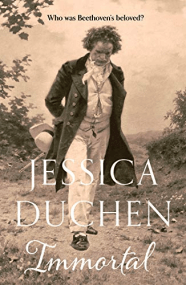
One of the key strengths of Immortal is the fascinating insight it gives into the character of Beethoven. This description of his appearance brings to life the figure depicted on the cover of the book:
“…dark as a Spaniard…not tall, but broad, imposing, confident, hair swept back above his collar. His eyes were eager and curious, under low-set brows that threatened to meet in the middle. His neck was wide and short, his jawline squared, with a cleft chin that made him more determined in aspect; high cheekbones brought refinement to this unusual visage.”
The book vividly conveys Beethoven’s musical prowess and amazing ability to improvise – “I find it within myself, and it must out”. The author calls upon her own musical knowledge to comment in scholarly fashion on the structure of and themes behind some of Beethoven’s compositions, such as the piano sonatas which the two Brunsvik sisters learn to play under his tuition.
Described by Therese at one point as a ‘walking firework’, it is sad to see the first signs of Beethoven’s deafness and the impact it has on him. As Therese laments, “He, a sociable and generous soul, now preferred to avoid company rather than allow his disability to be seen”. The ups and downs of his musical career don’t help. Forced to rely on financial support from patrons, Beethoven’s ground-breaking compositions are not met with universal acclaim.
For me the pace of the book was more andante than vivace. However, the Coda revealed an unexpected new angle and the historical notes provided a fascinating insight into the afterlives of many of the characters featured in the book. This includes Therese herself whose interest in and championing of progressive education, especially for girls, was her lasting legacy.
Less a mystery than a painstaking historical biography, Immortal will appeal to lovers of Beethoven’s works who wish to find out more about the man behind the music and to those with an interest in the social history of Europe during a period of upheaval.
In three words: Detailed, assured, well-researched
Try something similar: Ecstasy by Mary Sharratt
Follow this blog via Bloglovin
 About the Author
Jessica Duchen writes for and about music. She was a journalist and critic for the Independent from 2004 to 2016, and her work has appeared in the Guardian, the Sunday Times and BBC Music Magazine, among others. Her output includes fiction, biographies (Faure and Korngold), stage works and librettos. Among her recent novels is Ghost Variations (Unbound, 2016), based on the true story of the Schumann Violin Concerto’s rediscovery in the 1930s. It was chosen by John Suchet as his Best Read of 2016 for the Daily Mail‘s Christmas Books selection and was Book of the Month in BBC Music Magazine. Jessica often narrates concert versions of her novels, which have been heard at the Wigmore Hall, The Sage Gateshead, Kings Place and numerous music societies and festivals.
Her librettos include Silver Birch for composer Roxanna Panufnik, commissioned by Garsington Opera and shortlisted for a 2018 International Opera Award.
Jessica was born within the sound of Bow Bells, read music at Cambridge and lives in London with her violinist husband and two cats.
Connect with Jessica
Website | Twitter | Facebook

 About the Book
 About the Author

 What Cathy Read Next...