#BookReview Children’s Fate (The Meonbridge Chronicles 4) by Carolyn Hughes @rararesources

Childrens Fate

Welcome to today’s stop on the blog tour for Children’s Fate by Carolyn Hughes, the fourth book in her Meonbridge Chronicles series set in 14th century England. My thanks to Rachel at Rachel’s Random Resources for inviting me to take part in the tour and to Carolyn for my digital review copy. Do check out the posts by my tour buddies for today Anne at Being Anne and Elaine at Splashes Into Books.
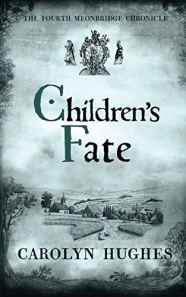

Children's FateAbout the Book

How can a mother just stand by when her daughter is being cozened into sin?

It’s 1360, eleven years since the Black Death devastated all of England, and six years since Emma Ward fled Meonbridge with her children, to find a more prosperous life in Winchester. Long satisfied that she’d made the right decision, Emma is now terrified that she was wrong. For she’s convinced her daughter Bea is in grave danger, being exploited by her scheming and immoral mistress. Bea herself is confused: fearful and ashamed of her sudden descent into sin, but also thrilled by her wealthy and attentive client.

When Emma resolves to rescue Bea from ruin and tricks her into returning to Meonbridge, Bea doesn’t at first suspect her mother’s motives. She is happy to renew her former friendships but, yearning for her rich lover, Bea soon absconds back to the city. Yet, only months later, plague is stalking Winchester again and, in terror, Bea flees once more to Meonbridge. But, this time, she finds herself unwelcome, and fear, hostility and hatred threaten…

Terror, betrayal and deceit, but also love and courage, in a time of continuing change and challenge –

Format: ebook (452 pages)                   Publisher: Riverdown Books
Publication date: 26th October 2020 Genre: Historical Fiction

Find Children’s Fate (The Meonbridge Chronicles #4) on Goodreads

Purchase links
Amazon UK
Links provided for convenience only, not as part of an affiliate programme
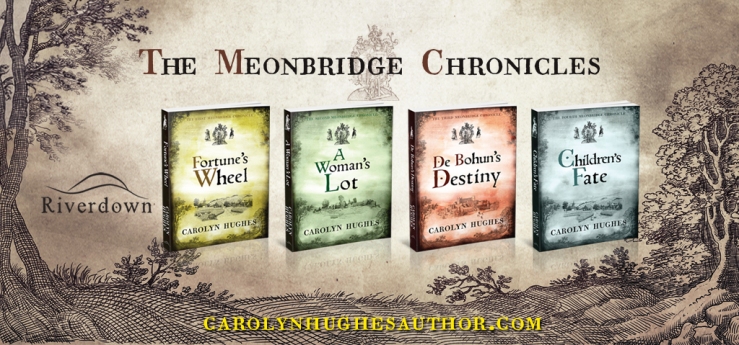
ch-banner-1024x479-4bks


My Review

Children’s Fate is the fourth in Carolyn Hughes’ series about the village of Meonbridge. You can find out more about the Meon Valley, the location of the fictional village, in this post on The History Girls blog.  Carolyn’s website also has a very useful glossary of medieval terms.  Readers new to the series  – or those who need their memories jogged – need not worry because the author incorporates useful recaps on events in the first three books.  Indeed, new readers may be surprised to learn that life in Meonbridge has not been without incident over the years.

As before, Children’s Fate explores the social and economic impacts of the Black Death on life.  “Folk weren’t tied to manors any more, or to one master.” The focus of the story is very much on the women of the village, in particular Emma Ward and her daughter Bea.  Life in Winchester brings opportunities for those prepared to grasp them but also temptations, as Emma and Bea will discover.  Their return to Meonbridge coincides with the Midsummer celebrations which involve torchlit processions around the village ‘bone-fires’, music and dancing, feasting and ‘fire-leaping’ by the young men.

Building on historical fact, the year 1361 sees the return of the plague, presaged in the belief of many by a solar eclipse.  For some, the resurgence of the pestilence is an Act of God, a sign of the Almighty’s displeasure at the prevalence of sin in their communities.  The only defence is confession or the power of prayer.  Luckily, we live in an age when science can provide us with facts about the method of transmission.  Our 14th century forbears lacked such information although the instructions to ‘keep your families at home, avoid public places where you can’ and wear a face covering were strikingly familiar.  Carolyn talks about the experience of writing about a pandemic and its aftermath during a pandemic here.

Faced with the indiscriminate nature of the pestilence and the loss of loved ones, it’s no surprise the people of Meonbridge search for answers as to why some live and others die and that some, fuelled by grief, despair and fear, look for scapegoats. As is often the case, suspicion falls on outsiders and those who have recently returned to the village. leading to some dramatic scenes.  The book’s conclusion sees happy endings for some and, for others, their just desserts.

Looking back at my reviews of the three previous books in the series – Fortune’s Wheel, A Woman’s Lot and De Bohun’s Destiny – I see a frequent comment is how the detailed depiction of daily life gives the books a real sense of authenticity.  This latest book is no exception. In Children’s Fate you don’t so much read about the folk of Meonbridge as dwell amongst them for a few precious hours.

In three words: Engaging, immersive, well-researched

Try something similar: The Turn of Midnight by Minette Walters

Follow this blog via Bloglovin
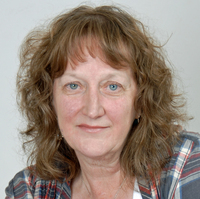

Carolyn HughesAbout the Author

Carolyn Hughes was born in London but has lived most of her life in Hampshire. After completing a degree in Classics and English, she started her working life as a computer programmer, in those days a very new profession. But it was when she discovered technical authoring that she knew she had found her vocation. She spent the next few decades writing and editing all sorts of material, some fascinating, some dull, for a wide variety of clients, including an international hotel group, medical instrument manufacturers and the government.

She has written creatively for most of her adult life but it was not until her children grew up and flew the nest several years ago that writing historical fiction took centre stage in her life. She has a Master’s degree in Creative Writing from Portsmouth University and a PhD from the University of Southampton.
Children’s Fate is the fourth novel in the Meonbridge Chronicles series. A fifth novel is under way.

Connect with Carolyn
Website | Twitter | Facebook
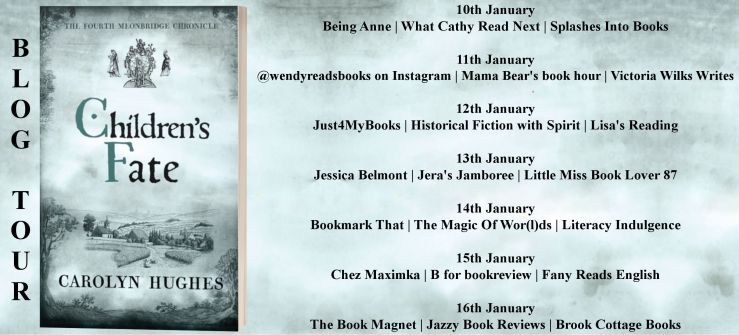
Childrens Fate Full Tour Banner

#BookReview Last Flight to Stalingrad by Graham Hurley @HoZ_Books

Last Flight to Stalingrad

Welcome to the first day of the blog tour for Last Flight to Stalingrad by Graham Hurley. My thanks to Lauren at Head of Zeus for inviting me to take part in the tour and for my digital review copy via NetGalley.


Last Flight to StalingradAbout the Book

Berlin, 1942. For four years, the men in field grey have helped themselves to country after country across Western Europe.

For Werner Nehmann, a journalist at the Promi – the Ministry of Propaganda – this dizzying series of victories has felt like a party without end. But now the Reich’s attention has turned towards the East, and as winter sets in, the mood is turning.

Werner’s boss, Joseph Goebbels, can sense it. A small man with a powerful voice and coal-black eyes, Goebbels has a deep understanding the dark arts of manipulation. His words, his newsreels, have shaken Germany awake, propelling it towards its greater destiny and he won’t let – he can’t let – morale falter now. But the Minister of Propaganda is uneasy and in his discomfort has pulled Werner into his close confidence.

And here, amid the power struggle between the Nazi Chieftains, Werner will make his mistake and begin his descent into the hell of Stalingrad.

Format: Hardcover (416 pages)         Publisher: Head of Zeus
Publication date: 7th January 2021 Genre: Historical Fiction

Find Last Flight to Stalingrad on Goodreads

Purchase links
Hive | Amazon UK
Links provided for convenience only, not as part of an affiliate programme


My Review

Last Flight to Stalingrad is the fifth book in the author’s ‘Wars Within’ series. I read the first in the series, Finisterre, way back in 2016. In fact, it was one of the first books I reviewed on my blog after I discovered the delights of (or should I say temptations of) NetGalley. However, don’t worry if you haven’t read that or any of the other books in the series – Aurore, Estocada and Raid 42 –  because each novel is set in a different period in the run-up to or during WW2 and, with a couple of exceptions, features different characters. Furthermore they don’t follow on chronologically making them perfect to read in any order.

Like previous books in the series, Last Flight to Stalingrad has two main protagonists – Werner Nehmann and Georg Messner.  Both men occupy positions that place them close to powerful figures in the Third Reich.  In Messner’s case,  it’s Wolfram von Richthofen of the Luftwaffe, and in Nehmann’s case, it’s Joseph Goebbels, head of the Ministry of Propaganda.  Whereas in Finisterre the two storylines took some time to come together, I had no such reservations about Last Flight to Stalingrad. How the two men meet is completely believable and, as they get to know each other, it’s clear they both recognize – based on their different experiences – how badly the war against the Russians is going. Not that the German people would know it from the propaganda they are fed.

One of the most fascinating aspects of the book for me was the light it shed on the manipulation of information and power of propaganda.  This made Nehmann a particularly interesting character, especially given his proximity to someone so high up in the Reich.  He knows his survival (and, it transpires, the survival of others close to him) depends on him continuing to prove useful to Goebbels and he has a clear-eyed view of what that involves.

“This was the age of the lie, big or small. Truth filleted for what might be useful and then tossed aside. Deception practiced on the grandest scale. Whole nations, millions of Volk, misled, manipulated, lied to. Nehmann was part of that. He understood the power of the lie, the artful sleight of hand, the dark sorcery that turned black into white, and good into evil. That’s how he’d made his reputation. That’s how he’d won the precious freedoms offered by – yes – the Minister of Lies himself.”

In a particularly compelling episode, Nehmann is tasked with demonstrating the success of German bomber raids on Stalingrad. Taking aerial photographs, he hunts “for the kind of trophy images that might please the author of this wrecked city: huge petroleum tanks on the riverbank, still aflame, their metal carcasses torn apart; a lake of blazing oil drifting slowly down the river, dragging thick coils of smoke that circled slowly upwards in the updraught from the water; a nearby building on the western shore that must have been a hospital, eviscerated by high explosive, dozens of beds plainly visible inside.”

Another memorable scene sees Nehmann and Goebbels working together on a speech Hitler is to give at Berlin’s Sportpalast:

“Nehmann had never liked the Sportpalast. Recently…he’d likened it to something you’d find in Goebbels’ kitchen. It was a cooking pot, he said. It was a favourite utensil you’d fetch out for those special occasions when you wanted to whip up something irresistible to keep everyone happy. You put together the recipe from what you knew and trusted. A little of that intimate frenzy from the Burgerbraukeller days in Munich. Plus a huge helping of spectacle and mass adoration from the Zeppelinfeld at Nuremburg: hanging banners, roving spotlights and a sound system that would put Hitler’s rasp and Goebbels’ chest-thumping roar into every German heart. When the national pulse showed signs of faltering, a couple of deafening hours in the Sportpalast always did the trick. The trick.”

During his work for Goebbels, Nehmann stumbles upon evidence of SS atrocities and in the process makes himself a truly formidable enemy.  A thrilling – and chilling – game of cat and mouse ensues, provoking an uncharacteristically extreme and visceral response from Nehmann.

The author’s impeccable research is evident throughout the book but it never detracts from the pace of the story, instead adding a fantastic sense of authenticity to what is a compelling work of historical fiction.

In three words: Gripping, authentic, immersive

Follow this blog via Bloglovin


Graham HurleyAbout the Author

Graham Hurley is the author of the acclaimed Faraday and Winter crime novels and an award-winning TV documentary maker. Two of the critically lauded series have been shortlisted for the Theakston’s Old Peculier Award for Best Crime Novel. His French TV series, based on the Faraday and Winter novels, had won huge audiences. The first Wars Within novel, Finisterre, was shortlisted for the Wilbur Smith Adventure Writing Prize. Graham now writes full-time and lives with his wife, Lin, in Exmouth.

Connect with Graham
Website