
 About the Book
Irisa’s parents are dead and her younger sister Kassia is away on a journey when the sisters’ mysterious customer returns, urging Irisa to leave with him before disaster strikes. Can she trust him to keep her safe? How much does he know about the fate of her father? Only a voyage across the Eastmor Ocean to the land of her ancestors will reveal the truth about her family’s disturbing past. Once there, Irisa steps into a future she has unknowingly been prepared for since childhood, but what she discovers is far more sinister than she could have ever imagined. Will she have the courage to claim her inheritance?
Format: Paperback, ebook (417 pp.) Publisher:
Published: 1st September 2017 Genre: Historical Fiction, Fantasy, YA
Purchase Links*
Amazon.co.uk ǀ Amazon.com ǀ Hive.co.uk (supporting UK bookshops)
*links provided for convenience, not as part of any affiliate programme
Find The King’s Daughter on Goodreads
My Review
The King’s Daughter is the sequel to The Scribe’s Daughter but as the events run largely in parallel to the events in the earlier book it can definitely be read as a standalone. However, personally I would recommend reading the series in order. You can read my review of The Scribe’s Daughter here. It’s now also available as an audiobook.
Whereas The Scribe’s Daughter concentrated on the exploits of younger sister, Kassia, The King’s Daughter focuses on her older sister, Irisa. The Scribe’s Daughter was full of the excitement of Kassia’s adventures and initially I found I missed that element in The King’s Daughter. Having said that, the first chapter provides a cliff-hanger opening in which Irisa finds herself in a (literally) precarious position. What follows is a flashback to events in the two years leading up to that point. The reader must wait until close to the end of the book to find out if and/or how Irisa manages to extricate herself.
Like Irisa, I soon became immersed in the politics and intrigue of the court of King Bellek and – again like Irisa – was occupied with trying to work out who were the ‘goodies’ and the ‘baddies’. That turned out to be easier said than done in some cases with a few surprises skilfully delivered by the author late on in the book. “What does it all mean, this game of kings and their thrones?” Before long Irisa is learning sometimes contradictory things about her family’s past, hints of yet more secrets still to be uncovered and some surprising things about her future. ‘Everything I thought I understood was wrong. Nothing was as it seemed and never would be again.’
I’ll confess that, in the beginning, I found Irisa somewhat passive compared with the feisty, adventurous Kassia, and a bit naïve as well, rather careless about the safety of others who daily risk exposure. She finds herself influenced as well by her heart and begins to doubt the path that seemed so obviously right to begin with. However, after a while, the author lets the reader witness the development of Irisa’s character as she begins to find ways to exercise influence, at first in small ways but all which demonstrate her humane attitude to those around her.
Events unfold in an increasingly dramatic way as the book progresses culminating in some exciting scenes that involve treachery, unexpected reunions, sad partings and close escapes. There is also a tender love story which unfolds as the book progresses. Most excitingly, the book ends with tantalising hints about a story line relating to events in the life of Kassia and Irisa’s mother, Naria, offering the prospect of a prequel at some point (soon, I hope).
Described as ‘fantasy that reads like historical fiction’, The King’s Daughter is a sort of Game of Thrones without the gore and violence…or the unnatural relationships between family members! The setting is an imagined world and, although no time period is specified, the clothes, buildings and weapons suggest the equivalent of the early medieval period in our world. There is some tremendous world building with evocative descriptions of the landscape of Agrius – mountains, cliff-top fortresses, vast forests, and thriving seaports – and its population of lords and vassals, slaves, merchants, traders, brigands and pirates.
The King’s Daughter is an entertaining mix of historical fiction and fantasy with an interesting cast of characters and plenty of intrigue and secrets to uncover. If my review is not enough to tempt you, you can read an extract from The King’s Daughter – the exciting opening scene mentioned above, no less – here.
I received a review copy courtesy of the author in return for an honest and unbiased review. The King’s Daughter is the fifth book in my 20 Books of Summer (click here to see my full list).
In three words: Engaging, dramatic, lively
Try something similar…The Scribe’s Daughter by Stephanie Churchill
 About the Author
When Stephanie was a child, she was curious about everything, particularly as it related to “old stuff.” And because in those days there was no internet, when she was bored or wanted to learn something new about history or anything else, she could be found sitting on the floor at home reading an encyclopaedia. Her fondest memories are of wandering her grandparents’ farm in rural Nebraska, daydreaming and telling herself fairy tales, usually with a medieval twist.
Upon reaching adulthood, Stephanie developed a love of reading history and historical fiction. But never once did it occur to her to become a writer. Working in the field of law instead, it took a nudge from her favorite author suggesting that she try her hand at becoming an author.
Evoking the essence of historical fiction but without the history, Stephanie’s writing draws on her knowledge of history even while set in purely fictional places existing only in her imagination. Filled with action and romance, loyalty and betrayal, her writing relies on deeply drawn and complex characters, exploring the subtleties of imperfect people living in a gritty, sometimes dark world. Her unique blend of historical fiction and fantasy ensures that her books are sure to please fans of historical fiction or epic fantasy literature alike.
Connect with Stephanie
Website ǀ Facebook ǀ Twitter | Goodreads


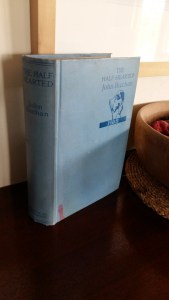 The Half-Hearted was written in 1899 and published in September 1900 by Isbister & Co Ltd. However, it had first appeared in serial form (in thirty-three parts) earlier that year in Good Words, a magazine also published by Isbister. Hodder & Stoughton published a new edition of The Half-Hearted in 1920.
 What Cathy Read Next...