
 Welcome to today’s stop on the blog tour for A Quiet Death in Italy by Tom Benjamin. My thanks to Rachel at Rachel’s Random Resources for inviting me to participate in the tour and to Constable for my digital review copy. You can read my review below but do also take a look at the posts by my tour buddies, The Magic of Wor(l)ds and Tizi’s Book Review.
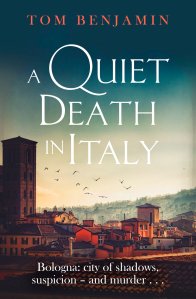 About the Book
Bologna: city of secrets, suspicion . . . and murder.
When the body of a radical protestor is found floating in one of Bologna’s underground canals, it seems that most of the city is ready to blame the usual suspects: the police.
But when private investigator Daniel Leicester, son-in-law to a former chief of police, receives a call from the dead man’s lover, he follows a trail that begins in the 1970s and leads all the way to the rotten heart of the present-day political establishment.
Beneath the beauty of the city, Bologna has a dark underside, and English detective Daniel must unravel a web of secrets, deceit and corruption – before he is caught in it himself.
A dark and atmospheric crime thriller set in the beautiful Italian city of Bologna, perfect for fans of Donna Leon, Michael Dibdin and Philip Gwynne Jones.
Format: Paperback (352 pages) Publisher: Constable
Publication date: 21st May 2020 Genre: Crime
Find A Quiet Death in Italy on Goodreads
Purchase links*
Amazon UK | Amazon US | Hive (supporting UK bookshops)
*links provided for convenience not as part of an affiliate programme
My Review
Although a debut novel, A Quiet Death in Italy has the feel of a book part way through a series. I mean that in a good way as its location – the Italian city of Bologna – and its main characters seem so very well realised. In particular, the author has given private detective, Daniel Leicester, a back story that makes him both a sympathetic character and leaves open plenty of possibilities for future story lines. There’s a great cast of secondary characters as well – Rose, Jacopo, Alba and Dolores. Not forgetting Daniel’s boss and father-in-law, the formidable Comandante for whom the phrase “We are family” is more than mere words, it’s a credo to live – and act – by.
But perhaps the key character is Bologna itself; a city in which ancient and modern exist cheek by jowl. So fashionable bars and restaurants are housed in former Renaissance palaces with trompe l’oeil ceilings and behind the high walls of family homes are hidden gardens and courtyards.
The satisfyingly intricate plot skilfully encompasses both past and present Italian political history involving a complex web of relationships, recrimination and revenge, and encompassing all levels of society. There are exciting action scenes and dramatic moments that make the most of city locations. And there is delicious sounding food – tortellini in brodo, tagliatelle al ragu, zuppe inglese to name but a few. (The book has a useful glossary in which, among other things, you can learn about ‘the Italian Banksy’ and the dish you should never ask for in a restaurant in Bologna.)
I really enjoyed A Quiet Death in Italy. An assured debut, it promises to be the start of a terrific new crime series. It won’t do the tourist industry of Bologna any harm either. My review copy came with a bonus – an excerpt from the next book in the series, The Hunting Season. I, for one, shall be eagerly awaiting its publication in November.
In three words: Suspenseful, assured, atmospheric
Try something similar: A Season for the Dead (Nic Costa #1) by David Hewson
Follow this blog via Bloglovin
 About the Author
Tom Benjamin started off as a reporter before moving to the press office at Scotland Yard and running drugs awareness campaign FRANK. He moved to Bologna where his work as doorman at a homeless canteen inspired him to create English detective Daniel Leicester in a series that serves up equal helpings of the local cuisine and ubiquitous graffiti; the city’s splendour, decay, and danger.
Connect with Tom
Instagram | Twitter | Facebook

 Lockdown and social distancing measures due to the coronavirus continue to be gradually eased here in the UK. The 15th June saw the reopening of “non-essential” shops, which includes bookshops, although it’s a case of look, don’t touch…unless you’re going to buy. And bars, restaurants and, most importantly, hairdressers are due to re-open on 4th July. I managed to get myself an appointment in three weeks time which is sooner than I’d expected.


 What Cathy Read Next...