#BuchanOfTheMonth Introducing… A Prince of the Captivity by John Buchan

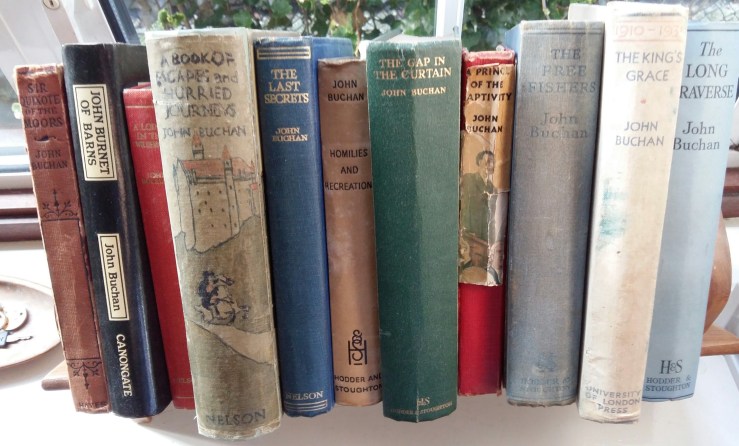
A Prince of the CaptivityMy Buchan of the Month for August is A Prince of the Captivity. It was published in the UK by Hodder & Stoughton on 6th July 1933 and in the US by Houghton Mifflin on 23rd August 1933. My copy (pictured right) is a later Nelson edition from September 1935 with its rather tatty dust jacket. It is some years since I read the book but it is one of my favourites of Buchan’s novels, not least for one thrilling part set in the Arctic.

Janet Adam Smith, Buchan’s first biographer, compares the book’s melodramatic opening in which Adam Melfort is found guilty of a crime he did not commit to A E W Mason’s The Four Feathers. She observes the book is full of topics of concern to Buchan, such as leadership and the relationship between different social classes. However, she finds his “thriller equipment” inadequate for exploring such issues. For her, the book only gathers energy in the last section, recalling in theme and tone Buchan’s earlier novel, The Half-Hearted.

Buchan scholar David Daniell describes A Prince of the Captivity as John Buchan’s “longest and most complicated novel” and says that, according to Buchan’s wife, Lady Tweedsmuir, the book was written out of concern “something was very wrong in Europe”. (Ursula Buchan, the author’s granddaughter and latest biographer, makes a similar point when she observes that A Prince of the Captivity has been called “almost certainly the first anti-Nazi popular novel”.) Although David Daniell feels the book does not really hang together because it contains too many ideas that are taken up and then dropped, he praises the section set in the Arctic (which I mentioned earlier) as “among the best things Buchan did”.

Andrew Lownie claims the book’s storyline was inspired by the real life experiences of Major Cecil Cameron whom it is likely Buchan met in 1914. He agrees with other commentators that A Prince of the Captivity contains many familiar elements such as “the liberating nature of the Scottish countryside, a hero able to speak several languages… the undercurrent of Calvinism”.

Although Lownie argues the book’s “didactic nature” and “poorly conceived characterization” put off readers, it did receive a warm response from some. In a letter to a friend, T E Lawrence enquired, “Did you read his latest?” going on to describe Buchan’s books as “like athletes racing: so clean-lined, speedy, breathless”.

According to figures collated by Janet Adam Smith, A Prince of the Captivity sold 83,000 hardback copies up to 1960 and a further 35,000 of the Pan paperback edition up to 1965. Look out for my review of the book later this month.

Sources:

Janet Adam Smith, John Buchan: A Biography (OUP, 1985 [1965])
Ursula Buchan, Beyond The Thirty-Nine Steps: A Life of John Buchan (Bloomsbury, 2019)
David Daniell, The Interpreter’s House: A Critical Assessment of John Buchan (Nelson, 1975)
Kenneth Hillier and Michael Ross, The First Editions of John Buchan: A Collector’s Illustrated Biography (Avonworld, 2008)
Andrew Lownie, John Buchan: The Presbyterian Cavalier (Constable, 1995)
20200205_130743-1

#BookReview The Girl from Vichy by Andie Newton @Aria_Fiction

Welcome to today’s stop on the blog tour for The Girl from Vichy by Andie Newton. My thanks to Vicky Joss at Head of Zeus for inviting me to take part in the tour and for my digital review copy via NetGalley.


cover194781-mediumAbout the Book

1942, occupied France. As the war in Europe rages on, Adèle Ambeh dreams of a France that is free from the clutches of the new regime. The date of her marriage to a ruthless man is drawing closer, and she only has one choice – she must run.

With the help of her mother, Adèle flees to Lyon, seeking refuge at the Sisters of Notre Dame de la Compassion. From the outside this is a simple nunnery, but the sisters are secretly aiding the French Resistance, hiding and supplying the fighters with weapons.

While it is not quite the escape Adèle imagined, she is drawn to the nuns and quickly finds herself part of the resistance. But her new role means she must return to Vichy, and those she left behind, no matter the cost.

Each day is filled with a different danger and as she begins to fall for another man, Adèle’s entire world could come crashing down around her.

Adèle must fight for her family, her own destiny, as well as her country.

Format: ebook (306 pages)                 Publisher: Aria
Publication date: 13th August 2020 Genre: Historical Fiction

Find The Girl from Vichy on Goodreads

Purchase links*
Amazon UK | iBooks | Kobo | Google Play
*links provided for convenience not as part of an affiliate programme


My Review

Set in World War 2, The Girl from Vichy is a drama-filled story of life in the French Resistance. The girl of the title is Adèle Ambeh who, having taking sanctuary in the convent of Notre Dame de la Compassion to escape marriage to a man she has come to despise, soon discovers there is more going on there than prayer and painting. In fact, the convent is cover for a Resistance network. Soon Adèle is recruited into the Resistance and witnesses first-hand the consequences of discovery or betrayal.

A novel featuring the French Resistance enters a fairly crowded field, jostling for attention with books such as Kristin Hannah’s The Nightingale or Kate Mosse’s Citadel. However, being set after the armistice with Germany and France’s separation into “Free” and “Occupied” zones provides a fresh slant. The author vividly conveys the divisions between those who supported the Vichy regime led by Marshall Pétain and those who opposed it, seeing it (rightly) as little more than a puppet of the Reich. These were divisions that were played out within communities, within families, between friends and even between husbands and wives.

The mission Adèle is given underlines those divisions only too clearly when she is asked to get close to the man from whom she originally fled, now an influential member of the Vichy police force. Able to receive or grant favours on a whim, he’s also a ruthless hunter of Resistance members.

I liked the way the book sheds a light on the different motives of those who joined the Resistance, whether that’s fighting to restore the freedom of France, the desire to rid the world of evil or for reasons of a more personal nature. And conversely how, in a time of uncertainty and scarcity, it may take very little for someone to be tempted into the role of informer.

The Girl from Vichy is set in a fascinating period of history with many dramatic, occasionally shocking moments, especially towards the end of the book. I found myself drawn into Adèle’s story, applauding her bravery (and that of the real-life women on whom her character is based) and wondering how events would unfold. As the book illustrates, even in time of war people experience loss and find love but they also learn what human beings are capable of – both the worst and, more importantly, the best. As her mother reminds Adèle, “We do what we have to do. When we have to.

In three words: Dramatic, emotional, absorbing

Try something similar: Flight Before Dawn by Megan Easley-Walsh

Follow this blog via Bloglovin


Annie Newton author The Girl From VichyAbout the Author

Andie Newton is an American writer living in Washington State with her husband and two boys. She writes female-driven historical fiction set in WWII. The Girl I Left Behind was her first novel. She would love to say she spends her free time gardening and cooking, but she’s killed everything she’s ever planted and set off more fire alarms than she cares to admit. Andie does, however, love spending time with her family, ultra trail running, and drinking copious amounts of coffee.

Connect with Andie
Website | Facebook | Twitter | Instagram | Goodreads

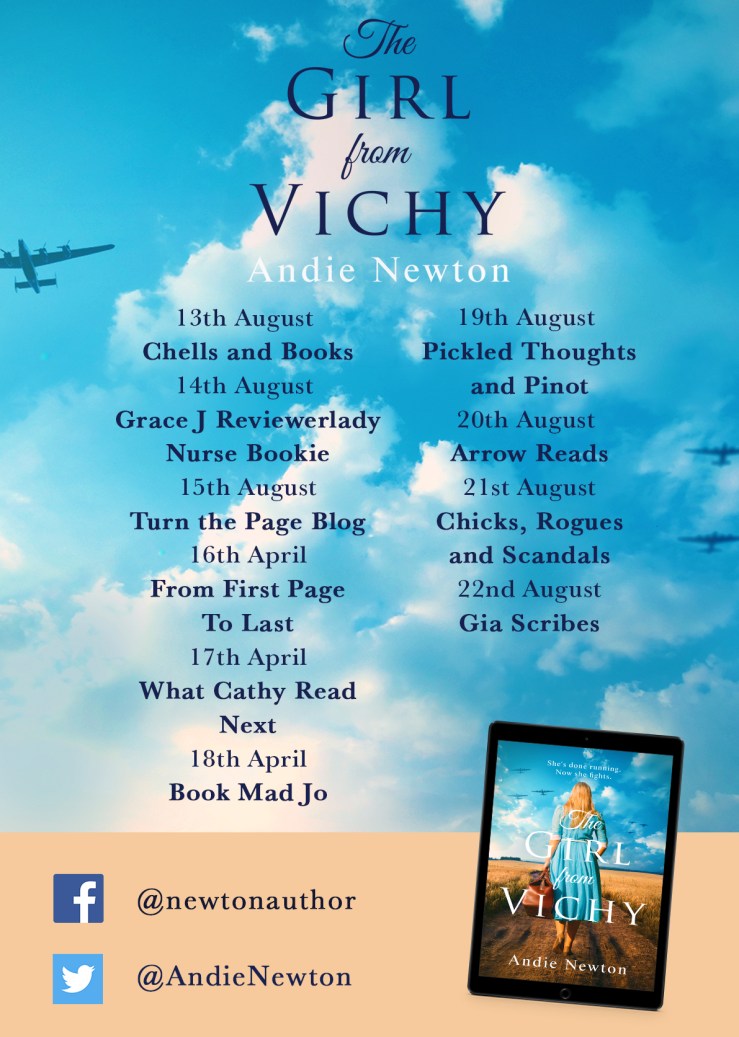
The Girl From Vichy blog tour poster