#BookReview The Drowned City (Daniel Pursglove 1) by K. J. Maitland @headlinepg

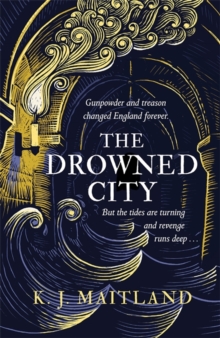
The Drowned CityAbout the Book

1606. A year to the day that men were executed for conspiring to blow up Parliament, a towering wave devastates the Bristol Channel. Some proclaim God’s vengeance. Others seek to take advantage.

In London, Daniel Pursglove lies in prison waiting to die. But Charles FitzAlan, close adviser to King James I, has a job in mind that will free a man of Daniel’s skill from the horrors of Newgate. If he succeeds.

For Bristol is a hotbed of Catholic spies, and where better for the lone conspirator who evaded arrest, one Spero Pettingar, to gather allies than in the chaos of a drowned city? Daniel journeys there to investigate FitzAlan’s lead, but soon finds himself at the heart of a dark Jesuit conspiracy – and in pursuit of a killer.

Format: Hardcover (448 pages)  Publisher: Headline
Publication date: 1st April 2021 Genre: Historical Fiction

Find The Drowned City on Goodreads

Purchase links
Bookshop.org
Disclosure: If you buy a book via the above link, I may earn a commission from Bookshop.org, whose fees support independent bookshops

Hive | Amazon UK
Links provided for convenience only, not as part of an affiliate programme


My Review

The author has created an interesting character in Daniel Pursglove. I liked the way small details about his often troubled past were dropped in now and again, laying the groundwork for future books. I also liked that the book was set in Bristol – the ‘drowned city’ of the title – not only because it made a change from the oft-used setting of London but also because it made sense from the point of view of the plot.

The writing was of the quality I’ve come to expect from other books I’ve read by the author, most recently A Gathering of Ghosts. Some episodes that particularly stood out were the dramatic prologue, a scene in which a Protestant mob attacks the house of a cordwainer and his family, and the New Year’s Eve masque.

Like any good hero, Daniel has some narrow escapes from those out to stop him achieving his mission.  This includes an adversary from his younger days. However, he always miraculously manages to turn up safely in his bed at his lodgings in the Salt Cat tavern. He also acquires a useful helper along the way whose knowledge of the city and ability to pass unnoticed aids Daniel’s intelligence gathering efforts as he seeks to carry out his mission but also determine if there is any connection between it and a series of murders.

No historical novel set in the period is complete without an appearance by one of the Cecil family; in this case it’s Robert Cecil. I actually felt some sympathy for him having to deal with the petulant and easily influenced King James I the author presents in the book. Although, with the discovery of the Gunpowder Plot still within recent memory, perhaps the King can be forgiven for imagining assassins at every turn and being concerned that one of the conspirators may still be at large. (I confess that until I read the historical notes at the end of the book I hadn’t realised Spero Pettingar was a real historical figure. For much of the book, I was convinced his name was an anagram!) And there are still adherents of Catholicism to be dealt with as well as the Jacobean equivalent of fake news, spread via illicitly printed pamphlets or ‘broadsides’. As Cecil warns the King, “Sire, even a superstition, if it takes hold of the imagination of the people, can be as powerful a weapon as any truth.” Indeed.

The Drowned City has all the ingredients to make an absorbing historical thriller although at certain points I found it on the slow side. However, it certainly picked up pace towards the end. As Daniel confides, ‘The art of legerdemain is to make the audience look in the wrong place’. In my case the author didn’t quite manage that when it came to the identity of the culprit whom I’d had my suspicions about for a few chapters, but I found enough to enjoy in The Drowned City to make me look out for future books in the series.

I received an advance review copy courtesy of Headline via NetGalley.

In three words: Atmospheric, intriguing, dramatic

Try something similar: The Angel’s Mark by S. W. Perry

Follow this blog via Bloglovin


karen maitlandAbout the Author

Karen Maitland (writing as K. J. Maitland) is an historical novelist, lecturer and teacher of Creative Writing, with over twenty books to her name. She grew up in Malta, which inspired her passion for history, and travelled and worked all over the world before settling in the United Kingdom. She has a doctorate in psycholinguistics, and now lives on the edge of Dartmoor in Devon. (Photo/bio credit: Publisher author page)

Connect with Karen
Website | Facebook

#WWWWednesday – 31st March 2021

WWWWednesdays

Hosted by Taking on a World of Words, this meme is all about the three Ws:

  • What are you currently reading?
  • What did you recently finish reading?
  • What do you think you’ll read next?

Why not join in too?  Leave a comment with your link at Taking on a World of Words and then go blog hopping!


Currently reading

The Drowned CityThe Drowned City by K. J. Maitland (eARC, courtesy of Headline Review via NetGalley)

1606. A year to the day that men were executed for conspiring to blow up Parliament, a towering wave devastates the Bristol Channel. Some proclaim God’s vengeance. Others seek to take advantage.

In London, Daniel Pursglove lies in prison waiting to die. But Charles FitzAlan, close adviser to King James I, has a job in mind that will free a man of Daniel’s skill from the horrors of Newgate. If he succeeds.

For Bristol is a hotbed of Catholic spies, and where better for the lone conspirator who evaded arrest, one Spero Pettingar, to gather allies than in the chaos of a drowned city? Daniel journeys there to investigate FitzAlan’s lead, but soon finds himself at the heart of a dark Jesuit conspiracy – and in pursuit of a killer.

The Heretics MarkThe Heretic’s Mark (Jackdaw Mysteries #4) by S. W. Perry (ARC, courtesy of Corvus and Readers First)

The Elizabethan world is in flux. Radical new ideas are challenging the old. But the quest for knowledge can lead down dangerous paths.

London, 1594. The Queen’s physician has been executed for treason, and conspiracy theories flood the streets. When Nicholas Shelby, unorthodox physician and unwilling associate of spymaster Robert Cecil, is accused of being part of the plot, he and his new wife Bianca must flee for their lives.

With agents of the Crown on their tail, they make for Padua, following the ancient pilgrimage route, the Via Francigena. But the pursuing English aren’t the only threat Nicholas and Bianca face. Hella, a strange and fervently religious young woman, has joined them on their journey. When the trio finally reach relative safety, they become embroiled in a radical and dangerous scheme to shatter the old world’s limits of knowledge. But Hella’s dire predictions of an impending apocalypse, and the brutal murder of a friend of Bianca’s forces them to wonder: who is this troublingly pious woman? And what does she want?

The Deception of Harriet FleetThe Deception of Harriet Fleet by Helen Scarlett (proof copy, courtesy of Quercus)

1871. An age of discovery and progress. But for the Wainwright family, residents of the gloomy Teesbank Hall in County Durham the secrets of the past continue to overshadow their lives.

Harriet would not have taken the job of governess in such a remote place unless she wanted to hide from something or someone. Her charge is Eleanor, the daughter of the house, a fiercely bright eighteen-year-old, tortured by demons and feared by relations and staff alike. But it soon becomes apparent that Harriet is not there to teach Eleanor, but rather to monitor her erratic and dangerous behaviour – to spy on her.

Worn down by Eleanor’s unpredictable hostility, Harriet soon finds herself embroiled in Eleanor’s obsession – the Wainwright’s dark, tragic history. As family secrets are unearthed, Harriet’s own begin to haunt her and she becomes convinced that ghosts from the past are determined to reveal her shameful story.

For Harriet, like Eleanor, is plagued by deception and untruths.


Recently finished

Links from the titles will take you to my review.

The Consequences of Fear (Maisie Dobbs #16) by Jacqueline Winspear

The Rose Code by Kate Quinn

A Book of Secrets by Kate Morrison 

There’s No Story There: Wartime Writing, 1944-45 by Inez Holden (paperback, Handheld Press)

There’s No Story There is about the lives of conscripted workers at Statevale, an enormous rural munitions factory somewhere in England during the Second World War. The workers are making shells and bombs, and no chances can be taken with so much high explosive around. Trolleys are pushed slowly, workers wear rubber-soled soft shoes, and put protective cream on their faces. Any kind of metal, moving fast, can cause a spark, and that would be fatal. All cigarettes and matches are handed in before the workers can enter the danger zone, and they wear asbestos suits.

This remarkable novel from 1944 about wartime life and work is a companion to Blitz Writing (2019), Handheld Press’s edition of Inez Holden’s novella Night Shift (1941) and her wartime diaries It Was Different At The Time (1943). This edition of There’s No Story There includes three pieces of Holden’s long-form journalism, detailing wartime life. (Review to follow)


What Cathy (will) Read Next

The Tuscan HouseThe Tuscan House by Angela Petch (eARC, courtesy of Bookouture via NetGalley)

Corbello, Italy, 1947. A woman and a little boy stagger into the ruins of an old house deep in the forest, wild roses overwhelming the crumbling terracotta walls. Since the war, nowhere has been safe. But they both freeze in shock when a voice calls out from the shadows…

For young mother Fosca Sentino, accepting refuge from ex-British soldier Richard – in Tuscany to escape his tragic past – is the only way to keep her little family safe. She once risked everything to spy on Nazi commanders and pass secret information to the resistenza. But after a heartbreaking betrayal, Fosca’s best friend Simonetta disappeared without trace. The whole community was torn apart, and now Fosca and her son are outcasts.

Wary of this handsome stranger at first, Fosca slowly starts to feel safe as she watches him play with her son in the overgrown orchard. But her fragile peace is shattered the moment a silver brooch is found in the garden, and she recognises it as Simonetta’s…

Fosca has always suspected that another member of the resistenza betrayed her. With Richard by her side, she must find out if Simonetta is still alive, and clear her own name. But how did the brooch end up at the house? And with a traitor hiding in the village, willing to do anything to keep this secret buried, has Fosca put herself and her young son in terrible danger?