#BookReview Kyiv by Graham Hurley @HoZ_Books

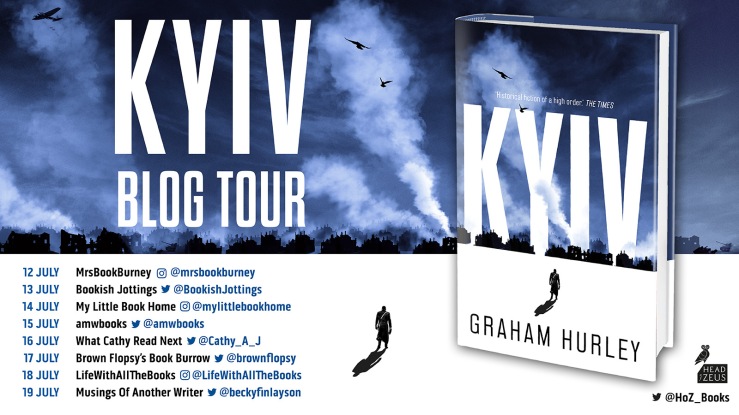
KYIV blog tour banner_V1

Welcome to today’s stop on the blog tour for Kyiv by Graham Hurley, his latest WW2 thriller set against the backdrop of Operation Barbarossa, the German code name for the invasion of Russia. My thanks to Lauren at Head of Zeus for inviting me to take part in the tour and for my digital review copy via NetGalley.
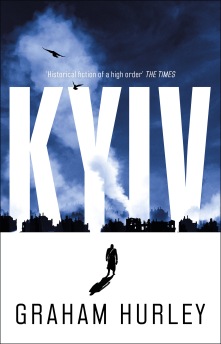

Hurley_KYIV_HBAbout the Book

On Sunday 22nd June 1941 at 03.05, three-and-a-half million Axis troops burst into the Soviet Union along a 1,800-mile front to launch Operation Barbarossa. The southern thrust of the attack was aimed at the Caucuses and the oil fields beyond. Kyiv was the biggest city to stand in their way.

Within six weeks, the city was under siege. Surrounded by Panzers, bombed and shelled day and night, Soviet Commissar Nikita Krushchev was amongst the senior Soviet officials co-ordinating the defence. Amid his cadre of trusted personnel is British defector Bella Menzies, once with MI5, now with the NKVD, the Soviet secret police.

With the fall of the city inevitable, the Soviets plan a bloody war of terror that will extort a higher toll on the city’s inhabitants than the invaders. As the noose tightens, Bella finds herself trapped, hunted by both the Russians and the Germans.

As the local saying has it: life is dangerous – no one survives it.

Format: Hardcover (416 pages) Publisher: Head of Zeus
Publication date: 8th July 2021 Genre: Historical Fiction, Thriller

Find Kyiv on Goodreads

Purchase links
Bookshop.org
Disclosure: If you buy a book via the above link, I may earn a commission from Bookshop.org, whose fees support independent bookshops

Hive | Amazon UK
Links provided for convenience only, not as part of an affiliate programme


My Review

I really enjoyed Last Flight to Stalingrad, the first book in Graham Hurley’s Spoils of War series. Although part of the same series, Kyiv can definitely be read as a standalone.

The setting is the city we today know as Kiev, the capital of Ukraine, and once again the author blends historical fact and fiction into the storyline. For example, Kim Philby, who it’s clear knows how to bowl a googly, makes an early appearance and Guy Burgess turns up soon afterwards. However, the two main characters, Isobel (Bella) Menzies and Tam Moncrieff are fictional.

In alternating chapters, the book charts events over the course of several weeks starting in September 1941. We follow Bella as she travels to Kiev alongside Ilya Glivenko (known as The Pianist) who is overseeing the transport of a mysterious cargo to that city from Britain. And we witness the attempts by Bella’s lover, intelligence officer Tam, to unearth more information about Bella. In the process, he uncovers evidence, in true John le Carré style, about possible moles at the heart of the British intelligence operation.

With the benefit of hindsight, the reader won’t find it hard to identify likely individuals, but for Tam it means following his instincts. There’s a terrific scene that put me in mind of the exploits of Richard Hannay, the hero of John Buchan’s adventure novels, in which Tam attempts to surreptitiously follow a man he suspects may be a traitor through the streets of London. ‘Moncrieff had spent many years stalking deer in the mountains… the subtle arts of staying upwind, of moving carefully from cover to cover, of closing on the prey’. Despite this experience, Tam finds himself outfoxed and, it becomes apparent, in danger.  Indeed, as Bella observes at one point, “The world is always more complicated than you think”.

For Bella, her time in Kyiv is one of new experiences including being hustled from one safe place to another in order to escape the attentions of Stalin’s secret police, and adopting a new identity courtesy of the enigmatic Larissa. Unfortunately, once Russian forces quit the city and are replaced by a German army of occupation, Bella experiences first-hand what the SS are capable of although, to provide balance, the author demonstrates that not every German supported the extreme acts of violence perpetrated by the Nazi regime. There is one scene in particular that, as a woman, I found hard to read and another that is shocking because of its sheer scale. It’s as Yuri, one of Bella’s Ukranian contacts, had warned: “…everything will change. Everything. Here. In the city. Everywhere. We love the Russians going, but we should be careful what we wish for.”

It’s clear the depth of research that has gone into the book, whether that’s recreating the club-like atmosphere of MI5’s Central Registry in St. Albans, the discomfort of an overnight flight aboard a Halifax, or the streets of the besieged Kyiv as German bombs rain down.

In Kyiv, the author has created an unflinching picture of the chaos, confusion and horror of war, and its long legacy – physical, emotional and psychological – for those who live through it.

In three words: Compelling, authentic, powerful

Try something similar: Hitler’s Secret (Tom Wilde #4) by Rory Clements

Follow this blog via Bloglovin


Graham Hurley
Photo credit: Laura Muños

About the Author

Graham Hurley is the author of the acclaimed Faraday and Winter crime novels and an award-winning TV documentary maker. Two of the critically lauded series have been shortlisted for the Theakston’s Old Peculier Award for Best Crime
Novel. The first Wars Within novel, Finisterre, was shortlisted for the Wilbur Smith Adventure Writing Prize.

Connect with Graham
Website | Twitter | Goodreads

#BookReview Songbirds by Christy Lefteri @ReadersFirst1 @ZaffreBooks

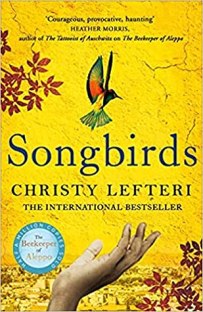
SongbirdsAbout the Book

Nisha has crossed oceans to give her child a future. By day she cares for Petra’s daughter; at night she mothers her own little girl by the light of a phone.

Nisha’s lover, Yiannis, is a poacher, hunting the tiny songbirds on their way to Africa each winter. His dreams of a new life, and of marrying Nisha, are shattered when she vanishes.

No one cares about the disappearance of a domestic worker, except Petra and Yiannis. As they set out to search for her, they realise how little they know about Nisha. What they uncover will change them all.

Format: Hardcover (400 pages) Publisher: Manilla Press
Publication date: 8th July 2021 Genre: Historical Fiction

Find Songbirds on Goodreads

Purchase links
Bookshop.org
Disclosure: If you buy a book via the above link, I may earn a commission from Bookshop.org, whose fees support independent bookshops

Hive | Amazon UK
Links provided for convenience only, not as part of an affiliate programme


My Review

I’ve not read the author’s previous novel, the best-selling The Beekeeper of Aleppo, but having finished Songbirds I can say it is definitely going to be added to my wishlist, along with her first novel, A Watermelon, a Fish and a Bible.

Set in Cyprus, in Songbirds the author paints a picture of an island divided both physically, along the so-called Green Line, and socially, with the employment of maids – usually foreign women – commonplace amongst the middle classes, women like Petra in fact.

Following Nisha’s unexplained disappearance and the reluctance of the police to get involved, Petra’s search for information leads her to speak to other foreign domestic workers who may have known Nisha and who perhaps may hold some clue to her whereabouts. In the process, Petra is forced to confront the fact that these women were largely invisible to her before. (In a clever touch, Petra is an optician who helps others to see better.) Petra hears their often shocking stories of abuse, mistreatment and exploitation.

Indeed, even in the small neighbourhood around Petra’s house – in Mr Yiakoumi’s antique shop, in Theo’s Greek restaurant or Maria’s bar – young women from Sri Lanka, the Philippines or Nepal are working long hours cleaning, preparing and serving food, or carrying out other domestic duties. And although Petra might think herself a generous employer in comparison to some, she still expects Nisha to work from 6am to 7pm six days a week, with a two-hour break in the afternoon, even stipulating that, when not working in the evening, Nisha rest in her room to ensure she is fresh to resume her duties the next day.

I liked the way the author explored the differences and similarities between Petra and Nisha. On the surface, the two women share similar experiences; they are both widows with young children. But Petra is financially secure and runs her own business whereas Nisha has been forced to leave her homeland to seek work as a maid, at the beck and call of others. Another difference is that Petra finds it hard to form the same effortless bond with her daughter, Aliki, that Nisha does. This is despite the fact that Aliki is close at hand for Petra yet Nisha’s daughter, Kumari, is faraway in Sri Lanka and Nisha can communicate with her only in brief video calls.

Yiannis’ involvement in the lucrative but illegal poaching of migrating songbirds – from which activity he admits he ‘makes a killing’ – neatly mirrors the ‘migration’ of foreign workers, such as Nisha, to Cyprus in search of work that will bring them greater financial reward than they could find in their own country. And in another deft connection, the reader is reminded of Cyprus’s history of repeated occupation and colonisation by other nations.

Alongside Yiannis and Petra’s search for Nisha are brief interludes set beside a lake coloured red due to copper extraction.  The scenes have an otherworldly feel to them but are based on a real place, Mitsero.  I found the contrast between the lush natural landscape and the signs of previous human activity that have polluted the area quite unsettling. The significance of these sections became more apparent as the book progressed towards an ending I wasn’t quite expecting.

I was fortunate enough to hear Christy talk about the book in an online event organized by Wokingham Borough Libraries on 13th July 2021. Christy revealed the inspiration for the book was reading about the real-life disappearance of several women and children in Cyprus whom the police refused to search for because they were ‘foreign’.  Also, that the character of Nisha was based on a maid working in the house of relatives in Cyprus whom Christy had got to know during stays there over the years.

As well as answering questions from event host Stephanie Woods from Wokingham Borough Libraries and audience members, those attending were treated to a short reading by Christy from Songbirds. (For those who possess a copy, this was the first section of Chapter 6.) She also gave us a brief hint about what the subject of her next book might be. (Sorry, not telling!)

I really enjoyed the beautiful writing in Songbirds and the insight it gave into issues I had not thought about before. Incidentally, during the online event Christy said that, unlike some other authors, she enjoys reading reviews of her books, firstly because she learns much from readers’ responses to her writing, and secondly because it feels like a way to make an emotional connection between herself and her readers.  I very much hope Christy enjoys reading this review.

Follow this blog via Bloglovin


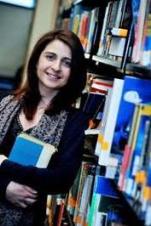
Christy LefteriAbout the Author

Brought up in London, Christy Lefteri is the daughter of Cypriot refugees. She holds a PhD in creative writing, and teaches creative writing at Brunel University. Her previous novel, The Beekeeper of Aleppo, is an international bestseller, selling a million copies worldwide. (Photo credit: Goodreads author page)

Connect with Christy
Twitter | Goodreads