#BlogTour #BookReview Sergeant Salinger by Jerome Charyn @RandomTTours @NoExitPress

Sergeant Salinger BT Poster

Welcome to today’s stop on the blog tour for Sergeant Salinger by Jerome Charyn. My thanks to Anne at Random Things Tours for inviting me to take part in the tour and to No Exit Press for my digital review copy.


Sergeant SalingerAbout the Book

J.D. Salinger, mysterious author of The Catcher in the Rye, is remembered today as a reclusive misanthrope. Jerome Charyn’s Salinger is a young American WWII draftee assigned to the Counter Intelligence Corps, a band of secret soldiers who trained with the British.

A rifleman and an interrogator, he witnessed all the horrors of the war – from the landing on D-Day to the relentless hand-to-hand combat in the hedgerows of Normandy, to the Battle of the Bulge, and finally to the first Allied entry into a Bavarian death camp, where corpses were piled like cordwood.

After the war, interned in a Nuremberg psychiatric clinic, Salinger became enchanted with a suspected Nazi informant. They married, but not long after he brought her home to New York, the marriage collapsed.

Maladjusted to civilian life, he lived like a ‘spook,’ with invisible stripes on his shoulder, the ghosts of the murdered inside his head, and stories to tell. Grounded in biographical fact and reimagined as only Charyn could, Sergeant Salinger is an astonishing portrait of a devastated young man on his way to becoming the mythical figure behind a novel that has marked generations.

Format: Paperback (352 pages)         Publisher: No Exit Press
Publication date: 21st October 2021 Genre: Historical Fiction

Find Sergeant Salinger on Goodreads

Purchase links
Bookshop.org
Disclosure: If you buy a book via the above link, I may earn a commission from Bookshop.org, whose fees support independent bookshops

Hive | Amazon UK
Links provided for convenience only, not as part of an affiliate programme


My Review

I have never read The Catcher in the Rye and knew little about the life of its author J.D. Salinger before reading this book. However, I’m always fascinated by finding out more about the lives of writers and how their life experiences might have influenced their writing. I certainly did not know about J.D. Salinger’s wartime experiences but in Sergeant Salinger, Jerome Charyn brings these vividly to life showing not only their effect on Salinger but the brutality of war.

We follow Salinger through the preparations for the D-Day landings, the landing themselves and the Allied advance through Normandy and eventually to Paris.  Along the way, Salinger experiences firsthand the reality of one-on-one combat with the enemy. ‘It was savagery in slow motion – men snarling, biting, shooting, and ripping at one another in a strange rhythmic dance.’  There are nightmare scenes as Salinger’s division fight their way through the Hürtgen Forest, a forest described as like something out of a fairy tale but one in which the ground is seeded with land mines, German snipers are hidden in pillboxes and mortar shells rain down. When Salinger and his comrades do reach villages that have been abandoned by the Germans they find booby traps waiting for them in the most unexpected places. Worse is to come when Salinger is one of the first to discover the horror of what is euphemistically called a Nazi a ‘labour’ camp but is in actuality a ‘charnel house’. Salinger also witnesses military incompetence and is forced at one point to become complicit in a cover-up on a chilling scale.  Understandably it all takes its toll on his mental state.

It’s a far cry from the opening scenes of the book in which Salinger – in pursuit of the love of his life, Oona O’Neill –  visits a New York night club frequented by Hollywood actors such as Peter Lorre and Merle Oberon, and rubs shoulders with his literary hero, Ernest Hemingway. (In one of the book’s more humourous moments, Salinger encounters Hemingway again but this time installed in the Ritz Hotel in a newly liberated Paris.)

At one point, Salinger expresses his desire ‘to write sentences that would scorch the reader’s soul like shards of burning ice’. Although there are occasional references to Salinger working on the novel that will eventually become The Catcher in the Rye, I would have liked to learn more about the development of his writing and the influence of his experiences on the book. Possibly this might have been more apparent to me had I read The Catcher in the Rye.  Having said that, Sergeant Salinger is certainly a vivid evocation of the brutality and confusion of war, an experience no doubt shared by many other soldiers over the centuries.

In three words: Powerful, intense, dark

Try something similar: The Prince of the Skies by Antonio Iturbe

Follow this blog via Bloglovin


Jerome CharynAbout the Author

Jerome Charyn is the author of more than fifty works of fiction and nonfiction. Among other honors, he has received the Rosenthal Family Foundation Award for Fiction from the American Academy of Arts and Letters and his novels have been selected as finalists for the Firecracker Award and PEN/Faulkner Award for Fiction. Charyn lives in New York.

Connect with Jerome
Website | Twitter

#BookReview When the Music Stops by Joe Heap @fictionpubteam

A note from Joe:

“I owe this book to my grandparents, John and Jean Sands, for sharing the stories that inspired it. In many ways their story is more remarkable than the one I have written.

At a summer season in Ramsgate, 1959, two ice skaters held a party. My grandfather, a Glaswegian saxophonist who would rather have gone to the pub, was convinced by a comedian on the same bill to come along. My grandmother, another one of the ice skaters, sat down next to him and spilt her drink in his lap. Though she has since denied it, her first words of note to him were ‘Oh no, not another Scot.’

Nobody could have guessed how much would spin off that moment, myself and this book included. Here are a few pictures of them.”

images


9780008293208About the Book

This is the story of Ella. And Robert. And of all the things they should have said, but never did.

‘What have you been up to?’
I shrug, ‘Just existing, I guess.’
‘Looks like more than just existing.’
Robert gestures at the baby, the lifeboat, the ocean.
‘All right, not existing. Surviving.’
He laughs, not unkindly. ‘Sounds grim.’
‘It wasn’t so bad, really. But I wish you’d been there.’

Through seven key moments and seven key people their journey intertwines. From the streets of Glasgow during WW2 to the sex, drugs and rock n’ roll of London in the 60s and beyond, this is a story of love and near misses. Of those who come in to our lives and leave it too soon. And of those who stay with you forever…

Format: Hardcover (384 pages)           Publisher: Harper Collins
Publication date: 29th October 2020 Genre: Contemporary Fiction, Romance

Find When the Music Stops on Goodreads

Purchase links*
Amazon UK | Hive (supporting UK bookshops)
*link provided for convenience not as part of an affiliate programme


My Review

The book’s structure, revisiting seven key moments and people in Ella’s life, was, according to the author, inspired by the ‘Seven Ages of Man’ speech from Shakespeare’s As You Like It. However, as Joe Heap also writes, “This is a book about music, inspired by music” so cleverly incorporated into the story are the seven modes that have been part of musical notation since ancient times.

In When the Music Stops, each of these modes is represented by a song in a music book Ella acquires when she first takes up the guitar. Although other elements of her memory have faded by the time we first meet her as an old woman – alone, in rather strange circumstances – the tunes are still at her fingertips, evoking memories of significant stages in her life – and the people who shared them with her. As she muses, “There are seven songs. I have to play all of them, though I don’t know what will come at the end. I just have to play them.”

The ability of music to evoke memories is just one of the fascinating concepts explored in the book, along with the nature of memory itself and how we experience the passing of time. I’ll leave others to explain Einstein’s theories on the latter but I liked the metaphor Robert, Ella’s friend since childhood, employs. He compares time to a long-playing record. While you’re listening to the second verse of a song, he explains, the first verse is still there but you’re just not listening to it anymore.

As the reader learns, Ella’s life has been punctuated by moments of loss, often signalled by that thing we’ve probably all come to dread – the unexpected early morning or late night telephone call. Robert’s earlier metaphor is applicable here too. As he confides to Ella about a person they both knew, “I don’t think she’s really gone… I just think we can’t see her anymore.”

Another key theme of the book is that of the missed opportunities in life, especially between people like Ella and Robert. ‘The Road Not Taken’ of Robert Frost’s poem, as it were. Their encounters over the years are populated by falsely reassuring thoughts such as “There will be other chances” and fateful hesitations, “The door of possibility stays open, waiting for her to walk through, but she stays put”.

I admired the way the author recreated the atmosphere of each stage on the journey through Ella’s life, referencing the clothing, the television programmes or even the food of the time: the school playground gift of tablet (a sweet similar to fudge for you non-Scots out there) or a corned beef and pickle sandwich prepared for a picnic.

The standout section for me, entitled ‘The Rebel’, was Ella’s experiences as a session musician in 1960s London, rubbing shoulders with many famous, or soon to be famous, bands of the period. (In his acknowledgements, Joe mentions Carol Kaye, “a trailblazing female musician” who played guitar and bass on many hit records and was the inspiration for Ella.) I also found the section entitled ‘The Matron’ particularly moving.

At one point in the book, a character mentions ‘fantastical thinking’ and I think that’s a great description of the premise of this clever but very touching novel. At the online book launch, Joe Heap mentioned fantasy as making up some of his own early reading – books by authors such as Terry Pratchett and Neil Gaiman – and it’s easy to see that influence in elements of the book. However, more than anything, When the Music Stops is an emotional story of love, loss and the power of the human spirit. I think it would make a great book club choice.

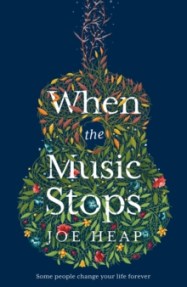
With its gorgeous cover, this is one of those occasions when I feel I’ve slightly missed out by opting for a digital version of a book.  So I may just have to treat myself and help out an independent bookshop through Lockdown 2.0 in the process…

In three words: Imaginative, insightful, heartfelt

Try something similar: Fred’s Funeral by Sandy Day

Follow this blog via Bloglovin


Joe Heap Author PicAbout the Author

Joe Heap was born in 1986 and grew up in Bradford, the son of two teachers. His debut novel, The Rules of Seeing, won Best Debut at the Romantic Novel of the Year Awards in 2019 and was shortlisted for the Books Are My Bag Reader Awards. Joe lives in London with his girlfriend, their two sons and a cat who wishes they would get out of the house more often.

Connect with Joe
Twitter