
About the Book
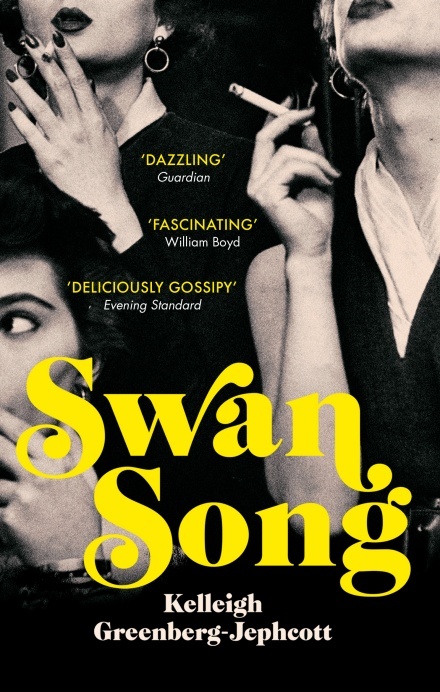
To the outside world, they were the icons of high society — the most glamorous and influential women of their age. To Truman Capote they were his Swans: the ideal heroines, as vulnerable as they were powerful. They trusted him with their most guarded, martini-soaked secrets, each believing she was more special and loved than the next…
Until he betrayed them.
Format: Paperback (496 pages) Publisher: Windmill
Publication date: 14th June 2018 Genre: Historical Fiction
Find Swan Song on Goodreads
Purchase Swan Song from Bookshop.org [Disclosure: If you buy books linked to our site, we may earn a commission from Bookshop.org, whose fees support independent bookshops]
My Review
Capote believed his (never-finished) novel, Answered Prayers, would be his crowning achievement as an author, a work comparable (in his own mind) to that of Marcel Proust. Crippled with writer’s block he decided to allow the first few chapters of the novel to be published in Esquire magazine. They depicted the thinly disguised lives and scandals of his closest female confidantes, the six women he referred to as his ‘swans’ – C.Z. Guest, Babe Paley, Marella Agnelli, Slim Keith, Lee Radziwill, and Gloria Guiness They never forgave him.
Pretty soon after I began reading Swan Song I wondered if I really wanted to spend time amongst a group of privileged women whose most pressing decisions seemed to be what to wear, where to lunch and with whom. Or with a man, Truman Capote, who was prepared to reveal their most intimate secrets – shared with him, so they believed, in confidence – in order to perpetuate his reputation as an author. In addition, a man with the most affected speech and mannerisms, who created cringeworthy nicknames for his ‘swans’ and possessed an insatiable appetite for gossip, the more scurrilous the better.
Slowly though I began to become more interested in these women, particularly those who had taken charge of their own destinies, working their way up from nothing. I started to see the women beneath the glitzy lifestyle of endless parties, vacations in glamorous locations, visits to the beauty parlour and costumiers. I got an insight into their frustrations, disappointments and failed relationships and began to see them as individuals not as some homogenous group. I found myself particularly drawn to Barbara “Babe” Paley’s story and moved by events later in her life.
The author’s bold choice to have the women act like a Chorus in a Greek tragedy, recounting their stories but also, omnisciently, Capote’s story did work for me. Often astute, sometimes wry and acerbic, they tempered their disappointment at Capote’s betrayal with a degree of compassion. After all he was excellent company, an entertaining conversationalist and a generous host for whom no extravagance seemed too over the top. Many of them looked upon him as a friend, a confidante with whom to share problems and someone to cheer them up when they felt down.
I’m not sure I ever got over my dislike of Truman Capote although the author made a great effort to detail his troubled childhood, abandoned for long periods by a mother he nevertheless adored. He came across as needy, self-absorbed and at times rather cruel. I had little sympathy for his ostracization by the women whose confidence he betrayed. Having said that I couldn’t help being moved as we witness his gradual decline, the result of alcohol and drug abuse.
The book moves back and forth in time so does demand a degree of concentration from the reader. However, Swan Song is a fascinating glimpse into the lives of the rich and famous in 1960s and 1970s New York with walk-on parts for celebrated film stars, authors and politicians. Above all, it’s a story of hubris. I’m glad I (finally) made time to read it.
I listened to the audiobook read by Debora Weston. Overall I think she did a great job but I found Truman Capote’s high-pitched, rather child-like voice (although no doubt a fairly accurate representation) grated on me over the 17 hours it took to listen to the book.
In three words: Fascinating, incisive, authentic
About the Author

Kelleigh Greenberg-Jephcott was born and raised in Houston, Texas, before coming to call Los Angeles and London her adopted homes. She is a graduate of UEA’s Creative Writing MA course and was the winner of the Bridport Prize Peggy Chapman-Andrews Award. Swan Song, her first novel, was longlisted for the Women’s Prize for Fiction 2019.
Connect with Kelleigh
X/Twitter




 What Cathy Read Next...