From Page to Screen: Murder on the Orient Express


About the Book: Murder on the Orient Express by Agatha Christie

Just after midnight, the famous Orient Express is stopped in its tracks by a snowdrift. By morning, the millionaire Samuel Edward Ratchett lies dead in his compartment, stabbed a dozen times, his door locked from the inside. Without a shred of doubt, one of his fellow passengers is the murderer. Isolated by the storm, detective Hercule Poirot must find the killer among a dozen of the dead man’s enemies, before the murderer decides to strike again.

Read my review of the book here.

Kenneth BranaghAbout the Film: Murder on the Orient Express (2017)

Murder on the Orient Express is directed by Sir Kenneth Branagh from a screenplay by Michael Green based on Agatha Christie’s novel. A star-studded cast includes Sir Kenneth Branagh as Hercule Poirot, Johnny Depp as Ratchett, Michelle Pfeiffer as Mrs Hubbard along with Penelope Cruz, Dame Judi Dench, Daisy Ridley, Sir Derek Jacob and others.

More information about the film can be found here.

Book v Film (Spoiler free)

Firstly, I’m going to confess that I’m a fan of the 1974 film adaptation of Murder on the Orient Express, directed by Sidney Lumet and starring Albert Finney as Hercule Poirot.  Alongside Finney are a succession of Hollywood big names such as Lauren Bacall and Richard Widmark and some of the cream of British film and theatre, including Sir John Gielgud, Michael York, Vanessa Redgrave and Sean Connery.

However, I’m also a great admirer of Sir Kenneth Branagh’s work, notably his wonderful version of Henry V. In fact, I’m not sure anyone other than him would have tempted me to consider seeing a new version of Murder on the Orient Express.   I was lucky enough to view the film at my local independent cinema, Reading Film Theatre. Its President is none other than Sir Kenneth Branagh. He was brought up in Reading and was a member of the RFT for a time. Those of us attending the film got a bonus in the form of a specially recorded video message from Sir Kenneth about the film and his connections with the RFT. He mentioned that one of the films he remembered seeing there was Dog Day Afternoon, directed by….yes, Sidney Lumet.

The script of this latest version follows fairly closely the plot of the book, although an opening scene has been added which I thought largely superfluous.   Branagh’s Poirot has the keen observational and deductive skills of Agatha Christie’s literary creation but is a tad more energetic. As director, Branagh chooses not to confine the action to inside the stranded train, as in the earlier film version and in the original book.

The passengers on the train represent the same varied collection of characters as in the book, although some character names have been changed and there is a little more diversity in the casting than in the earlier film version. With a large cast of characters, it’s probably impossible to avoid some of them having very little screen time and this was the case here. For instance, poor Olivia Colman got only a few lines and she had to say most of those in German! In terms of performances, Branagh’s stands out. The screenplay added some back story to the character of Hercule Poirot and a little wry humour but retained the essence of the fussy, exacting man of Agatha Christie’s books. Branagh was good at tempering Poirot’s, at times, pompous belief in his own abilities with hints of inner doubt and questioning of the nature of justice. I also really liked Sir Derek Jacobi’s sympathetic portrayal of Ratchett’s valet, Masterman, but then I’m a fan of Sir Derek and he represents that class of actor who can make something powerful on the screen out of very little on the page.

As you might expect from an experienced director like Branagh, the film is well shot, there are expertly handled crowd scenes and some luscious scenery as the train proceeds on its journey. The closing lines attempt to be a clever joke but to anyone familiar with another very famous Agatha Christie mystery come across merely as a goof.

The Verdict

The film respects the book’s ingenious plot and the inventiveness of the solution to the murder of Ratchett.   Although I enjoyed the film, as in so many cases before, I believe the book wins out. However, I’m sure people who have never read the book or are too young to have seen the earlier film version will probably enjoy it. Personally, I’d recommend reading the book and then watching the 1974 film version just to wallow in the glamourous setting, the starry cast and the glorious music of Richard Rodney Bennett.

What do you think? Have you read the book or seen the film?

Book Review – Fortune’s Wheel by Carolyn Hughes

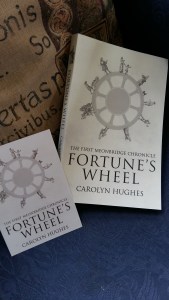
FortunesWheelAbout the Book

June 1349. In a Hampshire village, the worst plague in England’s history has wiped out half its population, including Alice atte Wode’s husband and eldest son. The plague arrived only days after Alice’s daughter Agnes mysteriously disappeared, and it prevented the search for her. Now the plague is over, the village is trying to return to normal life, but it’s hard, with so much to do and so few left to do it. Conflict is growing between the manor and its tenants, as the workers realise their very scarceness means they’re more valuable than before: they can demand higher wages, take on spare land, and have a better life. This is the chance they’ve all been waiting for. Although she understands their demands, Alice is disheartened that the search for Agnes is once more put on hold. When one of the rebels is killed, and then the lord’s son is found murdered, it seems the two deaths may be connected, both to each other and to Agnes’s disappearance

Format: eBook (319 pp.), paperback (270 pp.) Publisher: SilverWood Books
Published: 7th November 2016                            Genre: Historical Fiction

Purchase Links*
Amazon.co.uk ǀ Amazon.com ǀ Publisher
*links provided for convenience, not as part of any affiliate programme

Find Fortune’s Wheel (The Meonbridge Chronicles #1) on Goodreads


My Review

Carolyn Hughes has chosen to set Fortune’s Wheel, the first in her Meonbridge Chronicles series, in the aftermath of The Black Death (referred to by the villagers as the ‘mortality’). This is a time of terrible bereavement – husbands have lost wives, wives have lost husbands, couples have lost children, children have been orphaned and, in some tragic cases, whole families have perished. Fields lie untended, cottages lie empty and the surviving villagers face straitened times and an uncertain future. Not least because if the ‘mortality’ was indeed sent by God to punish sinners, as their priests tell them, what’s to say it might not return? But, if it was sent by God, why were some known to be sinners spared and others – innocent babes, godly men and pious women – taken?

I really felt I became part of the village of Meonbridge and totally immersed in the lives of the villagers. There are a lot of characters to get to know initially so I appreciated the helpful list at the beginning of the book. However, it would be an unusual and rather uninteresting village if it didn’t have a varied population and, since the story has three main protagonists, I never felt overwhelmed. The three protagonists are all female and I really enjoyed the independence of spirit they shared, given the constraints of society’s expectations at that time. There is Alice, sadly widowed by the ‘mortality’ but determined not to remarry and to retain her independence. There is Eleanor, a freewoman thrust into the role of managing her own lands by the death of her parents and resolved to remain unmarried until she is ready for matrimony. And there is Lady Margaret, wife of the Lord of the Manor, who subtly seeks to mitigate the stern justice meted out by her husband on the tenants and workers of the manor.

As the inhabitants of Meonbridge struggle to overcome the ravages of the ‘mortality’ and rebuild their lives, Alice and her son, John, continue to be troubled by the disappearance of Alice’s daughter, Agnes, shortly before the ‘mortality’ struck. They’re both convinced that others know more about Agnes’ disappearance than they are saying. Is she dead, or alive and, if she still lives, why did she run away?

The ‘mortality’ is bringing other changes to the village, with some using the economic realities of a reduced population to challenge the feudal system that has ruled their lives for so long. However, there are those whose position would be threatened by any change in the balance of power.  Who knows to what lengths they will go to protect the status they currently enjoy?

One of the many interesting things I learned from Fortune’s Wheel was that there was a hierarchy amongst the peasantry as well as between the peasants and the landowners. The book contains fascinating detail about the feudal system: the obligations demanded with limited rights offered in return, the restrictions with few freedoms given in exchange and the many payments that could be demanded with refusal risking loss of home, property or livelihood.  The book also really brought home to me how little the ordinary villagers knew of life outside the confines of the village, often living and dying without ever travelling more than a few miles from their birthplace.

I loved all the detail of village life which gave the story such an authentic feel. Clearly, the author has done an incredible amount of research, introducing me to new terms – merchet, legerwite, heriot – and the many different roles necessary to village life – bailiff, steward, reeve and (my favourite) ale-taster. A glossary would be a fantastic addition to the book and I’d also love to have a map of the village.  There are many fascinating articles on Carolyn’s blog, including this one about life after The Black Death.

As you can probably tell, I really enjoyed Fortune’s Wheel and thought it was an accomplished, fascinating historical fiction novel – and an impressive debut. I was thrilled to learn the author is working on a second book in the series, A Woman’s Lot, and that this is due for publication in 2018. I’ll certainly look forward to reading more about the lives of the people of Meonbridge.

I received a copy of Fortune’s Wheel in a giveaway organised by Brook Cottage Books. I’d like to thank Carolyn for providing the book as a prize and for signing my copy.

In three words: Well-researched, engaging, mystery

Try something similar: The Last Hours by Minette Walters (read my book review of The Last Hours)


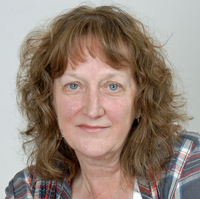
Carolyn HughesAbout the Author

Carolyn Hughes was born in London, but has lived most of her life in Hampshire. After a first degree in Classics and English, she started her working life as a computer programmer, in those days a very new profession. It was fun for a few years, but she left to become a school careers officer in Dorset. But it was when she discovered technical authoring that she knew she had found her vocation. She spent the next few decades writing and editing all sorts of material, some fascinating, some dull, for a wide variety of clients, including an international hotel group, medical instrument manufacturers and the Government.

She has written creatively for most of her adult life, but it was not until her children grew up and flew the nest, several years ago, that creative writing and, especially, writing historical fiction, took centre stage in her life. She has a Masters in Creative Writing from Portsmouth University, and a PhD from the University of Southampton.

Connect with Carolyn

Website ǀ Facebook ǀ Twitter ǀ Goodreads