
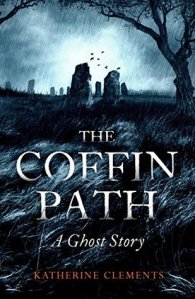
 About the Book
Maybe you’ve heard tales about Scarcross Hall, the house on the old coffin path that winds from village to moor top. They say there’s something up here, something evil.
Mercy Booth isn’t afraid. The moors and Scarcross are her home and lifeblood. But, beneath her certainty, small things are beginning to trouble her. Three ancient coins missing from her father’s study, the shadowy figure out by the gatepost, an unshakeable sense that someone is watching.
When a stranger appears seeking work, Mercy reluctantly takes him in. As their stories entwine, this man will change everything. She just can’t see it yet.
Format: Hardcover, eBook (284 pp.) Publisher: Headline Review
Published: 8th February 2018 Genre: Historical Fiction
Purchase Links*
Amazon.co.uk ǀ Amazon.com
*links provided for convenience, not as part of any affiliate programme
Find The Coffin Path on Goodreads
My Review
The Coffin Path’s striking opening line – “I was born with blood on my hands” – sets the scene for a story full of atmosphere and chilling moments. Ancient curses, family secrets, a remote moorland setting and a crumbling old house reached only by an ancient track called the coffin path – what more do you want?
Very much in the tradition of M. R. James, the sinister atmosphere the author creates comes more from suggestion than full-blown in your face horror. Noises from empty rooms, objects moving or disappearing without seeming human intervention, sudden chills or unusual scents are far scarier and unsettling to my mind than coming face-to-face with a monster. There is one particular scene that definitely made me want to draw the bedcovers up over my head! All the time the reader is made to wonder whether there is malicious human agency behind the goings-on, whether they are the product of a feverish or disturbed imagination – mass hysteria, even – or there is an actual supernatural presence.
As word of the strange occurrences at Scarcross Hall reach the wider community it’s not long before superstitious minds see the work of the Devil behind them and seek to assign blame. Like other women down the ages, Mercy, as an independent-minded, unconventional and most importantly unmarried woman, is an easy target for their suspicions, especially when fuelled by grudges of a more personal nature.
Alongside the strange events in the house, the author presents a convincing and detailed picture of the everyday struggle to eke out a livelihood on a remote moorland farm. There is some wonderful descriptive writing that conjures up the wild beauty of the moor that surrounds Scarcross Hall. ‘Now, in this moment, the wind brings it to him: the rich savour of damp peat, must and decay, the metallic, coppery scent of snow and ancient, rainwashed stone, a hint of salt and sea storms.’ I also liked the use of alliteration in lines like, ‘He craves the comfort of it, longs for the liquidity of limbs, the gradual sink into silent contemplation.’
I have to say that although the story is set in the 17th century, I didn’t get an overwhelming sense of that period for a lot of the book. It felt that events could believably have been taking place in the 18th or 19th century and that Mercy might easily have run into Emily Brontë whilst out on the moor. However, this does change towards the end of the book as the events and upheaval of the recent Civil War become very central to the story.
The Coffin Path is a satisfyingly creepy ghost story that builds slowly to a dramatic climax as secrets are finally revealed. I received an advance reader copy courtesy of NetGalley and publishers Headline in return for an honest and unbiased review.
In three words: Atmospheric, creepy, sinister
Try something similar…The Haunting of Hill House by Shirley Jackson (click here for my review) or The Little Stranger by Sarah Waters
 About the Author
Katherine was born in Littleborough, Lancashire and grew up in Surrey and Sheffield. She studied Ancient History and Archaeology at Manchester University, followed by a varied career in media, the charity sector and education. Most recently she worked for a national examination board where she led the development and launch of the UK’s first A Level qualification in Creative Writing.
Katherine’s critically acclaimed debut novel, The Crimson Ribbon, was published in 2014 and her second, The Silvered Heart, in 2015. Her work has been compared to the likes of Sarah Waters and Daphne du Maurier. Her third novel, The Coffin Path, will be published in February 2018. Katherine is editor of Historia, the online magazine of the Historical Writers’ Association, and is a member of the HWA committee. She is a member of the Society of Authors and authors’ collective the Prime Writers and is an occasional contributor to Northern Soul. She is currently Royal Literary Fund Fellow at Manchester University.
She lives in Manchester and is working on her next novel.
Connect with Katherine
Website ǀ Facebook ǀ Twitter ǀ Goodreads


