
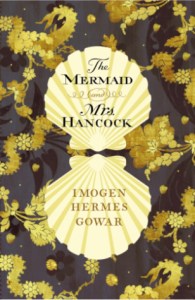
Book Review: The Mermaid and Mrs. Hancock by Imogen Hermes Gowar

The Mermaid & Mrs HancockAbout the Book

This voyage is special. It will change everything…

One September evening in 1785, the merchant Jonah Hancock hears urgent knocking on his front door. One of his captains is waiting eagerly on the step. He has sold Jonah’s ship for what appears to be a mermaid.  As gossip spreads through the docks, coffee shops, parlours and brothels, everyone wants to see Mr Hancock’s marvel. Its arrival spins him out of his ordinary existence and through the doors of high society. At an opulent party, he makes the acquaintance of Angelica Neal, the most desirable woman he has ever laid eyes on… and a courtesan of great accomplishment. This meeting will steer both their lives onto a dangerous new course, on which they will learn that priceless things come at the greatest cost.

Where will their ambitions lead? And will they be able to escape the destructive power mermaids are said to possess?

Format: eBook (482 pp.), hardcover (496 pp.)  Publisher: Vintage Books
Published: 25th January 2018                              Genre: Historical Fiction

Purchase Links*
Amazon.co.uk  ǀ  Amazon.com  ǀ Hive.co.uk
*links provided for convenience, not as part of any affiliate programme

Find The Mermaid and Mrs. Hancock on Goodreads


My Review

The Mermaid and Mrs. Hancock is notable for its cast of memorable female characters.  There’s Angelica, the beautiful, capricious, independent-minded courtesan who’s unfortunately insufficiently financially independent not to be in need of a new protector.  There’s the procuress to high society and Angelica’s erstwhile employer, Mrs Chappell, a somewhat grotesque figure but one who possesses an acute eye for business.  ‘Mrs Chappell is there to greet him, a vast toad in white linen, her stubby arms outstretched and her legs churning up her skirts as she paddles across the gleaming floor.’  There’s clever, organised Sukie, Mr Hancock’s niece, who’s been made to feel ‘a spare daughter’ in her mother’s large household and wonders about her future.  ‘Sukie’s secret ambition is to marry a gentleman in possession of s good trade but poor health, who will die very shortly after the children are born and leave her be.’  And there’s young Polly, whose dark skin makes her merely a valuable novelty for the men who patronise Mrs Chappell’s establishment.

However, my favourite character and the most sympathetic figure in the book to my mind is Jonah Hancock.  Widowed in tragic circumstances, he’s all too aware of his responsibilities to support his sister’s mighty brood.  Jonah is seized with the desire to better himself and it is in pursuit of this that he is persuaded to take the uncharacteristic step of putting the strange object he has unexpectedly acquired on public display.  What follows will bring him wealth and fame but also contact with elements of society that are totally outside of his previous experience.

Above all, Jonah is lonely. ‘Mr Hancock returns to his own doorstep, where no wife stands with her arms outstretched to him, and no children buzz with their observations of the day.’  He feels particularly keenly the sadness of having no child to make everything he’s achieved seem worthwhile.  ‘If he leaves nothing, who can say he lived at all?’ When he sets eyes on Angelica he is immediately captivated, although they seemingly have little in common.  Perhaps his life may take a different path, a path which he had long ago given up hope of?

The book has a fantastic period atmosphere reminiscent of that created by Francis Spufford in Golden Hill.  The sights, sounds and tastes of 18th century London are conjured up so the reader feels immersed in the period. ‘Syllabubs on cold slates; liqueur-flavoured jellies, and strawberries and melons and millefruits; and a great heaped centrepiece of butter-yellow pineapples, whose flesh both fresh and roasted perfumes the room.’  And there’s a touch of another ‘Hill’ – Fanny Hill by John Cleland – in some of the bawdy scenes at Mrs Chappell’s ‘entertainments’.

There’s some brilliantly witty writing and dry humour.  ‘It happens that a gentleman named Mr Brierley is one day caught in flagrante with this horse-boy, or some say his horse, but either way such prurient interest in the dealings of strangers has no place in this story.  It only signifies at all because after this Mr Brierley hanged himself, the extent of his debts was revealed, and his widow put his house and all its contents up for sale for a very reasonable price.’

Amid the lively atmosphere of high society taking its pleasures, there are darker undertones.  There is a reminder that the gilded cage in which Mrs Chappell’s ‘ladies’ reside is a form of imprisonment and that their lives could be transformed for the worse in a moment.   In fact, being trapped by one’s gender, class, race, financial situation or even marital status emerges as a theme of the book.  There are other messages as well: that you should be careful what you wish for, that you should count your blessings and that what you think you crave above all things may not bring you the happiness you believe – in fact, just the opposite.  “To be content as best we can must be enough for us.”  Perhaps contentment is all anyone needs.

I absolutely loved this book with its cast of colourful characters, its exquisite period detail and engaging story line.  It’s a long time away, but this will go straight on my list of books I’ll tip to make The Walter Scott Prize for Historical Fiction longlist in 2019. And, I’ll bet that’s not the only literary prize list it ends up on either.

I received an advance reader copy courtesy of NetGalley and publishers, Vintage, in return for an honest review.

Follow my blog with Bloglovin

In three words: Spirited, atmospheric, richly-textured

Try something similar…Golden Hill by Francis Spufford (click here to read my review)


Imogen Hermes GowarAbout the Author

Imogen Hermes Gowar studied Archaeology, Anthropology and Art History before going on to work in museums. She began to write fiction inspired by the artefacts she worked with, and in 2013 won the Malcolm Bradbury Memorial Scholarship to study for an MA in Creative Writing at UEA. The Mermaid and Mrs Hancock was a finalist in the MsLexia First Novel Competition and shortlisted for the inaugural Deborah Rogers Foundation Writers’ Award.

Connect with Imogen

Website ǀ   Twitter  ǀ  Goodreads


Blog Tour/Review: The Renaissance Club by Rachel Dacus

Blog Tour January 23, 2018 - February 23, 2018

I’m delighted to be hosting today’s stop on the blog tour for The Renaissance Club by Rachel Dacus.  You can read my review below.  If you’re interested in art history, Italy or just love a time travel romance, then this is the book for you.

Follow my blog with Bloglovin


The Renaissance ClubAbout the Book

May Gold, college adjunct, often dreams about the subject of her master’s thesis – Gianlorenzo Bernini. In her fantasies she’s in his arms, the wildly adored partner of the man who invented the Baroque.

But in reality, May has just landed in Rome with her teaching colleagues and older boyfriend who is paying her way. She yearns to unleash her passion and creative spirit, and when the floor under the gilded dome of St Peter’s basilica rocks under her feet, she gets her chance. Walking through the veil that appears, she finds herself in the year 1624, staring straight into Bernini’s eyes. Their immediate and powerful attraction grows throughout May’s tour of Italy. And as she continues to meet her ethereal partner, even for brief snatches of time, her creativity and confidence blossom. All the doorways to happiness seem blocked for May-all except the shimmering doorway to Bernini’s world.

May has to choose: stay in her safe but stagnant existence, or take a risk. Will May’s adventure in time ruin her life or lead to a magical new one?

Praise for The Renaissance Club

‘Enchanting, rich and romantic…a poetic journey through the folds of time. In The Renaissance Club, passion, art, and history come together in this captivating tale of one woman’s quest to discover her true self and the life she’s meant to lead. Rachel Dacus deftly crafts a unique and spellbinding twist to the time-traveling adventure that’s perfect for fans of Susanna Kearsley and Diana Gabaldon’. [Kerry Lonsdale, Wall Street Journal Bestselling Author]

‘The Renaissance Club is a beautifully written story about a woman torn between two worlds – the present and the distant past. This time-travel adventure kept me guessing until the end about which world May would choose, and if that choice would be the right one. Highly recommended for lovers of time travel fiction or anyone looking for a compelling story about a woman trying to find happiness.’  [Annabelle Costa, Author of The Time Traveler’s Boyfriend]

‘The Renaissance Club shimmers with beauty, poetry, and art. Author Rachel Dacus sweeps her readers away to Italy with her, lifting the senses with the sights, sounds, and tastes of that stunning country; imparting her deep knowledge of Renaissance and Baroque art while immersing the reader in a gorgeously romantic story. This book is time travel at its best!’ [Georgina Young-Ellis, author of The Time Mistress series]

Format: eBook, paperback (274 pp.)  Publisher: Fiery Seas Publishing
Published: 23rd January 2018              Genre: Contemporary Fiction, Romance

Purchase Links*
Amazon.co.uk  ǀ  Amazon.com  ǀ Barnes and Noble ǀ  iBooks ǀ  Kobo
*links provided for convenience, not as part of any affiliate programme

Find The Renaissance Club on Goodreads


My Review

Bernini1When I was contacted by Catherine at Fiery Seas Publishing about taking part in the tour, I was immediately attracted not only by the intriguing premise of The Renaissance Club but also by the fact that I’ve visited some of the Italian locations in the book – Rome and Venice.  I’ve even seen the Bernini sculptures at Villa Borghese in Rome – although I didn’t have a close encounter anything like May does.

The author uses the story of May’s travels around Italy with the other members of The Renaissance Club in an imaginative way to give the reader the story of Bernini’s life and work without the book ever feeling like an art history textbook.

May’s relationship with her boyfriend, Darren, is strained and what she experiences during her journey through Italy only seems to make their differences more apparent.  Although May feels gratitude towards Darren for bringing her on the trip, she feels frustrated at his unwillingness to commit to their future together.  They seem temperamentally very different as well.  He is ambitious and status driven, whilst May is more interested in exploring her creativity through writing poetry. When Darren remarks dismissively, “There’s not much money in writing poetry, is there?” May’s understandable reaction is to think his comments ‘eminently reasonable, but not exactly encouraging’.

At one point, initiated by Darren, they indulge in an academic debate over lunch about who was the better sculptor – Bernini or Michelangelo.  To my mind, the discussion that follows encapsulates the tensions in their relationship – it’s an argument loosely disguised as academic debate.   No surprise that Darren puts the case for Michelangelo, dismissing May’s adored Bernini as “a mere entertainer…a vaudevillian who equates art with spectacle…a showoff.”  May soon works out what’s really going on. ‘He was demolishing her idol with a savage analysis.  This wasn’t their usual game.  This was a fight.  She felt as if he were acting like a jealous lover.’

May, and her boss, Eva, both find their creativity awakened by their experiences on the tour.  For Eva it is getting up close and personal with the greatest Renaissance art, as represented by Michelangelo, that brings about this change and offers her the possibility of moving on from tragedies in her personal life.  For May, it is the master of the Baroque, Bernini, who gets her creative (and other) juices flowing.  Her creative outlet is poetry, the medium in which she can most effectively express her feelings and emotions.

As a reader, I felt almost transported to the various artistic sites The Renaissance Club visit on their tour thanks to the author’s wonderful descriptions of church interiors, frescoes and sculptures.  There are also some evocative descriptions of the cities the group visit on their tour: Rome, Siena, Assisi, Florence and Venice.  For example, this description of Rome: ‘Ancient city walls next to rough-piled medieval palazzos, Egyptian obelisks rising from Baroque fountains.  Rome was a hot mess of beauty.’  (I love that phrase ‘a hot mess of beauty’.  If you’ve ever been there, you’ll realise how apt it is.) Or this description of Venice: ‘White-domed churches shouldered next to palazzos of earthy colours, and the filigreed palaces, with fluted chimneys and Juliet balconies, were jewels against the blue sky.  Venice was the gaudy inheritance of a rich empire built on water, imagination, and bold ambition.’  The author also writes poetry and I got a real sense of this in some of the imaginative phrases and metaphors in the book.  For instance, as May feels herself slipping between past and present: ‘The city kept doing this to her, zigzagging through its eras so fast she had time-whiplash.’

I really enjoyed The Renaissance Club and found much to admire in it on a number of different levels.  I loved the imaginative use of the time travel aspect to provide an insight into Italian art of the Renaissance and the Baroque without feeling that I’d sat through a lecture on art history.  I enjoyed seeing the awakening of May’s creativity and the effect on her of Bernini’s energizing presence: ‘I need to learn to flow. Why do I always feel like I’m encased in stone?’.  And I found myself applauding the changes she decides to make in her life.  As the group’s remarkable tour guide, George, says, “Your life is yours to create, May.  Shape it like a poem, with imagination but also sense”.

I received an advance reader copy courtesy of publishers, Fiery Sea Publishing, in return for an honest and unbiased review.

In three words: Imaginative, romantic, time travel

Try something similar…The Winter Sea by Susanna Kearsley


Rachel DacusAbout the Author

Rachel Dacus is the daughter of a bipolar rocket engineer who blew up a number of missiles during the race-to-space 1950’s. He was also an accomplished painter. Rachel studied at UC Berkeley and has remained in the San Francisco area. Her most recent book, Gods of Water and Air, combines poetry, prose, and a short play on the afterlife of dogs. Other poetry books are Earth Lessons and Femme au Chapeau.

Her interest in Italy was ignited by a course and tour on the Italian Renaissance. She’s been hooked on Italy ever since. Her essay “Venice and the Passion to Nurture” was anthologized in Italy, A Love Story: Women Write About the Italian Experience. When not writing, she raises funds for non-profit causes and takes walks with her Silky Terrier. She blogs at Rocket Kid Writing.

Connect with Rachel

Website ǀ  Twitter ǀ  Goodreads