Book Review: Drift Stumble Fall by M. Jonathan Lee

Drift Stumble FallAbout the Book

Richard feels trapped in his hectic life of commitment and responsibility. From the daily mayhem of having young children, an exhausted wife and pushy in-laws who frequently outstay their welcome, Richard’s existence fills him with panic and resentment. The only place he can escape the dark cloud descending upon him is the bathroom, where he hides for hours on end, door locked, wondering how on earth he can escape.

Often staring out of his window, Richard enviously observes the tranquil life of Bill, his neighbour living in the bungalow across the road. From the outside, Bills world appears filled with comfort and peace. Yet underneath the apparent domestic bliss of both lives are lies, secrets, imperfections, sadness and suffering far greater than either could have imagined. Beneath the surface, a family tragedy has left Bill frozen in time and unable to move on.  As he waits for a daughter who may never return, Bill watches Richard’s bustling family life and yearns for the joy it brings. As the two men watch each other from afar, it soon becomes apparent that other people’s lives are not always what they seem.

Format: Paperback (310 pp.)          Publisher: Hideaway Fall
Published in UK: 12th April 2018   Genre: Contemporary Fiction

Pre-order/Purchase Links*
Amazon.co.uk  ǀ  Amazon.com  ǀ Publisher
*links provided for convenience, not as part of any affiliate programme

Find Drift Stumble Fall on Goodreads


My Review

Richard seems to have everything – a good job, two lovely children, a nice house – but it isn’t making him happy.  Richard feels trapped in a life that hasn’t turned out how he imagined, ‘trapped inside something I created.’  The heavy snowfall currently preventing his usual escape to work only increases this sense of entrapment.  Seeking refuge in the kitchen, he finds parallels between the mundane activity of drying the dishes and his life: ‘I pick up another plate and begin to dry it slowly and carefully…Around and around in a circular motion, like the stylus on a record, in ever-decreasing circles… My mind drifts and I realise I share so much in common with the tea towel and the plate.  An endless journey with no beginning and no end.’

Richard is actually a caring father but he doesn’t see that.  Instead he is overly self-critical, perceiving only his failings, thinking even that his family would be better off without him. There are small signs of Richard’s growing desperation such as his reference to the front door as ‘the door to freedom’.   The idea of escape and ‘starting over’ begins to dominate his thoughts and planning it provides him with a way to cope.  He’s very practical and methodical about his plans but the reader does wonder if he would actually ever go through with it or if just the mere existence of the plan acts as a coping mechanism for him.

The routine of domestic life in Richard’s household – meal times, bath time, bed time, watching TV – is chronicled in minute detail; so much so that I began to have a lot of sympathy with Richard’s desire to break free from it all.  I too found myself harbouring thoughts of escape when reading about mundane problems such as clearing snow from the drive and de-icing the car.

There were characters in the book I found it easy to empathise with – Richard, Richard’s father-in-law Kenneth, Bill and Rosie the neighbours across the road – and characters I frankly found irritating (Lisa and Dina, I’m looking at you.)  Richard and his wife, Lisa, have a curiously distant relationship and I struggled to find much attractive about Lisa, what with her snoring and rather slobbish habits.  However, I have to admit that the scenes of Dina, Lisa’s mother, and Lisa watching the TV together were amusing.  I’m sure we all have experience of a relative who insists on talking or asking questions throughout a programme (“Is that so and so from such and such?”) so you have to restrain yourself from shouting, ‘If you’d just shut up, you’d know what was going on!”.

As events unfold over the space of just a few days, it transpires that the ‘quiet peacefulness’ and ‘utopia’ that Richard believes exists in the bungalow across the road is anything but.  The irritations of Richard’s daily existence pale into insignificance compared with the tragedy that Bill and Rosie have experienced in their lives. In fact, the reader learns, Richard possesses everything that they have lost.

Drift Stumble Fall is a convincing portrait of a man struggling with the responsibilities of daily life, something I’m sure most of us can identify with from time to time unless we have been incredibly lucky.   However, I found the story of Bill and Rosie the most compelling element of the book – a heartbreaking, moving and thought-provoking reminder that the grass may not be greener (in fact, it probably isn’t) on the other side of the fence.

I received an advance reader copy courtesy of publishers Hideaway Fall in return for an honest and unbiased review.  If you’re a book blogger or reviewer and would like to be part of #teamhideaway you can sign up here.

Follow my blog with Bloglovin

In three words: Engaging, intimate, funny

Try something similar…Broken Branches by M. Jonathan Lee (click here to read my review)


MJonathanLeeAbout the Author

M Jonathan Lee is a nationally shortlisted author who was born Yorkshire where he still lives today with his wife, children and dog, Alfie.  His debut novel, The Radio, was shortlisted for The Novel Prize 2012. He has spoken in schools, colleges, prisons and universities about creative writing and storytelling and appeared at various literary festivals including Sheffield’s Off the Shelf and Doncaster’s Turn the Page festival.  His second novel, The Page, was released in February 2015.

His much anticipated third novel, A Tiny Feeling of Fear, was released in September 2015 and tells the story of a character struggling with mental illness. All profits from this novel are donated to charity to raise awareness of mental health issues. This was accompanied by the short film, Hidden which was directed by Simon Gamble.

In 2016, he signed for boutique publishers, Hideaway Fall and his fourth novel Broken Branches was released in July 2017, winning book of the month in Candis magazine for September.  He is a tireless campaigner for mental health awareness and writes his own column regularly for the Huffington Post. He has recently written for the Big Issue and spoken at length about his own personal struggle on the BBC and Radio Talk Europe.

His fifth book, the critically acclaimed Drift Stumble Fall is released in Spring 2018.

Connect with Jonathan

Website ǀ  Facebook ǀ  Twitter  ǀ  Goodreads


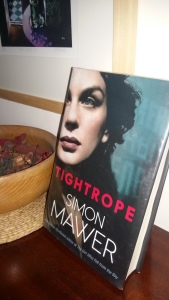
Throwback Thursday: Tightrope (Marian Sutro #2) by Simon Mawer

ThrowbackThursday

Throwback Thursday is a weekly meme hosted by Renee at It’s Book Talk.  It’s designed as an opportunity to share old favourites as well as books that we’ve finally got around to reading that were published over a year ago.  If you decide to take part, please link back to It’s Book Talk.

Today I’m reviewing Tightrope (Marian Sutro #2) by Simon Mawer, published in 2015.  It’s my book for the March theme (And The Award Goes To…) of The BookBum Club on Goodreads, run by the lovely Zuky, as it won The Walter Scott Prize for Historical Fiction in 2016.


TightropeAbout the Book

As Allied forces close in on Berlin in spring 1945, a solitary figure emerges from the wreckage that is Germany. It is Marian Sutro, whose existence was last known to her British controllers in autumn 1943 in Paris. One of a handful of surviving agents of the Special Operations Executive, she has withstood arrest, interrogation, incarceration, and the horrors of Ravensbrück concentration camp, but at what cost?

Returned to an England she barely knows and a post-war world she doesn’t understand, Marian searches for something on which to ground the rest of her life. Family and friends surround her, but she is haunted by her experiences and by the guilt of knowing that her contribution to the war effort helped lead to the monstrosities of Hiroshima and Nagasaki.  When the mysterious Major Fawley, the man who hijacked her wartime mission to Paris, emerges from the shadows to draw her into the ambiguities and uncertainties of the Cold War, she sees a way to make amends for the past and at the same time to find the identity that has never been hers.

A novel of divided loyalties and mixed motives, Tightrope is the complex and enigmatic story of a woman whose search for personal identity and fulfillment leads her to shocking choices.

Format: Hardcover (408 pp.)       Publisher: Little, Brown
Published: 4th June 2015              Genre:  Historical Fiction

Purchase Links*
Amazon.co.uk  ǀ  Amazon.com  ǀ Hive.co.uk (supporting UK bookshops)
*links provided for convenience, not as part of any affiliate programme

Find Tightrope on Goodreads


My Review

Based on the book description, I was anticipating an enthralling Cold War spy story in the manner of John Le Carré and I certainly got that in the final third of the book.  What I wasn’t expecting was such a devastating portrait of the lasting impact of their experiences on those who, like Marian, performed undercover roles in the Second World War.

Our narrator is Sam, who first encounters Marian when he is a child (as a friend of his mother), later when he is an impressionable teenager and finally when he is an adult but still slightly in thrall to her.  Marian’s story, as presented to the reader, is part her testimony, part Sam’s first-hand experience, part evidence he has gleaned from official files and part his recreation of how he imagines events may have taken place.  The reader is never entirely sure which. Of course, part of Marian’s undercover role involved presenting herself as someone she wasn’t, living an acquired identity, never really being herself.  ‘That was the problem with words – they nailed the thought down, made it explicit, fixed it, crucified it on the cross of exact meaning.  But life has no exact meanings, only shades of meaning, hints, versions and contradictions, s confusion of loves and hates, of motives and desires.’   What is the true story?

The author convincingly portrays Marian’s difficulty in adjusting to ‘normal’ life and overcoming the psychological, physical and emotional scars she bears as a result of her terrible experiences: arrest, interrogation, torture and, ultimately, confinement in the Ravensbrück concentration camp.  Marian feels a sense of dislocation from other people.  ‘It was just indifference, a sensation of estrangement from the ordinary matters of human contact.  Conversation with anyone felt like trying to talk to people in a foreign language when you only have a fraction of the vocabulary at your disposal and half the grammar.’  It is as if a yawning gulf separates her from the rest of humanity: ‘And she felt something strange, the sensation of uniqueness.  It wasn’t a good feeling, just one of separation’.

It’s not just Marian who has been changed by the war.  The author gives us an evocative and comprehensive picture of the impact of the war on people, places, geopolitics, political and philosophical argument, technology and much else.  Even small things, like the way people interact:
‘“Where are you from, then?” the barman asked.
No stranger ever asked a question like that last time she was in the city.  Questions drew you into other people’s stories, got you involved, got you into trouble.  Now no one cared.’

Marian and her brother, Ned, are appalled by the use of the atomic bomb on Hiroshima and Nagasaki and the prospect of the United States developing the technology still further.  In particular, Marian is plagued by guilt that her actions during the war might unwittingly contribute to a repetition of the horrors she has already witnessed, but multiplied a hundredfold.  This guilt propels Marian down a path of secrets, lies and betrayal that will require the use of all the skills and tradecraft she acquired in preparation for her wartime exploits.   Like how to fashion a weapon out of what’s to hand, how to tell if you’re being followed and how to shake off your followers.  It will put her in danger and make her question who, if anyone, she can trust so that carefully planning each small move, each sentence uttered, becomes critical.

‘She waited a moment, looking at him.  And then she made her move.  It felt like walking a tightrope, feeling the balance, knowing that a slight shift either side might be fatal.  She reached her foot forward and poised to transfer her weight onto it, feeling the rope wobbling.  No safety net.’

I loved Tightrope.  I was completely drawn into Marian’s story although the romantic in me would have liked a slightly different outcome for her and the man who becomes such an important part of her life.  However, the path the author chose for her was admittedly more true to her character. I haven’t read the first book in the series, The Girl Who Fell From The Sky (published under the title Trapeze in the United States), so I don’t have the benefit of knowing how much of this book repeats events from the earlier one. What I do know is that Tightrope works brilliantly as a standalone read and from the very beginning I got that comforting feeling that I was in the hands of a skilled writer and accomplished storyteller.

Follow my blog with Bloglovin

In three words: Insightful, powerful, moving

Try something similar…Nucleus (Tom Wilde #2) by Rory Clements (click here to read my review)


Simon MawerAbout the Author

Simon Mawer is a British author of ten novels and two non-fiction books. The Glass Room, published by Little, Brown in January 2009, was on the Man Booker shortlist. His current novel is entitled Tightrope. The UK paperback and the e-book are out now. The US edition was published in November 2015.

He currently lives in Italy.

Connect with Simon

Website  ǀ  Facebook  ǀ  Twitter ǀ  Goodreads