
WWW Wednesdays 20th June ‘18


WWWWednesdays

Hosted by Taking on a World of Words, this meme is all about the three Ws:

  • What are you currently reading?
  • What did you recently finish reading?
  • What do you think you’ll read next?

Why not join in too?  Leave a comment with your link at Taking on a World of Words and then go blog hopping!


Currently reading

GraceGrace by Paul Lynch (ebook)

Early one October morning, Grace’s mother snatches her from sleep and brutally cuts off her hair, declaring, ‘You are the strong one now.’ With winter close at hand and Ireland already suffering, Grace is no longer safe at home. And so her mother outfits her in men’s clothing and casts her out. When her younger brother Colly follows after her, the two set off on a remarkable journey in the looming shadow of their country’s darkest hour.

The broken land they pass through reveals untold suffering as well as unexpected beauty. To survive, Grace must become a boy, a bandit, a penitent and, finally, a woman – all the while afflicted by inner voices that arise out of what she has seen and what she has lost.

TheKing'sDaughterThe King’s Daughter by Stephanie Churchill (ebook, review copy courtesy of the author)

In this gripping sequel to The Scribe’s Daughter, a young woman finds herself unwittingly caught up in a maelstrom of power, intrigue, and shifting perceptions, where the line between ally and enemy is subtle, and the fragile facade of reality is easily broken.

Irisa’s parents are dead and her younger sister Kassia is away on a journey when the sisters’ mysterious customer returns, urging Irisa to leave with him before disaster strikes. Can she trust him to keep her safe? How much does he know about the fate of her father? Only a voyage across the Eastmor Ocean to the land of her ancestors will reveal the truth about her family’s disturbing past. Once there, Irisa steps into a future she has unknowingly been prepared for since childhood, but what she discovers is far more sinister than she could have ever imagined. Will she have the courage to claim her inheritance for her own?


Recently finished (click on title for review)

TThe Poison Bedhe Poison Bed by E. C. Fremantle (eARC, NetGalley)
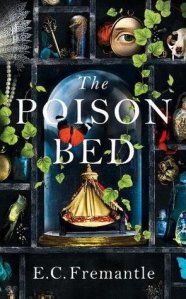
A king, his lover and his lover’s wife. One is a killer.

In the autumn of 1615 scandal rocks the Jacobean court when a celebrated couple are imprisoned on suspicion of murder. She is young, captivating and from a notorious family. He is one of the richest and most powerful men in the kingdom.

Some believe she is innocent; others think her wicked or insane. He claims no knowledge of the murder. The king suspects them both, though it is his secret at stake.

Who is telling the truth? Who has the most to lose? And who is willing to commit murder?

The Mountain Man's BadgeThe Mountain Man’s Badge by Gary Corbin (ebook, review copy courtesy of the author)

Lehigh Carter never wanted to be sheriff. And he sure never wanted to arrest his new father-in-law for murder.

Mountain Man Lehigh Carter got talked into serving the unexpired term of disgraced long-time Mt. Hood County sheriff Buck Winters, hoping for a quiet nine months in office before the voters selected a new, permanent office-holder. But a few months into the job, poachers discover the body of Everett Downey, a sleazy local businessman, and the evidence points to Lehigh’s brand-new father-in-law, the once-powerful senator George McBride. To his chagrin and his new bride’s fury, Lehigh is forced to arrest George for the murder, and suddenly his happy marriage is on the rocks. Soon he’s living in a tent with only his two dogs for companionship.

While most people in Mt. Hood County appreciate Lehigh’s honesty and his willingness to fight the cronyism and corruption that have plagued Mt. Hood County law enforcement for decades, his desire for reform ruffles some important feathers. Lehigh finds himself fighting unseen enemies, determined to portray him as inept and more corrupt than his predecessor – even at the cost of protecting the integrity of the murder investigation. Even his own deputies seem intent on bringing back the old guard, and a series of evidence leaks put Lehigh’s reputation and ability to serve as sheriff in jeopardy.

Lehigh’s not a quitter, though, and with dogged persistence, begins to chip away at the investigation, discovering facts that don’t add up…and leads him to suspect why some of those most intent on removing him from office have reasons far more sinister than Lehigh’s reform agenda.  Can Lehigh uncover the truth behind Everett Downey’s murder without becoming the killer’s next victim? (Review to follow)


What Cathy (will) Read Next

Old BaggageOld Baggage by Lissa Evans (eARC, NetGalley)

What do you do next, after you’ve changed the world?

It is 1928. Matilda Simpkin, rooting through a cupboard, comes across a small wooden club – an old possession of hers, unseen for more than a decade.

Mattie is a woman with a thrilling past and a chafingly uneventful present. During the Women’s Suffrage Campaign she was a militant. Jailed five times, she marched, sang, gave speeches, smashed windows and heckled Winston Churchill, and nothing – nothing – since then has had the same depth, the same excitement.

Now in middle age, she is still looking for a fresh mould into which to pour her energies. Giving the wooden club a thoughtful twirl, she is struck by an idea – but what starts as a brilliantly idealistic plan is derailed by a connection with Mattie’s militant past, one which begins to threaten every principle that she stands for.
Darkest HourDarkest Hour by Anthony McCarten (paperback)

May, 1940. Britain is at war, European democracies are falling rapidly and the public are unaware of this dangerous new world. Just days after his unlikely succession to Prime Minister, Winston Churchill, faces this horror – and a sceptical King and a party plotting against him. He wonders how he can capture the public mood and does so, magnificently, before leading the country to victory.

It is this fascinating period that Anthony McCarten captures in this deeply researched, gripping day-by-day (and often hour-by-hour) narrative. In doing so he revises the familiar view of Churchill – he made himself into the iconic figure we remember and changed the course of history, but through those turbulent and dangerous weeks he was plagued by doubt, and even explored a peace treaty with Nazi Germany. It’s a scarier, and more human story, than has ever been told.

Guest Post: ‘The Artist in Fiction’ by Arthur D. Hittner, author of Artist, Soldier, Lover, Muse

It’s so frustrating when authors contact you about fascinating sounding books and you know because of your already huge review pile it’s going to be quite a while until you can get to read them.  A case in point is Artist, Soldier, Lover, Muse by Arthur D. Hittner set in pre-war New York City.

However, I’m making amends by bringing you a fantastic guest post from Arthur about the challenge of capturing in words the inspiration that drives the creative process of an artist.  In his article, Arthur illustrates the approach he chose with two excerpts from the book and a wonderful painting by an artist definitely unknown to me.

If this has piqued your interest in Artist, Soldier, Lover, Muse, you can find purchase links below.

Follow my blog with Bloglovin


Artist Soldier Lover MuseAbout the Book

Freshly graduated from Yale in 1935, Henry J. Kapler parlays his talent, determination, and creative energy into a burgeoning art career in New York under the wing of artists such as Edward Hopper and Reginald Marsh.  The young artist first gains notoriety when his depiction of a symbolic, interracial handshake between ballplayers is attacked by a knife-wielding assailant at the Corcoran Gallery in Washington.

Yet even as his art star rises, his personal life turns precarious—and perilous—when his love for Fiona, a young WPA muralist, collides with his growing attraction to the exquisitely beautiful Alice, an ex-chorus girl who becomes his model and muse.  Alice is the girlfriend of Fiona’s cousin, Jake Powell, the hot-headed, hard-drinking outfielder for the New York Yankees whose jealousy explodes into abuse and rage, endangering the lives of all three.

While Henry wrestles with his complicated love life, he also struggles mightily to reconcile his pacifism with the rabid patriotism of his Jewish-Russian émigré father.  As war draws near, Henry faces two difficult choices, one of which could cost him his life.

Format: Paperback, ebook (301 pp.)    Publisher: Apple Ridge Fine Arts
Published: 5th December 2017              Genre: Historical Fiction, Art

Purchase Links*
Amazon.co.uk ǀ  Amazon.com
*links provided for convenience, not as part of any affiliate programme

Find Artist, Soldier, Lover, Muse on Goodreads


Guest Post: ‘The Artist in Fiction’ by Arthur D. Hittner, author of Artist, Soldier, Lover, Muse

I love art.  I’ve a particular affinity for the art of the Depression era, much of which is imbued with an emotional edge that reflects the perils of everyday existence during those difficult times.  In my debut novel Artist, Soldier, Lover, Muse I explore the creative mind of a struggling young painter in the New York City art world of the late 1930s.

How does a writer of historical fiction tap into the mind of an artist from another era?  I began by devouring the colorful accounts of the resourceful artists who practiced their craft in New York during the turbulent decade of the Thirties.  There can be no better source for the ambience of a time and place than the reminiscences of those who experienced it.  To further gauge the tenor of the times, I perused the Times—the historical database of The New York Times—whose articles offered a window into the events and controversies that shaped the lives of New Yorkers.  Armed with this knowledge, I could place my protagonist, the young artist Henry J. Kapler, in the midst of these events, as a participant, observer or commentator, as the story dictated.

But what of the creative act itself?  How do you capture on the written page the inspiration that drives the creative process?  In Artist, Soldier, Lover, Muse I utilized two distinct approaches to tap into the creative impulses of Henry Kapler.  One was to ponder an actual work of art and intuit the circumstances that may have brought it into being.  I’ll call this the Chevalier Method.  Tracy Chevalier created an entire novel from a single work of art in Girl With a Pearl Earring.  Consider, for example, the painting reproduced below.  It is the work of Harold J. Rabinovitz (1915-1944), a now obscure American artist whose life and work provided valuable inspiration for the fictional Henry Kapler.

Arthur Hittner Guest Post Image

The following excerpt reflects how I imagined Henry might have approached the subject of this poignant work of art:

‘The Seventh Avenue Express was the subway Henry knew best.  It stopped at Fourteenth Street, running north to Harlem and southeast to Brooklyn.  With his sketchbook and a pocket full of tokens, Henry descended into the bowels of the city.  He remained submerged for the better part of two weeks, riding from one end of the line to the other, observing and sketching.  Surfacing only to eat, sleep, and attend his morning classes at the League, Henry became as much a part of the screeching, grimy, often creepy world of the underground as the foot-long rats that scampered through the stations like frantic commuters.

The stark interior of a subway car was the setting for Henry’s opus.  Marsh had tackled a similar subject earlier in Why Not Use the “L”, portraying the indifference of passengers in documentary fashion.  Henry would go further, injecting social commentary by staging a morality play within the confines of his canvas.

Henry sifted through scores of sketches for the characters to inhabit his composition.  He roughed out a scene depicting two seated men on the near side of the car to the left, one with his head buried in a newspaper and the other looking blankly ahead; a third man barely awake across the aisle, his elbow resting against the seat back, his right hand propping up his weary head; and a young mother sitting beside him, straining to rein in her fidgety son.  One last figure would complete the composition and supply the narrative: a sightless young man in shirtsleeves and dark glasses proceeding down the aisle toward the viewer, his left hand limply grasping a walking cane, his right palm turned upward in supplication.  It was an all-too-familiar scene, variations of which he’d witnessed repeatedly during his self-banishment underground: a group of passengers, distracted by their own burdens, studiously ignoring the entreaties of a man less fortunate as he passes by seeking charity.’

The second (and diametrically opposite) entrée into the creative mind of my protagonist was through the developing plotline, trusting that the story would inform Henry who would, in turn, create an artwork derived purely from my own imagination.  In Artist, Soldier, Lover, Muse  Henry’s muse, Alice Woodley, is a beautiful ex-chorus girl involved in an abusive relationship with a professional athlete named Jake Powell.

Consider this excerpt from Chapter Twenty-Two:

‘For much of the next forty-eight hours, the portrait of Alice consumed him.  He realized that what he’d started to paint from life, he was now painting from deep within himself.  What she’d told him, and how she’d spoken and acted, were as much a part of what he was now creating as the actuality of her physical being.  He remembered the fist Kuniyoshi had placed on the table in the classroom, and the shadow it cast.  He’d captured the actuality of his model in their session two days earlier, but it took the succeeding couple days of laborious effort for the truth to emerge.  He studied the painting closely.  What had begun as a likeness of an extraordinarily beautiful young woman had evolved into a portrait of both beauty and vulnerability.  This was not the hardened, streetwise woman that had surprised and disappointed him at the automat, although that was certainly a part of what she’d become.  There was much more—and it thrilled him to discover it peering out from the canvas.

Waiting was the title he chose for the painting.  It made sense to him.  He perceived a young woman waiting to make sense of her life, to comprehend and reconcile the choices she’d made, to find a path forward.’

In the end, the writer’s means for divining the artistic vision of his protagonist shouldn’t matter.  What matters is that his character’s creative impulses feel genuine to the reader.  The paintings portrayed in the novelist’s narrative should be equally accessible in the reader’s mind, whether the artwork has an existence in the real world or solely in the writer’s imagination.  Whether I’ve succeeded in transporting you into the creative mind of Henry Kapler is something only you can judge.  I invite you to read Artist, Soldier, Lover, Muse to decide for yourself.                                  © Arthur D. Hittner, 2018


Arthur D HittnerAbout the Author

Arthur D. Hittner is the author of the historical novel Artist, Soldier, Lover, Muse and  Honus Wagner: The Life of Baseball’s ‘Flying Dutchman (McFarland, 1996), winner of the Seymour Medal awarded by the Society of American Baseball Research for the best book of baseball history or biography published in 1996.  Other books include At the Threshold of Brilliance:The Brief but Splendid Career of Harold J. Rabinovitz (The Rabinovitz Project, 2014), a biography and catalogue raisonne of a newly rediscovered master of American art of the Depression era and the irreverent travelogue, Cross-Country Chronicles: Road Trips Through the Art and Soul of America.

Mr. Hittner has also written about fine art subjects for Maine Antique Digest, Fine Art Connoisseur and Antiques & Fine Art and has served as a Trustee of the Danforth Museum of Art and the Tucson Museum of Art.

Connect with Arthur

Website ǀ  Goodreads