

Top Ten Tuesday is a weekly meme created by The Broke and the Bookish and now hosted by Jana at That Artsy Reader Girl.
The rules are simple:
- Each Tuesday, Jana assigns a new topic. Create your own Top Ten list that fits that topic – putting your unique spin on it if you want.
- Everyone is welcome to join but please link back to The Artsy Reader Girl in your own Top Ten Tuesday post.
- Add your name to the Linky widget on that day’s post so that everyone can check out other bloggers’ lists.
- Or if you don’t have a blog, just post your answers as a comment.
This week’s topic is Top Ten Books By My Favourite Authors That I Still Haven’t Read. I just have to look at by TBR shelf to see plenty of possibilities to choose from, including (shamefully) books received as birthday and (whisper) Christmas presents.
Click on the title to read the book description on Goodreads.
John le Carré – I’ve loved John le Carré’s spy novels, especially his books featuring George Smiley, such as Tinker Tailor Soldier Spy and Smiley’s People. However, there are two of his more recent books I still haven’t read.

Peter Guillam, staunch colleague and disciple of George Smiley of the British Secret Service, otherwise known as the Circus, is living out his old age on the family farmstead on the south coast of Brittany when a letter from his old Service summons him to London. The reason? His Cold War past has come back to claim him. Intelligence operations that were once the toast of secret London, and involved such characters as Alec Leamas, Jim Prideaux, George Smiley and Peter Guillam himself, are to be scrutinized by a generation with no memory of the Cold War and no patience with its justifications.
Interweaving past with present so that each may tell its own intense story, John le Carré has spun a single plot as ingenious and thrilling as the two predecessors on which it looks back: The Spy Who Came in from the Cold and Tinker Tailor Soldier Spy. In a story resonating with tension, humour and moral ambivalence, le Carré and his narrator Peter Guillam present the reader with a legacy of unforgettable characters old and new.
 The Pigeon Tunnel: Stories From My Life
From his years serving in British Intelligence during the Cold War, to a career as a writer that took him from war-torn Cambodia to Beirut on the cusp of the 1982 Israeli invasion to Russia before and after the collapse of the Berlin Wall, le Carré has always written from the heart of modern times. In this, his first memoir, le Carré is as funny as he is incisive, reading into the events he witnesses the same moral ambiguity with which he imbues his novels.
Whether he’s writing about the parrot at a Beirut hotel that could perfectly mimic machine gun fire or the opening bars of Beethoven’s Fifth; visiting Rwanda’s museums of the unburied dead in the aftermath of the genocide; celebrating New Year’s Eve 1982 with Yasser Arafat and his high command; interviewing a German woman terrorist in her desert prison in the Negev; listening to the wisdoms of the great physicist, dissident, and Nobel Prize winner Andrei Sakharov; meeting with two former heads of the KGB; watching Alec Guinness prepare for his role as George Smiley in the legendary BBC TV adaptations of Tinker, Tailor, Soldier, Spy and Smiley’s People; or describing the female aid worker who inspired the main character in The Constant Gardener, le Carré endows each happening with vividness and humour, now making us laugh out loud, now inviting us to think anew about events and people we believed we understood.
Best of all, le Carré gives us a glimpse of a writer’s journey over more than six decades, and his own hunt for the human spark that has given so much life and heart to his fictional characters.
Robert Harris – I really enjoyed An Officer and a Spy, Fatherland and Enigma so I’m a bit frustrated I haven’t yet got around to reading these two books that are sitting on my bookshelf.

All along the Mediterranean coast, the Roman empire’s richest citizens are relaxing in their luxurious villas, enjoying the last days of summer. The world’s largest navy lies peacefully at anchor in Misenum. The tourists are spending their money in the seaside resorts of Baiae, Herculaneum, and Pompeii.
But the carefree lifestyle and gorgeous weather belie an impending cataclysm, and only one man is worried. The young engineer Marcus Attilius Primus has just taken charge of the Aqua Augusta, the enormous aqueduct that brings fresh water to a quarter of a million people in nine towns around the Bay of Naples. His predecessor has disappeared. Springs are failing for the first time in generations. And now there is a crisis on the Augusta’s sixty-mile main line—somewhere to the north of Pompeii, on the slopes of Mount Vesuvius.
Attilius—decent, practical, and incorruptible—promises Pliny, the famous scholar who commands the navy, that he can repair the aqueduct before the reservoir runs dry. His plan is to travel to Pompeii and put together an expedition, then head out to the place where he believes the fault lies. But Pompeii proves to be a corrupt and violent town, and Attilius soon discovers that there are powerful forces at work—both natural and man-made—threatening to destroy him.

September 1938 – Hitler is determined to start a war. Chamberlain is desperate to preserve the peace. The issue is to be decided in a city that will forever afterwards be notorious for what takes place there. Munich.
As Chamberlain’s plane judders over the Channel and the Fürher’s train steams relentlessly south from Berlin, two young men travel with secrets of their own.
Hugh Legat is one of Chamberlain’s private secretaries, Paul Hartmann a German diplomat and member of the anti-Hitler resistance. Great friends at Oxford before Hitler came to power, they haven’t seen one another since they were last in Munich six years earlier. Now their paths are destined to cross again as the future of Europe hangs in the balance.
When the stakes are this high, who are you willing to betray? Your friends, your family, your country or your conscience?
Hilary Mantel – I can’t be the only historical fiction fan eagerly awaiting the final book in the author’s trilogy about Thomas Cromwell, The Mirror and the Light (following on from the award-winning Wolf Hall and Bring Up the Bodies). However, I have another book by Mantel that I started some years ago but put aside unfinished. For some reason, I couldn’t get on with the writing style but I’d like to make another attempt.
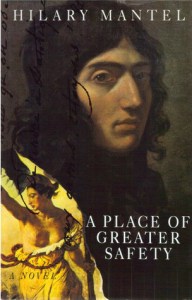
Capturing the violence, tragedy, history, and drama of the French Revolution, this novel focuses on the families and loves of three men who led the Revolution: Danton, the charismatic leader and orator; Robespierre, the cold rationalist; and Desmoulins, the rabble-rouser.
Philip Kerr – I came late to the author’s Bernie Gunther series, with my first experience being book 12 in the series, Prussian Blue. I enjoyed that so much that I’ve been acquiring earlier books in the series whenever I come across them so I can start where I ideally would have done, with the first book.
 March Violets (Bernie Gunther #1)
Ex-Berlin cop and private detective Bernie Gunther has seen his share of bad guys. But when the worst guys of all are the ones running the show, it’s much harder to stay out of their reach.
Hired by a wealthy industrialist to investigate the murder of his daughter and her husband in an apparent botched robbery, Bernie soon finds himself drawn into the complex – not to mention lethal – internal politics and corruption of the Nazi party. When Herman Goering himself calls Bernie in with a task for him that throws his existing case into a whole new light, he must weigh up his hatred of the Nazis against his desire to stay alive.
 The Pale Criminal (Bernie Gunther #2)
Five German schoolgirls are missing. Four have been found dead. But unlike the undesirables who make up the majority of dead and missing people in Hitler’s Berlin, these girls were blonde and blue-eyed – the Aryan flower of German maidenhood – and their gruesome deaths recall ritual killings.
Busy with a blackmail case, Bernie is reluctant when he is asked to rejoin the Berlin police in order to track down the murderer. But when the person doing the asking is none other than head of the SD, Reinhard Heydrich, it’s not exactly a request he can turn down. As Bernie gets closer to the truth, he realises that at the heart of this case is much more than one lone madman – in fact, there is a conspiracy at work more chilling than he could ever have imagined.
Kate Morton – I’ve enjoyed many of Kate Morton’s book, most recently The Clockmaker’s Daughter, but I do have one of her books sitting unfinished on my bookshelf – The Distant Hours. For some reason, it didn’t capture my interest and I set it aside unfinished. I’d like to give it another try at some point.
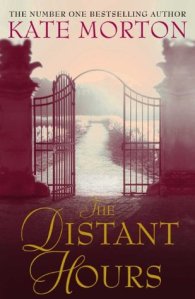
Edie Burchill and her mother have never been close, but when a letter arrives one Sunday, marked with the return address of Millderhurst Castle, Kent, Edie begins to suspect that her mother’s emotional distance masks an old secret.
Sarah Waters – I’ve read all of Sarah Waters’ books with the exception of this one.
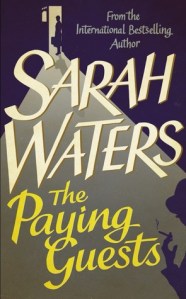
It is 1922, and London is tense. Ex-servicemen are disillusioned; the out-of-work and the hungry are demanding change. And in South London, in a genteel Camberwell villa – a large, silent house now bereft of brothers, husband, and even servants – life is about to be transformed, as impoverished widow Mrs. Wray and her spinster daughter, Frances, are obliged to take in lodgers.
With the arrival of Lilian and Leonard Barber, a modern young couple of the “clerk class,” the routines of the house will be shaken up in unexpected ways. Little do the Wrays know just how profoundly their new tenants will alter the course of Frances’s life – or, as passions mount and frustration gathers, how far-reaching, and how devastating, the disturbances will be.
Daphne du Maurier – One of my favourite books of all time is Rebecca and I’ve read many of du Maurier’s other Cornish novels. I’ve heard great things about one of her other novels.

By chance, two men – one English, the other French – meet in a provincial railway station. Their physical resemblance is uncanny, and they spend the next few hours talking and drinking – until at last John, the Englishman, falls into a drunken stupour. It’s to be his last carefree moment, for when he wakes, his French companion has stolen his identity and disappeared. So John steps into the Frenchman’s shoes, and faces a variety of perplexing roles – as owner of a chateau, director of a failing business, head of a fractious family, and master of nothing.
Gripping and complex, The Scapegoat is a masterful exploration of doubling and identity, and of the dark side of the self.

 About the Book
 About the Author


