As someone for whom no Christmas is complete without re-reading Charles Dickens’ A Christmas Carol (or watching one of the many TV adaptations), I was delighted to receive Joe Thomas’ invitation to join the blog tour for Miss Marley by Vanessa Lafaye. Subtitled The Untold Story of Jacob Marley’s Sister, it’s described as ‘a spellbinding Dickensian tale of ghosts, goodwill and hope – a perfect prequel to A Christmas Carol’.
Sadly, as many of you will be aware, Vanessa Lafaye passed away earlier this year before she was able to finish the book. However, fellow author Rebecca Mascull stepped in to complete the task as a lasting tribute to her friend.
 About the Book
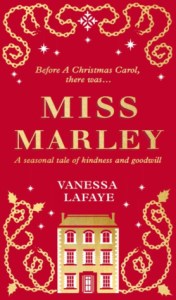
Orphans Clara and Jacob Marley live by their wits, scavenging for scraps in the poorest alleyways of London, in the shadow of the workhouse. Every night, Jake promises his little sister ‘tomorrow will be better’ and when the chance to escape poverty comes their way, he seizes it despite the terrible price.
And so Jacob Marley is set on a path that leads to his infamous partnership with Ebenezer Scrooge. As Jacob builds a fortress of wealth to keep the world out, only Clara can warn him of the hideous fate that awaits him if he refuses to let love and kindness into his heart…
Format: Hardback, ebook, audiobook (112 pp.) Publisher: Harper Collins/HQ
Published: 1st November 2018 Genre: Historical Fiction
Purchase Links*
Amazon.co.uk ǀ Hive.co.uk (supporting UK bookshops)
*links provided for convenience, not as part of any affiliate programme
Find Miss Marley on Goodreads
My Review
In her author’s note, Vanessa Lafaye explains her intention in Miss Marley was to try to explain what the Jacob Marley the reader encounters in A Christmas Carol had done to deserve his ‘desperately severe punishment’. The book gives the reader an insight into the development of Jacob’s character from caring boy, determined to provide for his sister and end their life of penury, to ruthless business man building ‘a fortress of money around the two of them’.
The atmosphere of Dickensian London is skilfully recreated and Miss Marley also pays homage to A Christmas Carol in its three part structure. As someone very familiar with A Christmas Carol. it was fun to spot the references to the book the authors have sprinkled throughout Miss Marley. For example, Jacob’s thoughts about Christmas and use of a word associated until now with his business partner, Ebenezer Scrooge. Or the walk-on part at the start of parts one and two for a character reminiscent of one in A Christmas Carol.
The final part of Miss Marley draws strongly on the spirit of Dickens’ original and Scrooge’s encounters in A Christmas Carol, although what is revealed to Jacob Marley is definitely not ‘A Wonderful Life’.
One of the challenges an author faces when writing a prequel is that they cannot change what happens in the original story. As most readers will know, A Christmas Carol starts with the death of Marley and his appearance in spirit form to try to ensure Scrooge does not take the same path as him. Therefore, the reader of Miss Marley will finish the book knowing the possibility of redemption offered to Scrooge in A Christmas Carol is sadly not going to be available to Jacob Marley in his lifetime, despite the efforts of his sister.
Miss Marley is an engaging story that conjures up the atmosphere of Dickens’ original. The back story to the book and how it came to be written makes it an especially emotional read. It is to Rebecca Mascull’s credit that the transition from the sections written by Vanessa Lafaye to her own appears seamless to the reader. With its gorgeous cover, I’d like to suggest Miss Marley would make the perfect Christmas gift for someone special.
The phrase from the book that really stayed with me was ‘Tomorrow will be better’. An inspiring thought from a gifted writer.
I received a review copy courtesy of publishers, HQ.
In three words: Charming, heart-warming, entertaining
Try something similar…Mr Dickens and his Carol by Samantha Silva (read my review here)
 About Vanessa Lafaye
Vanessa Lafaye was born in Florida and studied in North Carolina. She moved to the UK in 1999 (having been deported once). Her debut Summertime was chosen for the Richard and Judy Book Club in 2015 and was shortlisted for the Historical Writers Award. Vanessa passed away in February 2018 after a battle with cancer which she documented on her blog, Living While Dying.
About Rebecca Mascull
Rebecca Mascull is the author of three historical novels. She is currently hard at work on her next trilogy of historical fiction, with the first novel due for release in April 2019 to be published by Bonnier Zaffre as The Ironbridge Saga under the pen-name of Mollie Walton.
Rebecca’s first novel The Visitors (2014) tells the story of Adeliza Golding, a deaf-blind child living on her father’s hop farm in Victorian Kent. Her second novel Song of the Sea Maid (2015) is set in the 18th century and concerns an orphan girl who becomes a scientist and makes a remarkable discovery. Her third novel, The Wild Air(2017) is about a shy Edwardian girl who learns to fly and becomes a celebrated aviatrix but the shadow of war is looming.
Rebecca has previously worked in education, has a Masters in Writing and lives by the sea in the east of England.
Connect with Rebecca
Website ǀ Facebook ǀ Twitter ǀ Instagram ǀ Goodreads


