Blog Tour/Book Review: Aurelia (Roma Nova #4) by Alison Morton

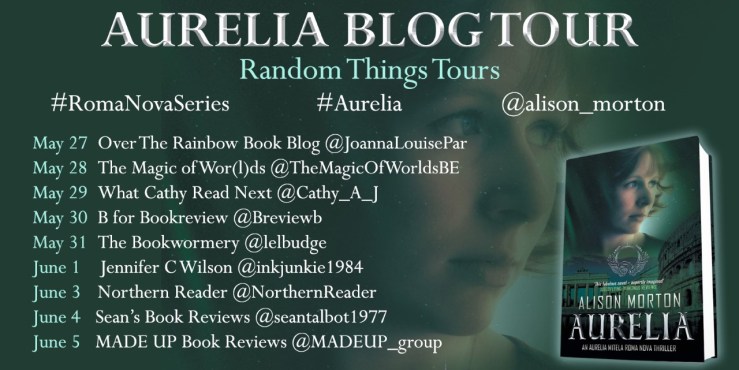
Aurelia Blog Tour Poster

Welcome to today’s stop on the blog tour for Aurelia (Roma Nova #4) by Alison Morton. The fourth in the ‘Roma Nova’ thriller series but the first book in the ‘Aurelia’ trilogy, Aurelia is the perfect place to start for readers (like me) who are new to the series.  Thanks to Anne at Random Things Tours for inviting me to take part in the tour and to the author for my review copy.

Aurelia Series


AureliaAbout the Book

1960s Roma Nova. Retrained as an undercover agent, ex-Praetorian officer Aurelia Mitela is sent to Berlin to investigate silver smuggling, but barely escapes a near-lethal trap. Her lifelong nemesis, Caius Tellus, is determined to eliminate her. When Aurelia is closing in on him, he strikes at her most vulnerable point – her young daughter.

A former military commander, Aurelia is one of Roma Nova’s strong women, but she doubts in her heart and mind that she can overcome her implacable enemy. And what part does the mysterious and attractive Miklós play – a smuggler who knows too much?

Format: Paperback, ebook (286 pp.)    Publisher: Pulcheria Press
Published: 22nd January 2019 [2015] Genre: Historical Fiction, Thriller

Purchase Links*
Amazon.co.uk  ǀ  Amazon.com
*links provided for convenience, not as part of any affiliate programme

Find Aurelia (Roma Nova #4) on Goodreads


My Review

I was aware of Alison Morton’s ‘Roma Nova’ series and its premise piqued my interest but I’d never had the opportunity to read any of the books….up until now.  As mentioned above, Aurelia is the fourth book in the ‘Roma Nova’ series but the first book of the ‘Aurelia’ trilogy and takes place before the events of the first three books.  So it’s the perfect place for readers new to the ‘Roma Nova’ series to start.

I went into the book expecting the alternate history element to be a strong focus of the book – as indeed it is – but I was perhaps unprepared for how much the book has the pace and feel of a modern day thriller.  The book pitches the reader right into the imagined world of Roma Nova the author has created.  There is a helpful historical note for readers who want to learn more about the background to the alternate history of the Roman Empire imagined by the author.

I really enjoyed the mixture of ancient and modern.  There are things readers may be familiar with from Roman history: imperial structures; military organisation and weaponry; celebration of festivals, such as Saturnalia; and customs, such as funeral rites and curse tablets.   Alongside these though there is cutting edge technology in the fields of forensics, communications and surveillance.

Roma Nova is a female-dominated society where it’s the men who carry the bags.  There are some nice touches of humour on that theme. For example, when Aurelia mentions the prospect of a new computer system to her boss, Plico, he responds, “The gods forbid! That’s what we have typists for.  What in Hades would we do with all the spare young men who sit in the typing pool?”

Aurelia is one tough lady who, thanks to her military training, can look after herself when the need arises.  She certainly does in this book because she’s up against a cunning, cruel and ruthless enemy in Caius Tellus, who will stop at nothing to get what he wants.  Along the way, Aurelia faces attempted kidnap, false imprisonment, personal loss and is presented with difficult choices between following her heart, protecting her family and doing her duty.  Luckily she has some capable female allies, including lawyer, Galba, and second-in-command, Fabia.  And, as head of one of the Twelve Families of Roma Nova, Aurelia also has the ear of the Empress Justina. Useful.

The action moves from Roma Nova to Berlin and Vienna (with a pit-stop for some romance: cue hunky smuggler, Miklós) as Aurelia and Caius do battle – literal and intellectual.  The author’s previous military career is evident in the dramatic action scenes whether on operational manoeuvres on a snowy mountainside, in dark side streets or closer to home.  Building to a tense and gripping climax, it’s clear that even if you’ve won the battle, you’ve not necessarily won the war.

The author describes her books as being for readers who enjoy ‘mystery books for women with plenty of twists and a female protagonist driving the action’.  I have to agree.  I found the combination of alternate history, strong female characters and the pace of a thriller a compelling one.  I shall look forward to reading more of Aurelia’s adventures in Insurrectio and Retalio.

I received a review copy courtesy of Random Things Tours and the author.

Follow my blog with Bloglovin

In three words: Action-packed, pacy, imaginative

Try something similar…False Lights by K. J. Whittaker (read my review here)


Alison Morton Author PicAbout the Author

Alison Morton writes the Roma Nova thriller series featuring modern Praetorian heroines. This springs from a deep love of Roman history, six years’ military service and a life of reading crime, adventure and thriller fiction.

All six full-length novels have received the BRAG Medallion. Successio, Aurelia and Insurrectio were selected as Historical Novel Society’s Indie Editor’s Choices. Aurelia was a finalist in the 2016 HNS Indie Award. Successio featured as Editor’s Choice in The Bookseller.

A ‘Roman nut’ since age 11, Alison has misspent decades clambering over Roman sites throughout Europe. She holds an MA History, blogs about Romans, social media and writing. Oh, and she gives talks. She continues writing, cultivates a Roman herb garden and drinks wine in France with her husband. To get the latest news, subscribe to her free newsletter.

Connect with Alison

Website  ǀ Facebook  ǀ  Twitter  ǀ  Goodreads

Book Review: The Lost Shrine (Hills & Barbrook #2) by Nicola Ford @AllisonandBusby

The Lost ShrineAbout the Book

Clare Hills, archaeologist and sometime sleuth, is struggling to finance her recently established university research institute along with her long-time friend, Dr David Barbrook. When Professor Margaret Bockford finds the Hart Unit commercial work with a housing developer on a site in the Cotswolds, the pair are hardly in a position to refuse. There is just one slight catch: the previous site director, Beth Kinsella, was found hanged in a copse on-site, surrounded by mutilated wildlife.

Despite initial misgivings, Clare leads a team to continue work on the dig, but with rumours about Beth’s mental state and her claims that the site was historically significant refusing to be laid to rest, and lingering disquiet between local residents and the developers, progress is impeded at every turn. When one of the workers finds something unsettling, Clare suspects there may be more to Beth’s claims than first thought. But can she uncover the truth before it is hidden for ever?

Format: Hardcover, ebook (320 pp.)    Publisher: Allison & Busby
Published: 23rd May 2019  Genre: Crime

Purchase Links*
Amazon.co.uk  ǀ  Kobo | Google
*links provided for convenience, not as part of any affiliate programme

Find The Lost Shrine (Hills & Barbrook #2) on Goodreads


My Review

I really enjoyed The Hidden Bones, the first book in the series featuring archaeologists Clare Hills and David Barbrook. You can read my review here along with a guest post from author Nicola Ford. Although The Lost Shrine can definitely be enjoyed as a standalone, it does contain references to events in the earlier book so, ideally, I would recommend reading the series from the beginning.

I enjoyed being reunited with some of Clare’s team from the previous book, such as Margaret and Jo, and, of course, her friend and colleague, David. They share her passion for archaeology or, as it’s described at one point, the process of ‘bringing the obscure, the overlooked, the people who lived in the cracks into the light’.

As I noted in my review of The Hidden Bones, archaeology has much in common with the investigation of a crime. They both involve gathering and piecing together evidence, investigating available source information, testing assumptions and coming to conclusions. And a crime scene must be preserved in the same way as an archaeological excavation site.

Having taken over the excavation, Clare finds herself getting contradictory messages about the person Beth really was – dedicated archaeologist or obsessive, troubled soul? ‘It seemed as if everyone had known a different Beth Kinsella’. Clare sets out to find out more using the approach of an archaeologist, visiting a former site Beth had excavated. ‘She wanted to get a sense of her from the places that had shaped her.’

The mystery of Beth’s death is not the only thing competing for Clare’s attention. As well as the administrative responsibilities of being site director and the financial worries about the future of the research institute, there’s the unwelcome activity of so-called ‘nighthawks’ (illegal metal detectorists), opposition from local residents to the housing development and pressure from the developer, Paul Marshall, to get the job finished quickly. Oh, and Clare’s still dealing with the emotional and financial consequences of her husband’s death, not to mention its circumstances.

The murder of a young man initially seems unconnected but perhaps like Clare’s boss, David, you don’t believe in coincidences. Soon the bodies are piling up and they’re definitely not all Iron Age. As with The Hidden Bones, the author kept me guessing as to who the culprit was right up to the book’s dramatic climax. Eventually the perpetrator and their motive is revealed but not before Clare has been reminded how dangerous asking questions can be.

As you might expect from an author who is also a National Trust archaeologist, the book is full of realistic detail about archaeological procedures. Also, the modern day reality of being a professional archaeologist, whether that’s the need to secure research funding when working in an academic environment or, when working on commercial excavations as in The Lost Shrine, the conflict that can arise between maintaining archaeological integrity and pressure from developers to work quickly and at minimum cost.

There are a few secondary plot lines left unresolved at the end of the book which some may regard as loose ends.  I prefer to think of them as finds waiting to be discovered on future digs as I, for one, very much hope there will be more books in the series.

Like its predecessor, The Lost Shrine is an engrossing murder mystery. With apologies to those not familiar with UK TV series, think of it perhaps as the intriguing love child of Midsomer Murders and Time Team. I believe The Lost Shrine will appeal equally to fans of crime fiction and those with an interest in history or archaeology.

I received an advance review copy courtesy of publishers, Allison and Busby.

Follow my blog with Bloglovin

In three words: Intriguing, engaging, mystery

Try something similar…Dark Sky Island by Lara Dearman (read my review here)


Nicola FordAbout the Author

Nicola Ford is the pen-name for archaeologist Dr. Nick Snashall, National Trust Archaeologist for the Stonehenge and Avebury World Heritage Site.  Through her day job and now her writing, she’s spent more time than most people thinking about the dead. (Photo credit: Goodreads author page)

Connect with Nicola

Website  ǀ  Facebook  ǀ  Twitter  ǀ  Instagram ǀ Goodreads