Book Review: The Secret Life of Alfred Nightingale by Rebecca Stonehill

The Secret Life of Alfred NightingaleAbout the Book

1967: Handsome but troubled, Jim is almost 18 and he lives and breathes girls, trad jazz, Eel Pie Island and his best friend, Charles. One night, he hears rumours of a community of young people living in caves in Matala, Crete. Determined to escape his odious, bully of a father and repressed mother, Jim hitch-hikes through Europe down to Matala.

At first, it’s the paradise he dreamt it would be. But as things start to go wrong and his very notion of self unravels, the last thing Jim expects is for this journey of hundreds of miles to set in motion a passage of healing which will lead him back to the person he hates most in the world: his father.

Format: eBook, paperback (299 pp.)           Publisher: Sunbird Press
Published: 11th November 2017                 Genre: Historical Fiction

Purchase Links*
Amazon.co.uk ǀ Amazon.com
*links provided for convenience, not as part of any affiliate programme

Find The Secret Life of Alfred Nightingale on Goodreads

Follow my blog with Bloglovin


My Review

Structured in three parts, the first section of the book, set in 1967, is told from the point of view of seventeen-year old Jim. He is troubled by his frequent clashes with his taciturn, seemingly remote and disciplinarian father who disapproves of Jim’s trips to Eel Pie Island to listen to bands, dance and drink the night away. When Jim learns about a group of young people living in ancient caves in a place called Matala in southern Crete, he defies his father and, with his best friend, Charles, hitch-hikes across Europe to the island.

Initially, Jim is spellbound by Matala and the free and easy lifestyle of the community of young travellers he and Charles find living there, even if living conditions are basic to say the least. He becomes captivated by one girl in particular, the beautiful and free-spirited Chenoa, but in his naivety fails to grasp the ‘rules of the game’ are different here. After an act of what Jim regards as betrayal, he becomes disillusioned with what he had previously regarded as an utopia. Returning home he learns the cost of his time away is not just his father’s wrath but something much more troubling and significant.

The author conjures up a believable picture of life in the 1960s, whether that’s Jim’s home life (Vesta beef curry, foil-wrapped teacakes), the atmosphere of Eel Pie Island or the freewheeling, hippy lifestyle in Matala.

In my interview with Rebecca (see link below), she revealed one of the things she finds interesting is ‘what we share with one another and what we decide to keep to ourselves’ and described her fascination with words left unspoken. She also observed that secrets and mysteries can be the force that propels readers through a story.

In the case of The Secret Life of Alfred Nightingale a significant part of the mystery for the reader is to do with when or how they are going to meet Alfred and discover the nature of his secret life. Without giving too much away, I’ll just say that the author keeps the reader waiting for quite a while to find out (although some readers may have an inkling earlier on). Ironically, for a long time, Jim is not even aware that secrets exist for him to discover. It’s only conversations with other cave dwellers in Crete that make him start to wonder why he knows so little about his father’s past. What Jim eventually finds out (in, for me, the most powerful parts of the book) utterly changes how he feels about his father. Perhaps they are not so very different after all? Although maybe, unlike his father, Jim has a chance to put some things right.

The Secret Life of Alfred Nightingale is both an insightful coming-of-age story and a powerful exploration of the horror, heartbreak and lasting impact of war. It’s also about the kindness of strangers and the possibility of second chances.

Thanks to Rebecca for my copy of her book and for her patience in waiting for my review. You can read my earlier interview with Rebecca about the book and her approach to writing here.


Rebecca StonehillAbout the Author

Rebecca Stonehill is from London but currently lives in Nairobi with her husband and three young children where she set up Magic Pencil, an initiative to give children greater access to creative writing and poetry. She has had numerous short stories published over the years, for example in Vintage Script, What the Dickens magazine, Ariadne’s Thread and Prole Books but The Poet’s Wife (Bookouture) was her first full-length novel, set in Granada during the Spanish Civil war and Franco’s dictatorship. Her second novel, The Girl and the Sunbird, was published by Bookouture in June 2016.

Connect with Rebecca

Website ǀ Facebook ǀ Twitter ǀ Pinterest ǀ Instagram | Goodreads


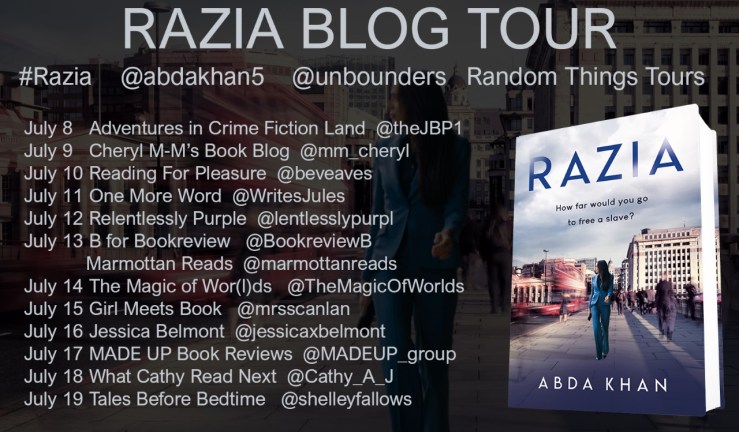
Blog Tour/Book Review: Razia by Abda Khan

Razia BT Poster

Welcome to today’s stop on the blog tour for Razia by Abda Khan, described as ‘a fast-paced thriller that exposes the truth behind Britain’s darkest secret.’  That secret? Modern slavery.

  • The Home Office estimates that there are currently around 13,000 slaves in the UK, though other sources suggest this is a gross underestimate
  • The novel is published to coincide with World Day against Trafficking in Persons on 30 July
  • It combines years of research with the pace and intrigue of a character-driven thriller

Thanks to Anne at Random Things Tours for inviting me to participate and to Unbound for my review copy.


RaziaAbout the Book

Farah is a young lawyer living and working in London. She’s just ended a long relationship, and her parents are looking for a husband – whether Farah wants one or not. So far, so normal. But at a work dinner, hosted by a dangerously powerful man, she comes across a young woman called Razia, who Farah soon realises is being kept as a domestic slave.

We follow Farah’s daring investigations from the law courts of London to the brick kilns of Lahore, as she begins to uncover the traps that keep generation after generation enslaved. Everywhere she turns there is deep-rooted oppression and corruption, and when the authorities finally intervene, their actions have dire consequences.

Farah teams up with a human rights lawyer, Ali, and the two become close… but can she trust him; can they help Razia and others like her; and will they ever discover the explosive secret behind these tragic events?

Format: Paperback, ebook (304 pp.)    Publisher: Unbound
Published: 11th July 2019   Genre: Contemporary Fiction

Purchase Links*
Amazon.co.uk  ǀ  Amazon.com  ǀ Hive.co.uk (supporting UK bookshops)
*links provided for convenience, not as part of any affiliate programme

Find Razia on Goodreads


My Review

Farah is an interesting character. There’s a dichotomy in that she’s a successful, independent woman pursuing a career as a lawyer but nevertheless feels the need to consider an arranged marriage in order to meet the expectations of her family and cultural heritage. I have to say that some of Farah’s actions did seem a little naive at times but one couldn’t help admire her determination to help Razia.

When later in the book Farah travels to Pakistan, the author allows the reader to see, through Farah’s eyes, the vast gulf between rich and poor in that country: the rich in their swanky air-conditioned mansions; the poor toiling in the heat making bricks with no way out of poverty and debt and with limited access to education or healthcare. I also liked that the author briefly gives the reader the chance to hear directly from the otherwise ‘voiceless’ Razia even if the events she recounts are intensely troubling.

A tragic development propels Farah into a course of action that exposes her to danger at the hands of those who wield power and influence, and aren’t afraid to use it. Fortunately, Farah has local lawyer, Ali Omar, as her ally, who is more aware than she is of the lengths to which such people will go. The development of their relationship from initial distrust to – well, I’ll leave you to guess/find out – adds another dimension to the book.

I really liked the insight the book provides into Pakistani culture: food, clothing, religious practices and social customs. There are some great descriptions of meals that will probably set your stomach rumbling! I do think a glossary would be helpful for readers unfamiliar with some of the Urdu words used.

Razia is a thought-provoking book that deals with important issues such as corruption, exploitation and inequality but in an accessible way and with the feel of a mystery novel. Its unexpectedly bittersweet and poignant ending shows an author with a deft touch for creating a satisfying reading experience.

I received a review copy courtesy of publishers, Unbound, and Random Things Tours.

Follow my blog with Bloglovin

In three words: Thought-provoking, compelling, topical

Try something similar…Hold by Michael Donkor or (set in Lahore) The Inside City by Anita Mir (click on titles to read my review)


Abda Khan Author PictureAbout the Author

Abda Khan is an author and lawyer who works with victims of domestic violence. She was born in Bradford in 1969 to Pakistani immigrant parents, and she now lives and works in the West Midlands. Her first novel, Stained, was published in 2016 and described by Booklist as ‘a contemporary Tess of the d’Urbervilles’. She was Highly Commended as a finalist at the 2017 NatWest Asian Woman of Achievement Awards, in the Arts and Culture category.

Connect with Abda

Website  ǀ  Facebook  ǀ  Twitter  ǀ  Instagram ǀ Goodreads