
#BuchanOfTheMonth Introducing…A Lodge in the Wilderness by John Buchan

My Buchan of the Month for March is A Lodge in the Wilderness. It was published by Blackwood on 14th November 1906, initially anonymously. It was only for the second impression in February 1907 that John Buchan was credited as the author. When the Nelson edition was published in 1917, its preface was signed with the initials “JB” and dated “British Army in France, December 1916”.
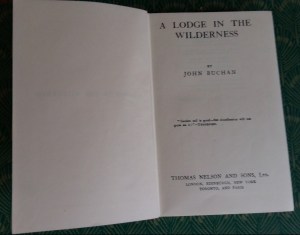
20200314_134401Buchan had begun working on the book in 1905. It takes the form of a symposium in which, through various fictional characters, he expresses some of his own views on the British Empire, based partly on his experiences in South Africa with Lord Alfred Milner. Buchan’s motivation for writing the book can be gleaned from the introduction to the 1916 ‘cheap’ edition in which he expressed the view that “certain larger matters which did not truly belong to party politics were in danger of being obscured and degraded”.

The setting of the book is Musuru, a lavish home built by ‘an intelligent millionaire’ nine thousand feet up on the East African plateau. Janet Adam Smith, Buchan’s first biographer, describes the house, with its library containing 62,000 volumes, as combining ‘civilization with wildness’. Readers familiar with John Buchan’s works will recognise the thin line between those two conditions as a regular feature of his novels.

The cast of characters includes a former Prime Minister, a former Viceroy of India, a big-game hunter, a famous explorer, a well-travelled journalist and a financier. Predictably perhaps, the latter is Jewish although Janet Adam Smith, conscious of accusations of anti-Semitism directed at Buchan’s writing, argues that it is a sympathetic portrait. A number of married women (without their spouses) are included in the company. Janet Adam Smith describes their portrayal as relatively emancipated for the time (although her main examples are that they are pictured smoking and ‘adventuring’ ) and notes their views are listened to seriously by the male characters.

Although nominally fictional, Janet Adam Smith observes ‘Spotting the originals of the characters was one of the pleasures of the book for its first readers‘. John Buchan himself is represented by Hugh Somerville, ‘a young man of thirty’ and the real life model for Lady Flora Brume is Susan Grosvenor, later to become Mrs. Buchan.

For David Daniell, A Lodge in the Wilderness is ‘an extraordinary book’, characterizing it as ‘a little bit of Wells, with a pinch of Shaw…a Fabian urgency…some Kiplingesque poetry, strong Meridithian influence, a Balliol tone, a Hegelian structure and a mixture of dialogue and lengthy address‘. Look out for my review later this month to see if I agree – not that I’m very familiar with ‘Meridithian influence’ or ‘Hegelian structure’!

Sources:

Janet Adam Smith, John Buchan: A Biography (OUP, 1985 [1965])
David Daniell, The Interpreter’s House: A Critical Assessment of John Buchan (Nelson, 1975)
Kenneth Hillier and Michael Ross, The First Editions of John Buchan: A Collector’s Illustrated Biography (Avonworld, 2008)
20200205_130743-1

#BookReview Summer of the Three Pagodas by Jean Moran @HoZ_Books

Summer of the Three PagodasAbout the Book

Hong Kong, 1950. Now the war is over, Dr Rowena Rossiter is ready to plan a new life with her great love, Connor O’Connor. But before they can, bad news arrives.

A female doctor is urgently needed in Seoul and the powers that be want Rowena to go. She refuses – until rumours begin to swirl about the sinister, beautiful man who held her captive during the war.

They say he may still be alive and looking for her. By comparison, Korea on the brink of war seems safer, but will Rowena ever truly be able to escape the shadows of her violent past?

Format: Hardcover (422 pages)      Publisher: Head of Zeus
Publication date: 5th March 2020 Genre: Historical Fiction

Find Summer of the Three Pagodas on Goodreads

Purchase links*
Amazon.co.uk| Amazon.com | Hive (supporting UK bookshops)
*links provided for convenience, not as part of any affiliate programme


My Review

The events in Summer of the Three Pagodas follow on from Jean Moran’s previous book, Tears of the Dragon. If, like me, you haven’t read the earlier book I can reassure you that Summer of the Three Pagodas works perfectly well as a standalone read. However, it does contain references to key events in Tears of the Dragon which would amount to spoilers for that book.

Kim Pheloung, the ‘sinister, beautiful man’ mentioned in the book description (and who featured prominently in the previous book) is a constant if shadowy presence in Summer of the Three Pagodas. However, Rowena’s fear that he may still pose a threat to her and her daughter, Dawn, propels much of the plot and will have dramatic and, in some cases, tragic consequences. And, as it happens, there’s another candidate for ‘chief villain’ close at hand who proves to be just as ruthless.

The storyline moves between Hong Kong Island and Kowloon, to Korea and back again. There is some great descriptive writing. I particularly liked how the author conjured up the atmosphere of Kowloon’s Walled City, a squalid labyrinth of ‘shambolic and haphazard construction’, full of dark alleyways that are the haunt of criminal gangs. A place to venture into at your peril.

It seems the author has a fondness for invertebrate-related similes. For example, ‘The local headquarters was based in what had been a school, typewriters clicking like manic grasshoppers.‘ Or how about
‘The chock-chock-chock sound of helicopter blades filled the air, their outlines like a swarm of hornets roused from their nest.‘ Later a helicopter is described as hanging ‘like a black insect in the sky, like a huge mosquito’ and later still another as like ‘a black spider’. Ugh.

As well as being a compelling, well-crafted story, Summer of the Three Pagodas exposes the cruelty and futility of war and explores issues such as racism, the plight of refugees and women’s rights. The book features some strong female characters; Rowena herself but also the capable and formidable Kate, sister of Rowena’s partner, Connor, and the courageous Sheridan Warrington, prepared to defy her father despite the consequences. As Rowena remarks at one point, “This is nineteen fifty. The world is changing.”

My thanks to Lauren at Head of Zeus for my advance review copy.

In three words: Atmospheric, compelling, romantic

Try something similar: The Garden of Evening Mists by Tan Twan Eng

Follow my blog via Bloglovin


Jean_MoranAbout the Author

Jean Moran was a columnist and editor before writing full-time. She has since published over fifty novels and been a bestseller in Germany.

Jean was born and raised in Bristol. Her mother, who endured both the depression and war years, was a natural born storyteller, and it’s from her telling of actual experiences of the tumultuous first half of the twentieth century that Jean gets her inspiration.

Her novel Tears of the Dragon was published by Head of Zeus in 2019. Jean now lives in Bath. (Photo credit: Publisher author page)

Connect with Jean
Twitter