
I’m delighted to welcome author Luna Westish to What Cathy Read Next today. Luna’s novel Meet Me at the Ruins was published in June 2025 and is described as ‘a contemplative, neurodiverse, romantic and spicy novel’.
Meet Me at the Ruins is available to purchase as an ebook from Bookshop.org or in paperback from Amazon and other online retailers. All formats include a Readers’ Guide.
Read on as I chat to Luna about the book, why she chose Edinburgh as its location and the experience of writing fiction for the first time.
What was the inspiration for Meet Me at the Ruins?
I started writing it as a writing practice project; I had no idea whether I would finish it, let alone publish it! But as I got deeper into writing, I fell in love with the story and characters. I knew I had something special. The story was very loosely inspired by my study experiences in Scotland but, as I wrote, the characters seemed to drive their own stories. While I like to think of Margo as her own person, some elements, like her anxiety, come from my experiences as well.
Can you you give us a brief pen picture of Margo, the book’s main character?
I didn’t intend to write Margo as an anxious person, but she made it clear very to me, early in the story, that she was! She feels disconnected from the world, and those feelings make her even more isolated. Today, she would likely be diagnosed with a generalized anxiety disorder, have therapy and take anti-anxiety medication. But in the early 2000s it was still somewhat taboo to go to therapy, have any kind of mental health diagnosis or take medication for mental health issues. Margo doesn’t have anyone to talk to or even a vocabulary to talk about her feelings. She’s at that age where we’re learning who we really are, outside of our parents and our home town. She struggles with her life’s direction, with maintaining friendships and knowing exactly what she wants. By the end of the book, these issues aren’t gone but she’s starting to trust her feelings more. She’s at the very beginning of carving out a life that feels good to her, and I find that so hopeful.
Why did you choose Edinburgh as a location and set it in 2003?
The book is set in 2003 partly because that’s when I was actually in Scotland. I like to write about what I know so it was natural to set it then. I fell in love, hard, with Edinburgh in the early 2000s. I studied at the University of Edinburgh for six months and it was such an impactful experience for me. The city is so atmospheric, moody and beautiful. It didn’t hurt that I fell in love with a Scottish guy. We didn’t even last a year but my love for Edinburgh is forever! When I started writing the book, I thought writing about the early 2000s would be easier since that’s when I was there but it was actually hard to fact check things.
Was there any part of the book that was particularly challenging to write?
Writing sex scenes was totally new for me. I found them easy to write but immediately second-guessed myself after writing each one. Was it too graphic? Not graphic enough? Did I write about consent in a way that was respectful but also realistic for 2003? I was lucky to have a few people read some of these scenes – I wanted to double check my instincts and make sure I wasn’t totally off on the tone.
What’s the best piece of advice you’ve received about writing?
Unusually, I went into the book with almost no fiction writing experience and no advice, because I initially conceived of my novel as an experiment, not a plan. I stumbled my way through the process – writing for a long chunk of time once a week, letting the characters drive the story, rewriting when the story demanded it and taking breaks when I needed to. Since then I’ve read books and articles about writing, and most of them would tell you to do the opposite of what I did. In retrospect, I’m glad I knew nothing about fiction writing conventions because my book is the truest version of itself. If I’d known a cross-genre, new adult story would be hard to pitch to agents or that publishing on Kindle Vella would kill most opportunities for publication, would I have done anything differently? Probably, and it would have been a different book. I’m proud of the book as it came to be, that it’s truly mine, not tempered by industry expectations. The best advice I could give is that for many writers, including me, writing isn’t actually the hard part. Taking the hundreds of steps to self publish and thoroughly market a book is infinitely harder. I wish I’d known that so I wouldn’t have felt so deflated when I found it challenging!
What have your learned about yourself from writing the book?
Oh, so much! First, that I had a lot of unprocessed anxiety and trauma from college that I’ve never really examined. I’m at the point in my life where I welcome my neurodiversity and I don’t worry very much about how I’m perceived by other people. But there are still times where I feel my social awkwardness like a heavy cloak. Second, I’ve written essays and articles for years helping to process some of the hardest parts of my life, but I had no idea writing fiction could be just as healing. Third, that I’m not as ambitious or motivated as when I was younger. I set the book aside for a whole year before publishing it. I wanted to make sure I wasn’t starting something I couldn’t finish so I waited until I felt really ready. Many writers write every day no matter what comes out. I never did that – I let myself take pauses, rest and come back renewed. It was a lesson I’ve taken into other areas of my life too.
What would you’d like a reader to feel after finishing the book?
I hope they come away feeling comforted and hopeful. Many readers have told me they felt seen and understood through the exploration of Margo’s anxiety and struggles with adulting. So I hope that, for my anxious and/or neurodivergent readers, the book fills a little spot in their heart where they needed to be supported, seen and held but didn’t get that. I hope it helps people process feelings of otherness or challenges in their relationships. But honestly, if they read it on vacation and finish it feeling satisfied and cozy, that’s perfect too!
About the Book
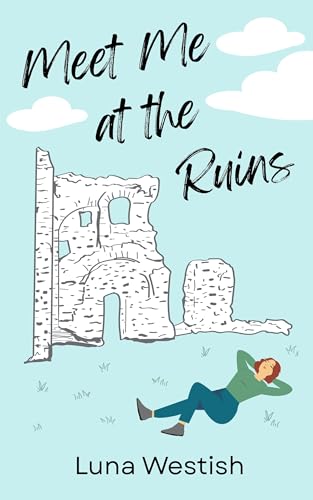
It’s 2003, and Margo is reeling from a bad breakup. She’s looking forward to a drama-free semester abroad at the University of Edinburgh, in Scotland. When she meets Ren, her beautiful and mysterious downstairs neighbour, her plans to keep things uncomplicated suddenly vanish.
Struggling with the pace of her courses and unsure of how to nurture her new friendships, Margo’s brain works overtime to make sense of her environment. She longs for Ren but she’s unwilling to place her life on hold while he figures out his complicated feelings.
Always trying to rise above her anxious nature, Margo throws herself into the social and romantic opportunities offered by her new city. She finds happiness in small moments, reveling in fluffy cappuccinos, long runs past ancient stone buildings, museums with friends and surprising, spicy encounters. Despite the low rumble of an existential crisis nipping at her feet, Margo is determined to find her place in the world.
Find Meet Me at the Ruins on Goodreads
About the Author
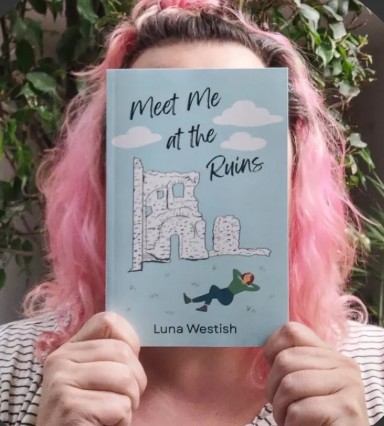
Luna Westish is a wanderer, always looking up at buildings and searching for their next coffee. In another life, they write about sustainability, business, motherhood and their ex-cult experiences. Their study abroad trip and later visits to Scotland are a constant source of fond memories and inspiration.
Connect with Luna
Website | Bluesky | Facebook | Instagram

 What Cathy Read Next...